
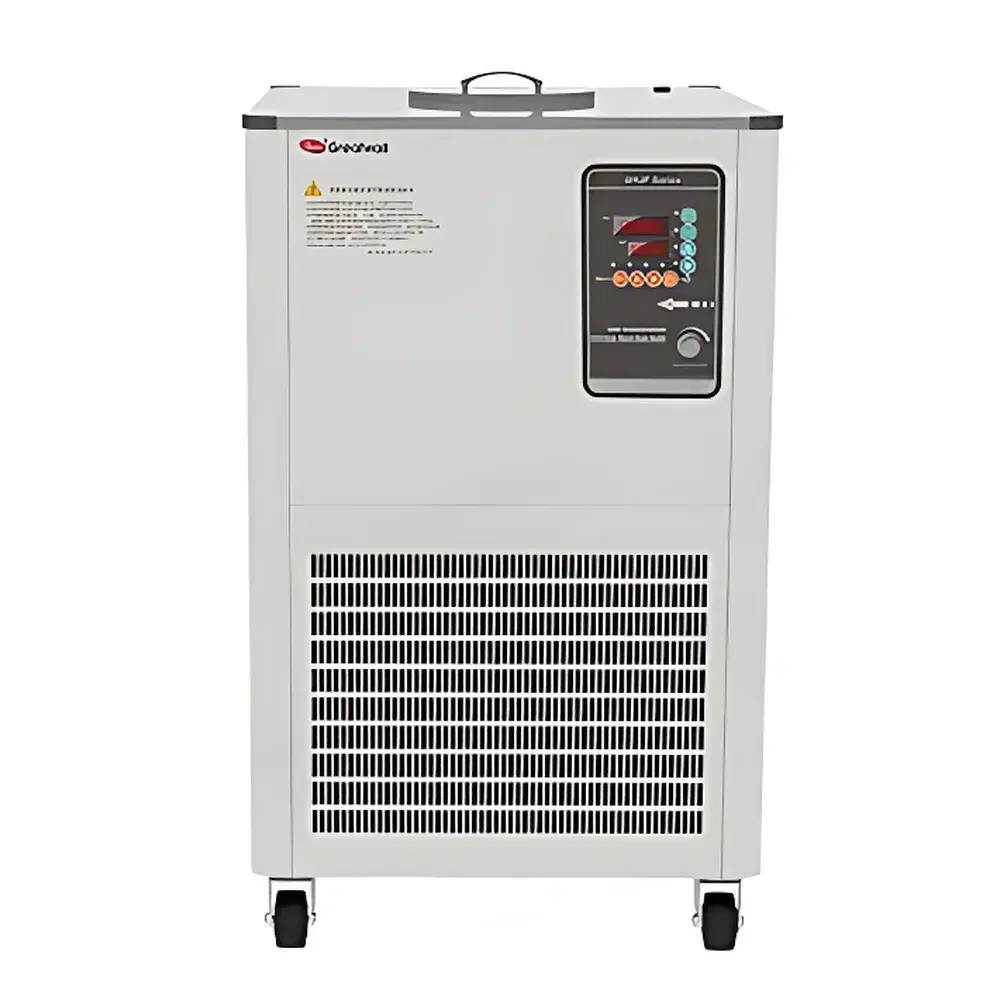
Great Wall DHJF-1205 Low-Temperature Constant-Temperature Stirred Reaction Bath
| Brand | The Great Wall |
|---|---|
| Origin | Henan, China |
| Manufacturer Type | Original Equipment Manufacturer (OEM) |
| Country of Manufacture | China |
| Model | DHJF-1205 |
| Quotation | Upon Request |
| Bath Volume (L) | 5 |
| Temperature Range (°C) | –120 to –60 |
| Temperature Stability (°C) | ±2 |
| Rated Power (W) | 820 |
| Refrigerant | Mixed Cryogenic Refrigerant |
| Cooling Capacity (W) | 110 @ –60°C |
| Magnetic Stirring Power (W) | 50 |
| Stirring Speed (rpm) | 100–1000 |
| Ambient Operating Temperature (°C) | 5–35 |
| Ambient Relative Humidity | ≤70% |
| Power Supply | 220–240 V~, 50 Hz |
| Drain Port Size | 1/2" |
| Bath Opening Diameter (mm) | Ø210 |
| Bath Dimensions (mm) | Ø220 × 180 (D × H) |
| Max Flask Capacity (mL) | 2000 |
| Bath Material | AISI 304 Stainless Steel |
| Overall Dimensions (mm) | 630 W × 795 D × 790 H |
| Net Weight (kg) | 125 |
| Safety Protections | Delayed Start, Overcurrent, Overtemperature |
Overview
The Great Wall DHJF-1205 Low-Temperature Constant-Temperature Stirred Reaction Bath is an integrated cryogenic laboratory system engineered for precise thermal control and dynamic mixing in demanding synthetic, catalytic, and low-temperature physical chemistry applications. It operates on a single-stage compression cascade refrigeration principle—leveraging a proprietary series-connected heat exchanger architecture—to achieve stable operation down to –120°C without requiring liquid nitrogen or multi-compressor staging. This design eliminates the complexity and maintenance burden associated with traditional two-stage or Gifford-McMahon systems while maintaining high thermodynamic efficiency and long-term operational reliability. The bath integrates a hermetically sealed reciprocating compressor (Tecumseh/Taikang), air-cooled condenser with oxygen-free copper spiral tubing, capillary tube expansion device, and coil-type evaporator fully immersed in the stainless-steel reservoir. Its all-welded refrigerant circuit minimizes leak paths and enhances structural integrity under deep-cryogenic thermal cycling.
Key Features
- Single-stage compression cascade refrigeration enabling continuous, stable operation from –120°C to –60°C with no external cryogen dependency
- AISI 304 stainless-steel bath tank (Ø220 × 180 mm, 5 L capacity) resistant to thermal shock and corrosion from organic solvents and low-temperature media (e.g., liquid N₂-saturated baths, ethane/ethanol mixtures)
- Digital intelligent controller with 0.1°C resolution temperature display, programmable ramp/soak profiles, and real-time PID parameter monitoring
- Integrated magnetic stirring system (50 W, 100–1000 rpm) with adjustable torque and non-contact coupling—designed to maintain consistent agitation even at –120°C without mechanical seal failure
- Comprehensive safety architecture: delayed compressor restart, overcurrent protection, dual independent overtemperature cutoffs (refrigerant loop and bath sensor), and ambient temperature interlock (disabled if ambient >35°C)
- Modular service design: accessible refrigerant circuit with minimal brazed joints; front-panel diagnostic interface for pressure and temperature logging
Sample Compatibility & Compliance
The DHJF-1205 accommodates standard laboratory glassware up to 2000 mL (e.g., jacketed reactors, three-neck flasks, Schlenk tubes) via its Ø210 mm opening. Its 304 stainless-steel bath and inert mixed-refrigerant composition ensure compatibility with common cryosolvents—including acetone/dry ice slurries, liquid nitrogen–cooled ethanol, and chlorofluorocarbon alternatives—without material degradation or outgassing concerns. The unit complies with IEC 61010-1:2010 for electrical safety in laboratory equipment and meets CE marking requirements for electromagnetic compatibility (EN 61326-1). While not certified to ISO/IEC 17025 as a metrological instrument, its temperature stability (±2°C across the full range) supports GLP-aligned reaction monitoring when paired with traceable external calibration probes (e.g., Pt100 Class A).
Software & Data Management
The DHJF-1205 operates via embedded firmware with no external PC dependency. All setpoints, actual bath temperature, stirring speed, and alarm history are logged internally for up to 72 hours at 10-second intervals. Data export is supported via RS-232 serial interface (optional USB-to-serial adapter) using ASCII-formatted CSV output compatible with LabVIEW, MATLAB, or Excel-based trend analysis. The controller supports audit trail functionality per FDA 21 CFR Part 11 when used with validated third-party data acquisition software—enabling electronic signature capture, user-level access control, and immutable record retention for regulated QC environments.
Applications
- Low-temperature Grignard, organolithium, and lithium–halogen exchange reactions requiring strict thermal control below –80°C
- Catalytic hydrogenation and asymmetric synthesis where exothermicity must be offset by sub–100°C heat sinking
- Crystallization studies of polymorphic APIs under controlled supercooling conditions (–120°C to –60°C)
- Calibration and validation of cryogenic sensors and IR spectrometer sample compartments
- Stability testing of battery electrolytes and solid-state ion conductors under deep-cold thermal stress
- Pre-cooling of NMR probe inserts and cryo-TEM specimen holders prior to transfer
FAQ
What refrigerant blend is used in the DHJF-1205, and is it compliant with current environmental regulations?
The unit employs a proprietary zeotropic mixture of HFC-23/HFC-134a/HFC-227ea optimized for ultra-low-temperature performance and low global warming potential (GWP < 1500), meeting EU F-Gas Regulation (EU) No 517/2014 phase-down schedules.
Can the bath maintain –120°C continuously with a 2 L reaction flask immersed?
Yes—under nominal load (2 L solvent volume, ambient ≤25°C, no significant exothermic reaction), the system sustains –120°C with ±2°C stability for >8 hours; cooling capacity at that point is 20 W, sufficient for passive heat leakage compensation.
Is the magnetic stirrer rated for operation at –120°C?
The stirrer motor and coupling are specifically derated and tested for continuous operation at –120°C; torque remains linear across the full 100–1000 rpm range with no stalling or demagnetization observed.
Does the unit support external temperature feedback control (e.g., from a reactor jacket sensor)?
No—the DHJF-1205 regulates solely based on internal bath temperature sensing; external feedback loops require integration via analog 0–10 V or 4–20 mA signal input using optional OEM control module (part #DHJF-CTRL-EXT).
What maintenance intervals are recommended for the refrigeration system?
Compressor oil and filter-drier replacement every 36 months or 6000 operating hours; annual inspection of condenser coil cleanliness and refrigerant charge verification via manifold gauge set is advised.
Related Products



