
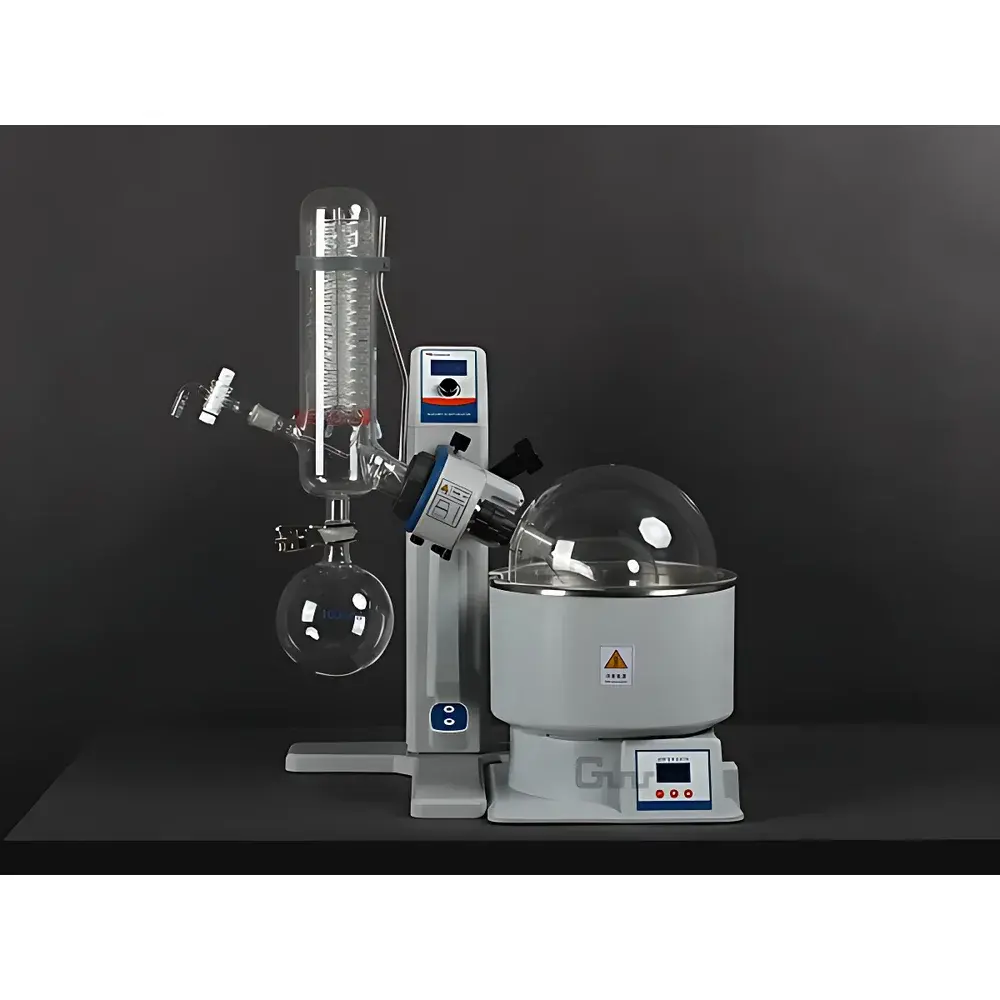
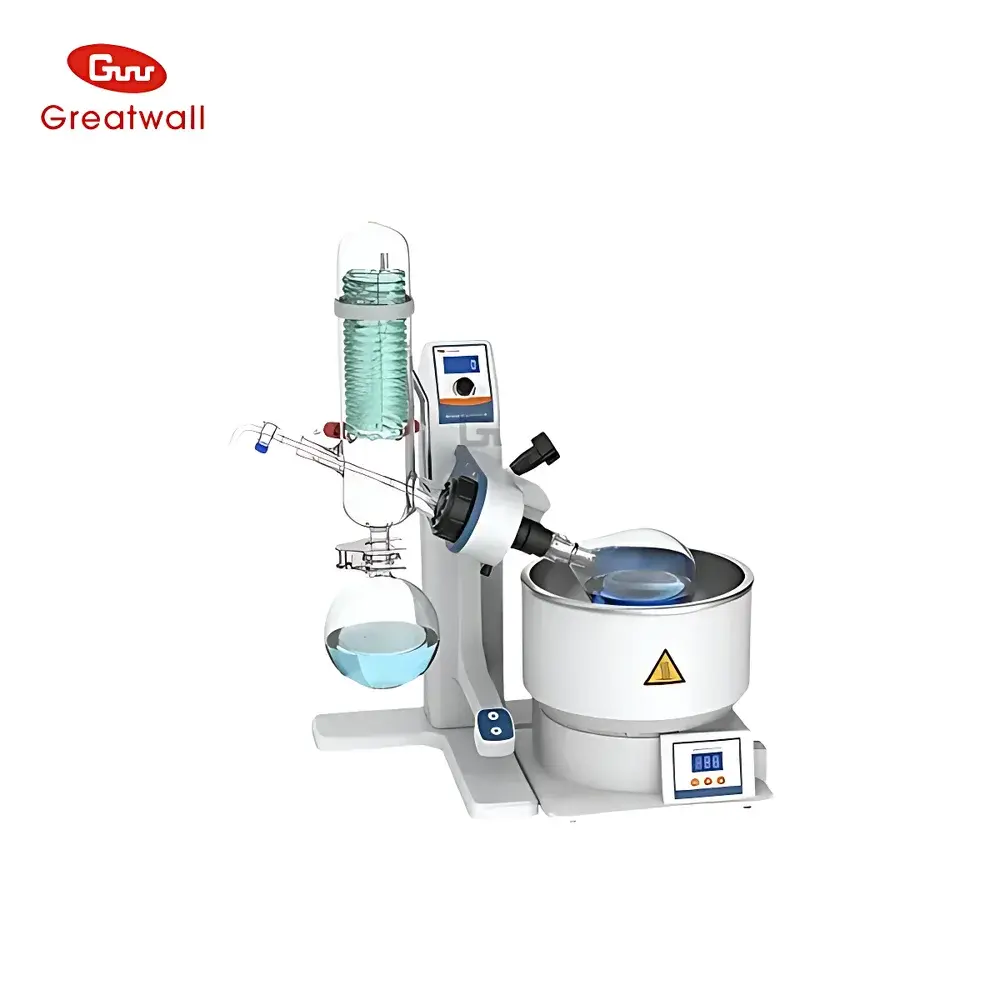
Great Wall R-3001 Benchtop Electric-Lift Rotary Evaporator
| Brand | The Great Wall |
|---|---|
| Origin | Henan, China |
| Manufacturer | The Great Wall Scientific Industrial & Trading Co., Ltd. |
| Model | R-3001 |
| Collection Flask Capacity | 1000 mL |
| Rotation Speed Range | 10–280 rpm |
| Temperature Control Range | Ambient +5°C to 95°C |
| Condenser Cooling Area | 0.126 m² |
| Lift Stroke | 150 mm |
| Sealing Leakage Rate | ≤ 0.33 kPa/min |
| Motor Power | 40 W |
| Evaporation Rate (Water) | 23 mL/min |
| Dual Seal | PTFE-modified + Fluoroelastomer |
| Certified | CE (TUV) |
Overview
The Great Wall R-3001 Benchtop Electric-Lift Rotary Evaporator is a precision-engineered system designed for efficient solvent removal, fractional distillation, and gentle compound recovery under reduced pressure. Operating on the principle of rotary evaporation—where sample solution is rotated in a heated water or oil bath under vacuum to increase surface area and lower boiling points—the R-3001 delivers consistent performance across academic research, pharmaceutical development, and quality control laboratories. Its modular architecture separates the main drive unit from the heating bath, enabling flexible configuration with external chillers, vacuum controllers, and cold traps. The system is engineered for reproducibility in routine purification workflows and supports GLP-compliant documentation when integrated with validated data acquisition software.
Key Features
- Electric vertical lift mechanism with 150 mm stroke range, enabling precise positioning of the rotating flask relative to the bath and condenser—critical for optimizing heat transfer and preventing bumping during volatile solvent removal.
- PTFE-modified + fluoroelastomer dual-seal system at the vapor path interface, achieving a verified leakage rate of ≤ 0.33 kPa/min under vacuum—ensuring stable operation down to <10 mbar and minimizing solvent loss or air ingress during extended runs.
- Stepless speed control (10–280 rpm) via digital LCD interface, allowing fine-tuned adjustment to match viscosity, volatility, and thermal sensitivity of diverse samples—from low-boiling ethers to high-molecular-weight polymers.
- High-efficiency double-loop condenser with 0.126 m² effective cooling area, fabricated from borosilicate glass and optimized for rapid vapor condensation across wide temperature gradients (e.g., when paired with −20°C recirculating chillers).
- Synchronous belt drive transmission, eliminating gear backlash and mechanical vibration—resulting in quiet (<55 dB), smooth rotation essential for maintaining emulsion stability or preventing crystallization nucleation during concentration.
- Quick-lock rotating shaft coupling and adjustable immersion angle mechanism simplify flask installation, cleaning, and cross-contamination mitigation—supporting rapid turnaround between batches in regulated environments.
Sample Compatibility & Compliance
The R-3001 accommodates standard ISO-K spherical ground-glass joints (24/29 and 29/32), supporting interchangeable 500 mL and 1000 mL rotating flasks and 1000 mL collection flasks. It is compatible with common organic solvents (e.g., acetone, ethyl acetate, dichloromethane), aqueous buffers, and thermally labile natural product extracts. All wetted parts are constructed from borosilicate 3.3 glass and chemically resistant elastomers, ensuring compliance with ASTM E2656 (Standard Practice for Validation of Rotary Evaporators) and general laboratory safety requirements per IEC 61010-1. The unit carries CE marking certified by TÜV SÜD, confirming conformity with EU Machinery Directive 2006/42/EC and Low Voltage Directive 2014/35/EU. While not inherently 21 CFR Part 11 compliant, its analog control architecture allows integration into validated systems when paired with audit-trail-capable external controllers.
Software & Data Management
The R-3001 operates via an embedded microprocessor with backlit LCD display showing real-time rotation speed, bath temperature, and system status. Though standalone, it features analog voltage outputs (0–10 V) for rpm and temperature signals—enabling connection to third-party data loggers or LIMS platforms for traceable recordkeeping. Users may configure time-stamped run logs manually or via optional RS-485 interface modules (sold separately). For full GxP alignment, Great Wall provides IQ/OQ documentation templates and supports calibration verification against NIST-traceable standards for temperature (±0.5°C) and rotational speed (±2 rpm) per ISO/IEC 17025 guidelines.
Applications
- Concentration of natural product extracts in phytochemistry and nutraceutical R&D
- Removal of reaction solvents post-Suzuki coupling or Grignard synthesis
- Preparative-scale fractionation of crude distillates in fine chemical manufacturing
- Lyophilization pre-concentration in biopharmaceutical QC labs
- Environmental analysis sample preparation (e.g., EPA Method 502.2 for VOCs)
- Teaching laboratory demonstrations of colligative properties and phase equilibria
FAQ
What vacuum level is recommended for optimal operation?
A stable vacuum between 10–50 mbar is typical for most applications; deeper vacuum (<5 mbar) may be used for high-boiling-point solvents but requires careful bath temperature control to avoid bumping.
Can the R-3001 be used with corrosive solvents such as concentrated HCl or bromine?
No—standard configuration is not suitable for strong oxidizers or halogenated acids; optional quartz condensers and Hastelloy components must be specified for such use cases.
Is the heating bath included with the base unit?
Yes—the R-3001 ships with a detachable stainless-steel water/oil bath (capacity: 3 L), independently controllable within ambient +5°C to 95°C.
Does the system support automatic endpoint detection?
Not natively; however, integration with external conductivity or refractive index sensors enables programmable shutdown upon concentration threshold detection.
What maintenance intervals are recommended for long-term reliability?
Seal inspection every 200 operating hours; condenser cleaning after each solvent class change; annual verification of motor torque and lift motor calibration.



