
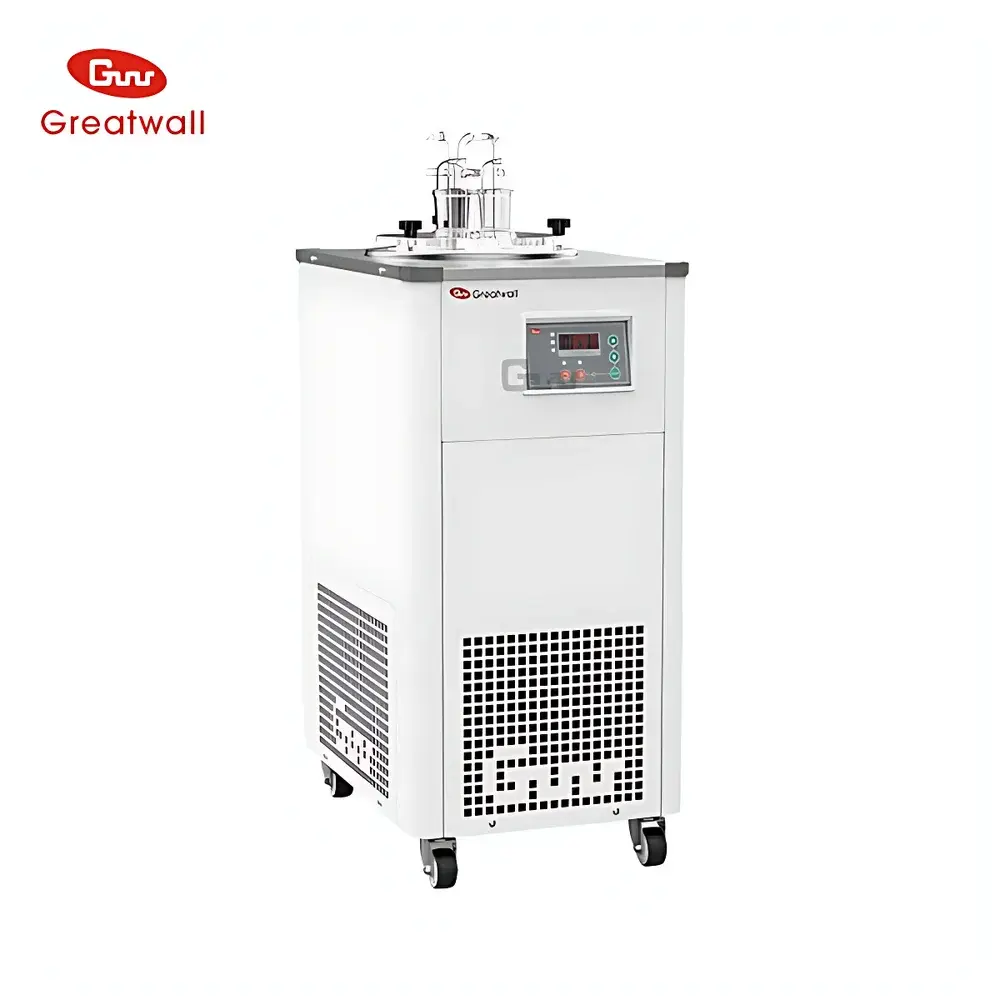
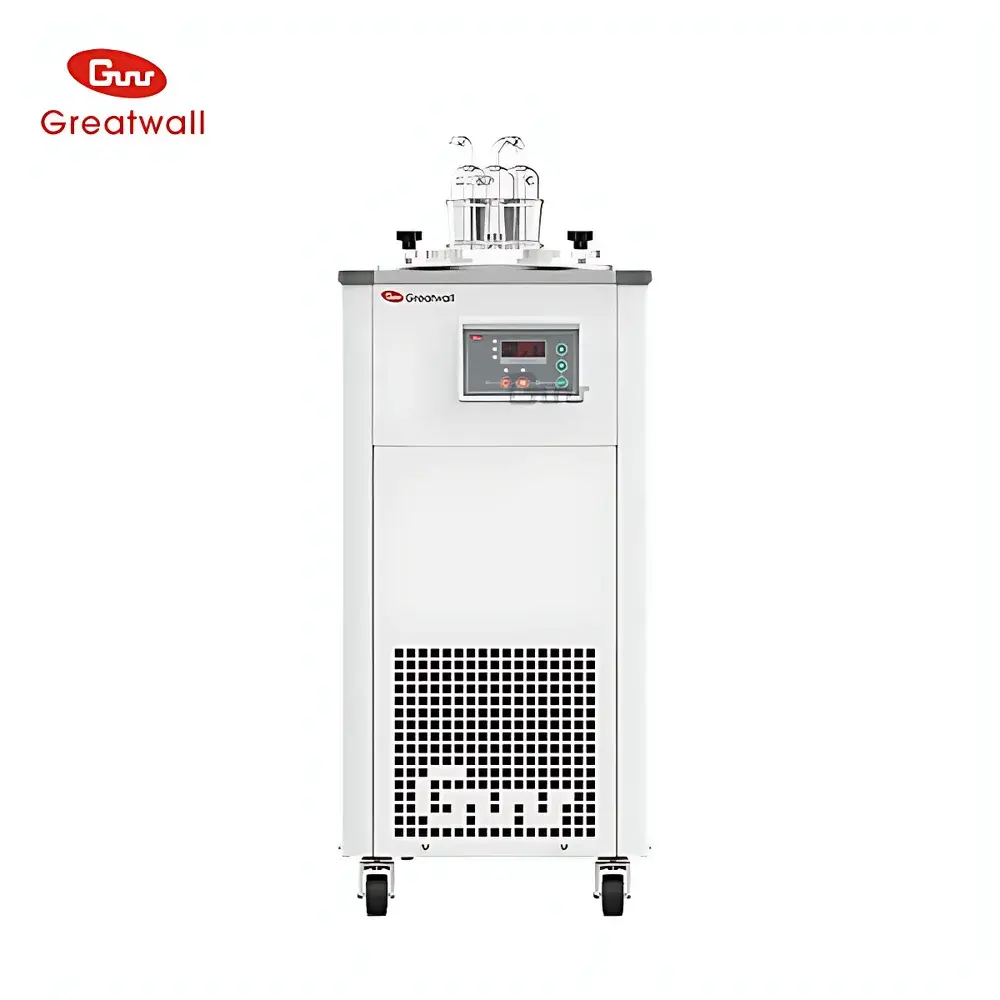
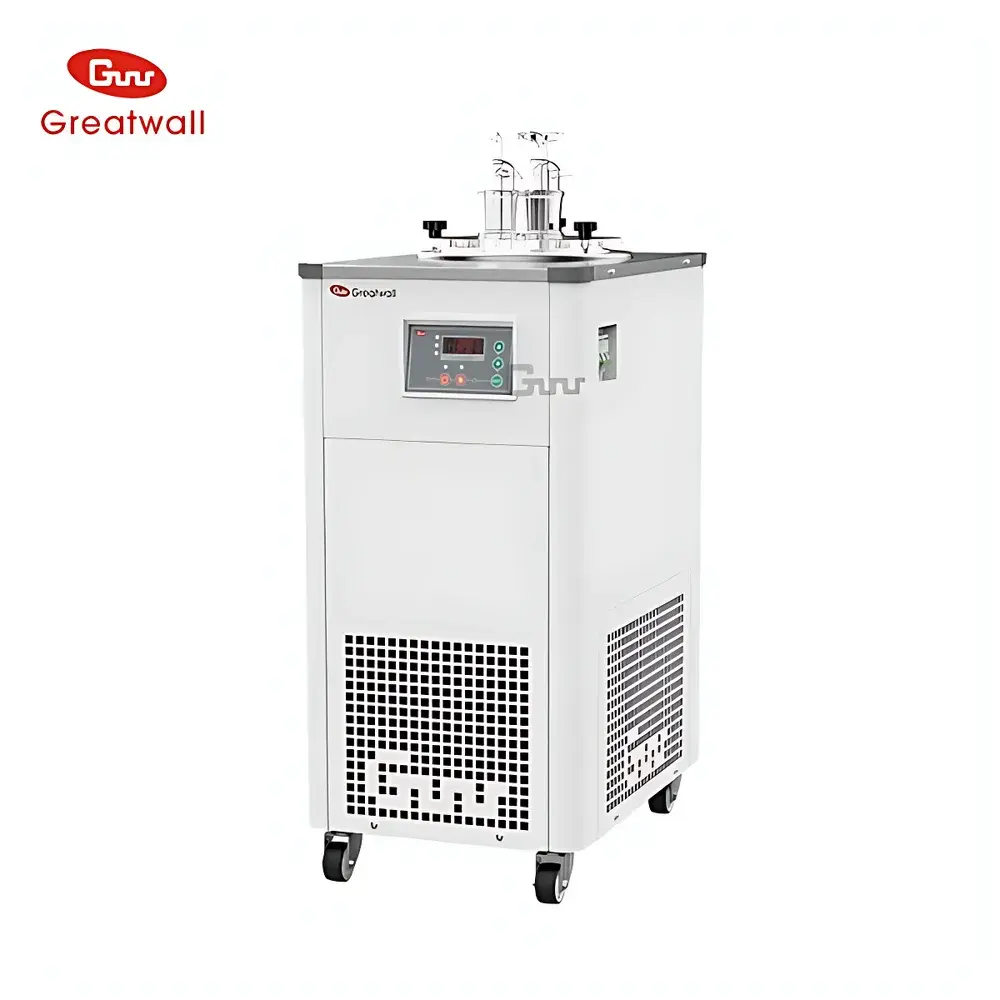
The Great Wall VT-5000HC Cryogenic Vapor Trap
| Brand | The Great Wall |
|---|---|
| Model | VT-5000HC |
| Origin | Henan, China |
| Manufacturer Type | Direct Manufacturer |
| Country of Origin | China |
| Cooling Capacity | 920 W at −10°C, 520 W at −20°C, 280 W at −30°C, 40 W at −40°C |
| Minimum No-Load Temperature | −40°C |
| Cooling Method | Indirect refrigeration |
| Temperature Display | Digital, Pt100 sensor |
| Temperature Setting Range | Adjustable within operational range |
| Safety Protections | Delay start, overcurrent protection, overtemperature protection |
| Refrigerant | R404A |
| Cold Trap Chamber Dimensions | Ø250 × 250 mm |
| Condenser Flask Dimensions | Ø50 × 300 mm |
| Condenser Flask Material | Borosilicate glass 3.3 |
| Quantity of Flasks | 3 |
| Vacuum Port Interface | Flexible hose connector, OD Ø12 mm |
| Ambient Operating Conditions | 5–35°C, ≤70% RH |
| Power Consumption | 835 W |
| Input Current | 3.8 A |
| Power Supply | 220–240 V~, 50 Hz |
| Overall Dimensions (W×D×H) | 537 × 579 × 1094 mm |
| Net Weight | 85 kg |
| Construction Material (Cold Trap Body) | AISI 304 stainless steel |
| Dual-Mode Operation | Direct cold trap chamber or optional glass condenser flask configuration |
| Application Compatibility | Water, ethanol, acidic, and organic solvent systems |
Overview
The Great Wall VT-5000HC Cryogenic Vapor Trap is an engineered solution for condensing and immobilizing volatile vapors—primarily water vapor, solvents, and low-molecular-weight corrosive gases—generated during vacuum drying, lyophilization, rotary evaporation, and low-pressure concentration processes. Operating on the principle of cryocondensation, the unit achieves a no-load minimum temperature of −40°C via a closed-loop indirect refrigeration system charged with R404A refrigerant. Unlike passive cold traps relying on liquid nitrogen, the VT-5000HC delivers consistent, controllable, and maintenance-reduced cold surface temperatures without consumables. Its dual-mode design supports both direct condensation within the 304 stainless steel chamber and optional use of three borosilicate glass 3.3 condenser flasks—enabling safe handling of aggressive media including hydrochloric acid, nitric acid, acetone, ethyl acetate, and NMP. This architecture ensures compatibility across pharmaceutical primary drying, battery electrode moisture removal, capacitor hermetic sealing, and R&D-scale solvent recovery workflows.
Key Features
- Stainless steel cold trap chamber (AISI 304) rated for aqueous and ethanol-based applications; corrosion-resistant and pressure-rated for continuous vacuum duty.
- Interchangeable borosilicate glass 3.3 condenser flasks (Ø50 × 300 mm, n = 3) certified to ISO 3585 standards, suitable for acidic, halogenated, and polar aprotic solvent systems.
- Digital temperature monitoring with Pt100 RTD sensor and intuitive front-panel interface—enabling real-time observation and precise setpoint adjustment across the full operating range.
- Multi-layer safety architecture: compressor delay start, thermal cutoff at critical junctions, and electronic overcurrent protection compliant with IEC 61000-4 immunity requirements.
- Optimized heat exchanger geometry and refrigerant charge distribution ensure stable cooling performance across ambient conditions (5–35°C, ≤70% RH), validated per ISO 8573-1 Class 4 particulate and dew point specifications.
- Integrated vacuum port with standardized Ø12 mm flexible hose connection—designed for seamless integration into existing vacuum manifolds, gloveboxes, and custom drying enclosures.
Sample Compatibility & Compliance
The VT-5000HC accommodates diverse sample matrices through material-selective condensation pathways. The 304 stainless steel chamber is validated for sustained exposure to water vapor, ethanol, isopropanol, and mild aqueous electrolytes—making it ideal for vacuum oven exhaust treatment in QC labs and battery electrode drying lines. When configured with borosilicate glass 3.3 flasks, the system complies with ASTM E438 Type I, Class A specifications for chemical resistance, supporting safe capture of HCl(g), HF(g), acetic anhydride vapors, and chlorinated solvents. All wetted surfaces meet USP extractables criteria. The unit’s electrical design conforms to CE marking requirements (EN 61010-1:2010, EN 61326-1:2013), and its mechanical construction adheres to ASME B31.3 process piping guidelines for vacuum service.
Software & Data Management
While the VT-5000HC operates as a standalone hardware unit with analog control logic, its digital temperature display outputs a 4–20 mA signal (optional accessory) compatible with PLC-based supervisory systems and SCADA architectures. This enables time-stamped logging of cold trap surface temperature against vacuum pump status, chamber pressure, and process cycle phase—supporting GLP-compliant audit trails per FDA 21 CFR Part 11 when integrated with validated data acquisition platforms. Firmware-level calibration certificates (traceable to NIST SRM 1750a) are provided with each unit, and temperature stability deviation remains ≤±0.5°C over 8-hour continuous operation under nominal load.
Applications
- Vacuum drying of Li-ion battery cathode/anode coatings—removing residual NMP and water to <10 ppm before cell assembly.
- Cryogenic trapping upstream of turbomolecular pumps in freeze-dryer secondary drying stages, extending pump oil life and reducing hydrocarbon backstreaming.
- Condensation of acidic off-gases (e.g., SO₂, HCl) from catalyst regeneration units in fine chemical synthesis.
- Pre-freezing and low-temperature hold function for small-batch cryo-storage of thermolabile intermediates prior to lyophilization.
- Integration into inert-atmosphere glovebox antechambers to prevent solvent saturation of purge gas loops during sample transfer.
FAQ
Can the VT-5000HC be used continuously under full vacuum load?
Yes—the unit is rated for uninterrupted operation at ≤1 × 10⁻² mbar with verified thermal stability and no performance degradation over 72-hour cycles.
Is the borosilicate glass condenser flask resistant to hydrofluoric acid?
No—while Type I borosilicate glass (e.g., Schott Duran® or Pyrex®) resists most mineral acids, it is not HF-compatible. HF exposure requires quartz or PFA-lined alternatives, which are available as custom-engineered options.
Does the unit support remote monitoring via Ethernet or RS-485?
Standard configuration includes only local digital display; however, 4–20 mA analog output and Modbus RTU (RS-485) interfaces can be factory-installed upon specification.
What maintenance intervals are recommended for long-term reliability?
Compressor oil inspection every 12 months; refrigerant leak check per ISO 5149-2 annually; Pt100 sensor recalibration every 24 months using traceable dry-block calibrators.
Can the cold trap chamber serve as a pre-cooling bath for samples prior to vacuum loading?
Yes—its −40°C capability and uniform thermal mass allow use as a pre-chill station for vials, electrodes, or metal substrates, minimizing thermal shock during subsequent vacuum exposure.



