
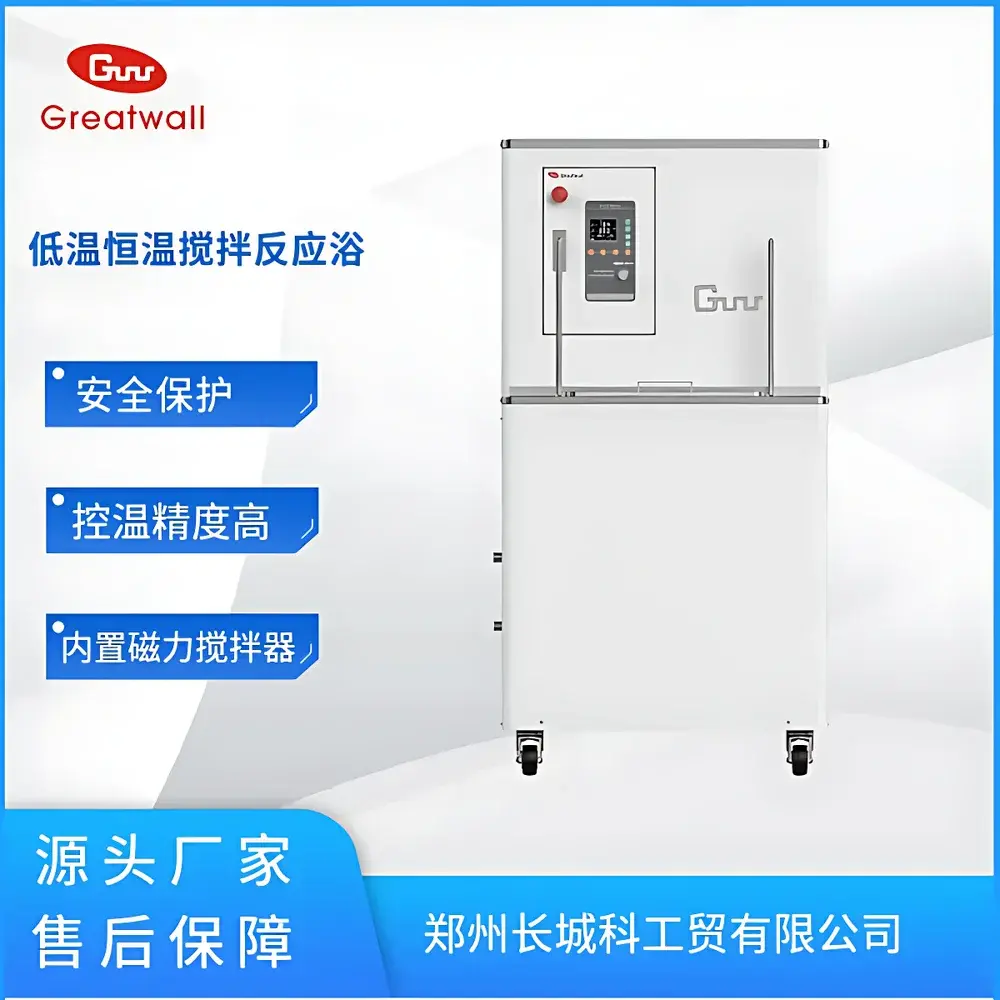
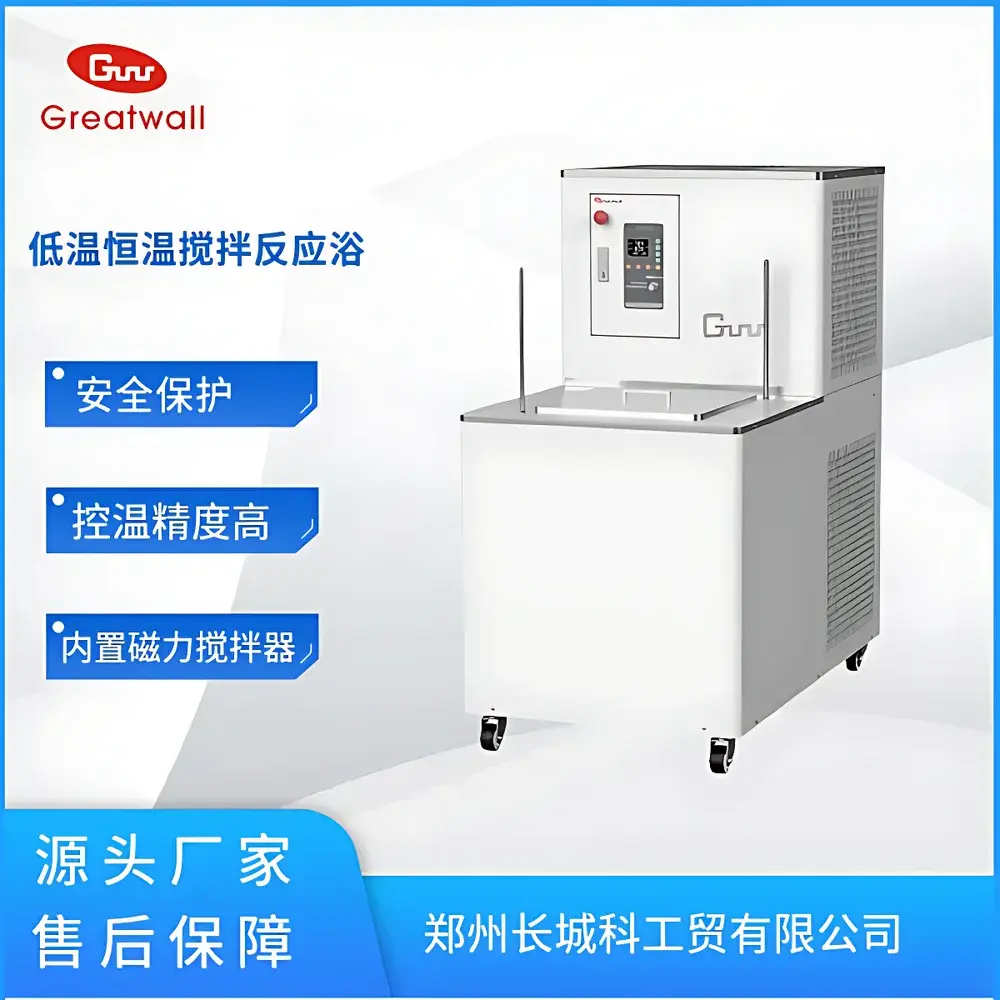
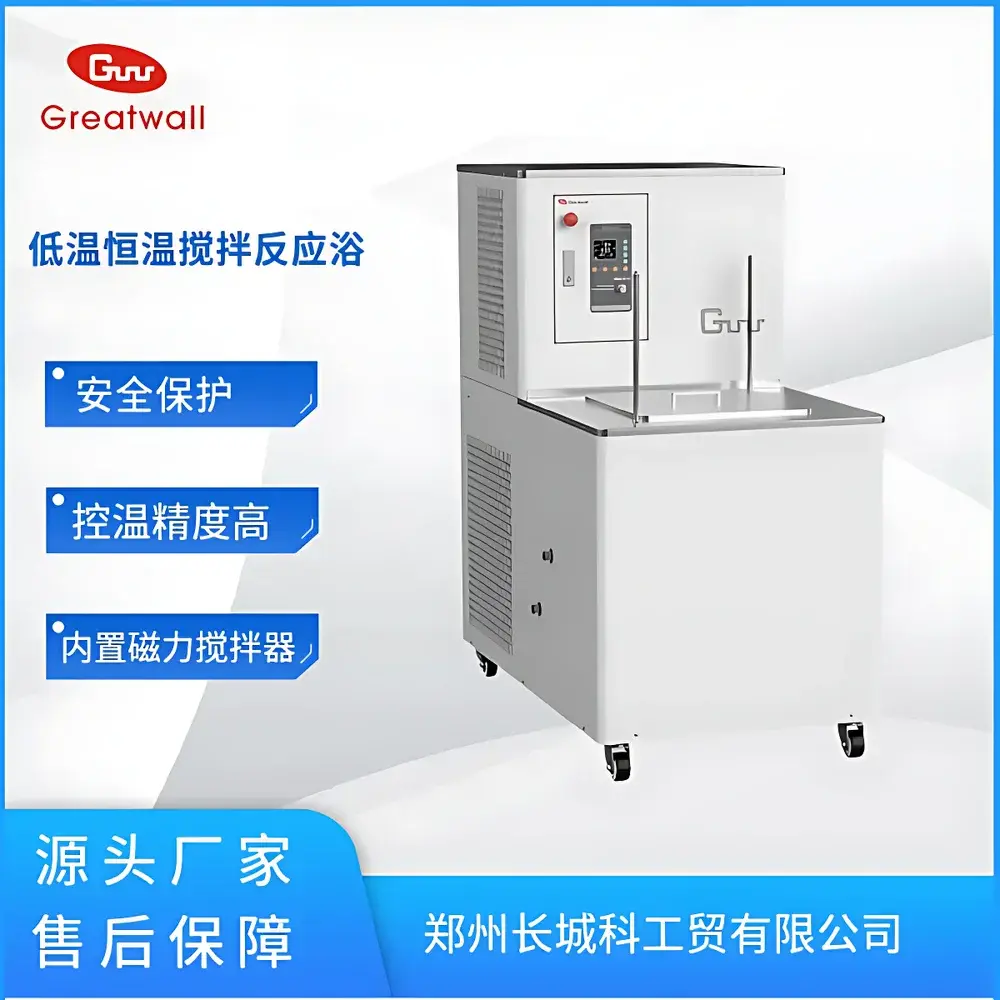
The Great Wall DHJF-4050 Horizontal Cryogenic Circulating Bath with Integrated Magnetic Stirring
| Brand | The Great Wall |
|---|---|
| Origin | Henan, China |
| Manufacturer Type | Direct Manufacturer |
| Instrument Type | Horizontal |
| Temperature Stability | ±0.5 °C |
| Temperature Uniformity | ±0.5 °C |
| Working Distance | 1 m |
| Temperature Range | −40 °C to 99 °C |
| Bath Opening Diameter | Ø400 mm |
| Heating Power | 6 kW |
| Bath Volume | 50 L |
| External Dimensions | 810 W × 1390 D × 1335 H mm |
| Net Weight | 150 kg |
| Refrigerant | R404A |
| Cooling Capacity (kW) | 10.5 @ 10 °C, 9.2 @ 0 °C, 7.2 @ −10 °C, 4.75 @ −20 °C, 2.45 @ −30 °C, 1.5 @ −40 °C |
| Circulation Pump | 280 W, 30 L/min, 1 bar |
| Magnetic Stirring | 50 W, 100–1000 rpm |
| Power Supply | 3-phase 380 V, 50 Hz |
| Protection Features | Dry-run prevention, overcurrent, overtemperature, leakage, pressure, and delayed start |
Overview
The Great Wall DHJF-4050 Horizontal Cryogenic Circulating Bath with Integrated Magnetic Stirring is an engineered thermal management platform designed for precision temperature control in demanding laboratory applications. It operates on a dual-mode thermodynamic principle—combining vapor-compression refrigeration (using R404A refrigerant) with resistive heating—to deliver stable, programmable thermal environments across a wide operational range of −40 °C to +99 °C. Unlike conventional immersion baths or external chillers, the DHJF-4050 integrates a high-torque magnetic stirrer directly into the bath reservoir, enabling simultaneous temperature regulation and active mixing of both the heat-transfer fluid and reaction vessels placed within the bath. This architecture supports reproducible kinetic studies, exothermic/endothermic reaction control, and calibration traceability under ISO/IEC 17025-aligned conditions. Its horizontal layout optimizes benchtop footprint while accommodating large-volume glassware up to 20 L, making it suitable for scale-up validation in academic synthesis labs, QC departments, and pharmaceutical process development suites.
Key Features
- High-precision PID temperature control with ±0.5 °C stability and uniformity—validated per ASTM E74 and ISO 17025 calibration protocols;
- Integrated 50 W magnetic stirrer with adjustable speed (100–1000 rpm), capable of driving both internal bath stirrers and vessel-mounted magnetic beads without mechanical coupling;
- Telescoping insulated lid with adjustable aperture (Ø400 mm max opening) minimizes evaporative loss of silicone oil or ethanol/water mixtures and reduces ambient thermal ingress;
- Dual-circuit thermal protection system: dry-run detection for heater elements, pressure-sensing refrigerant loop monitoring, and multi-stage overtemperature cutoffs aligned with IEC 61010-1 safety requirements;
- Robust 304 stainless-steel bath tank (Ø500 × 320 mm depth) resistant to corrosion from organic solvents and aqueous electrolytes;
- External circulation port (½″ BSP) supporting closed-loop integration with jacketed reactors, spectroscopic cells, or calorimeters at flow rates up to 30 L/min and 1 bar delivery pressure;
- Full 3-phase 380 V power architecture (11.35 kW total draw) ensuring stable operation during simultaneous heating/cooling transients.
Sample Compatibility & Compliance
The DHJF-4050 accommodates standard laboratory glassware—including round-bottom flasks (up to 20 L), jacketed reactors, and U-tube viscometers—via its spacious Ø400 mm opening and reinforced support frame. The bath’s inert 304 stainless-steel reservoir and fluoropolymer-coated pump housing ensure compatibility with common heat-transfer media: water-glycol blends, silicone oils (e.g., DC200 series), and low-temperature alcohols. All electrical and thermal safety systems comply with IEC 61010-1:2010 for laboratory equipment. While not certified for GMP manufacturing environments, the unit supports GLP-compliant workflows through configurable logging intervals, user-accessible calibration offsets, and audit-ready parameter retention (including timestamps for temperature setpoint changes and fault events). Optional RS485 Modbus RTU interface enables integration into centralized lab infrastructure for FDA 21 CFR Part 11–aligned electronic record systems when paired with validated third-party data acquisition software.
Software & Data Management
The DHJF-4050 features a front-panel LCD interface with intuitive menu navigation and real-time display of bath temperature, setpoint, stirring speed, and system status codes. Though it does not include embedded PC software, its analog output (0–5 V or 4–20 mA) and digital Modbus RTU interface allow seamless connection to SCADA platforms, LabVIEW-based DAQ systems, or LIMS-integrated controllers. Temperature logs can be exported via optional USB data logger modules (sold separately), supporting CSV-formatted time-series records compliant with ISO/IEC 17025 documentation requirements. All calibration constants—including sensor offset, PID gain tuning, and refrigerant charge compensation—are stored in non-volatile memory and accessible only via authorized service mode, preserving measurement integrity between scheduled recalibrations.
Applications
- Controlled-rate cooling/heating of catalytic hydrogenation reactions in 10–20 L flasks under inert atmosphere;
- Thermal conditioning of HPLC columns and detector flow cells to reduce baseline drift and improve retention time reproducibility;
- Calibration of platinum resistance thermometers (PRTs) and thermocouples across sub-zero to near-boiling ranges;
- Stabilization of laser diodes and photomultiplier tubes requiring low-noise thermal environments;
- Supporting ASTM D2570 cold-cracking tests for polymer solutions and ASTM D97 pour point determinations;
- Enabling temperature-dependent rheological profiling in tandem with rotational viscometers using external fluid-jacketed sample cups.
FAQ
What heat-transfer fluids are compatible with the DHJF-4050?
Silicone oils (e.g., Dow Corning DC200 series), 50/50 ethylene glycol/water mixtures, and anhydrous ethanol are commonly used. Avoid chlorinated solvents or low-flash-point hydrocarbons due to safety and material compatibility constraints.
Can the unit maintain −40 °C while circulating fluid externally?
Yes—the specified cooling capacity of 1.5 kW at −40 °C assumes full external load; performance may vary depending on insulation quality and loop length of the connected system.
Is the magnetic stirring function isolated from the refrigeration system?
Yes. The stirrer motor is hermetically sealed and electrically isolated from the refrigerant circuit and heating elements, preventing electromagnetic interference with sensitive measurements.
Does the unit support remote start/stop via digital signal?
Yes—through the optional Modbus RTU interface or hardwired dry-contact input (configurable via service menu).
What maintenance intervals are recommended for long-term reliability?
Refrigerant pressure verification and pump impeller inspection every 12 months; annual recalibration of the PT100 sensor against NIST-traceable reference; biannual cleaning of condenser coils in environments with airborne particulates.



