
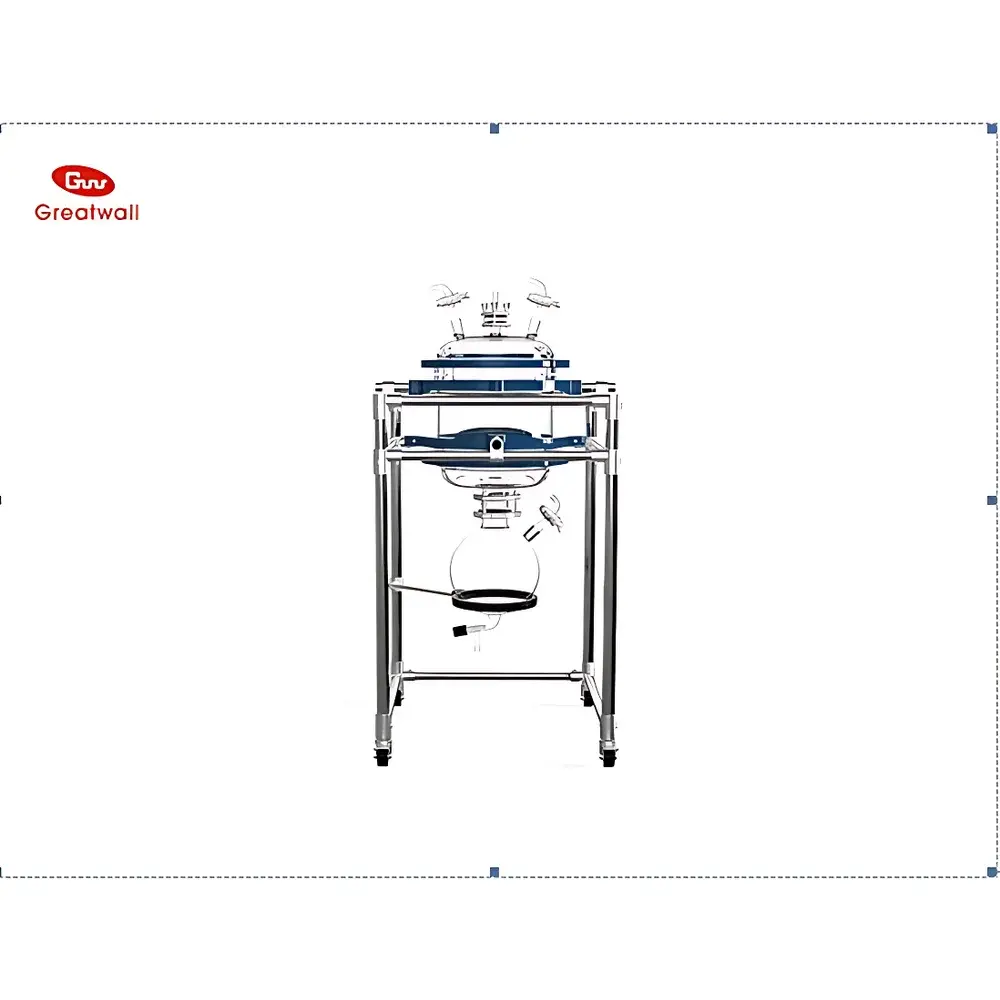
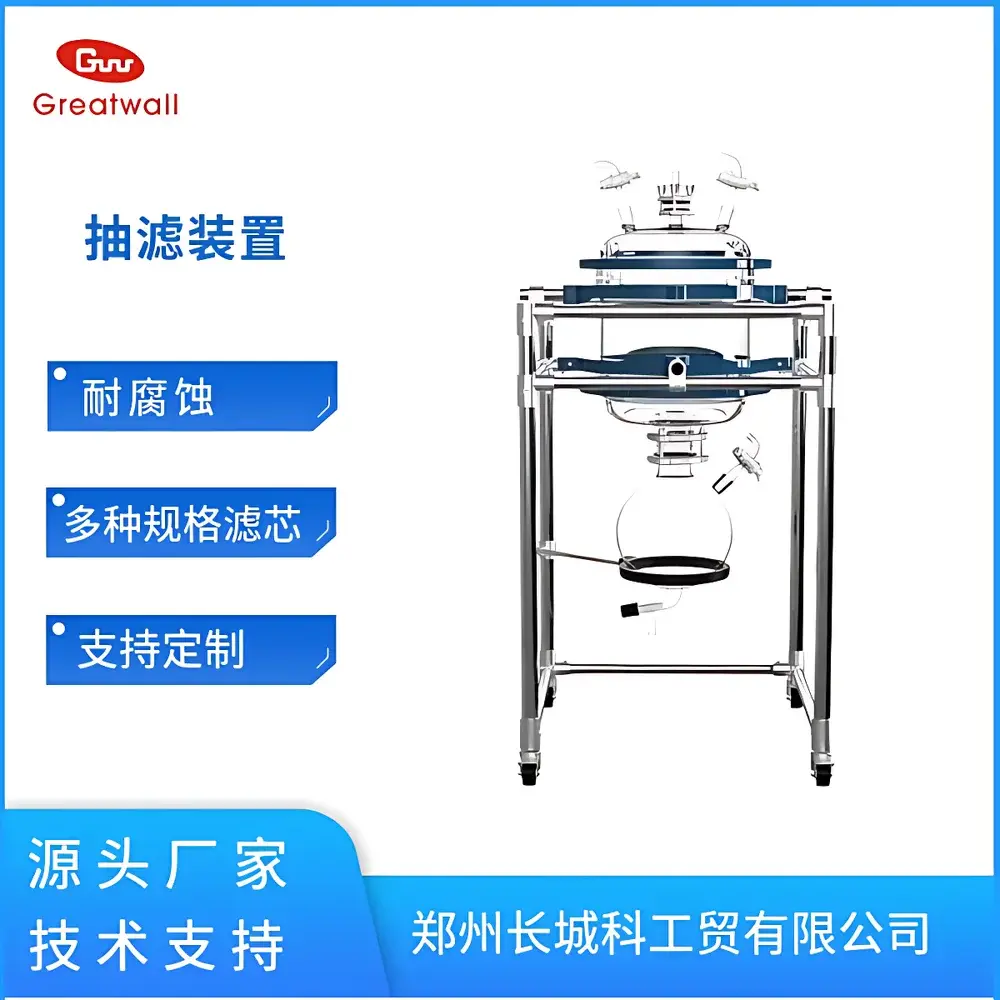
The Great Wall CLZZ-20 Vacuum Filtration Apparatus
| Brand | The Great Wall |
|---|---|
| Origin | Henan, China |
| Manufacturer Type | Direct Manufacturer |
| Country of Origin | China |
| Model | CLZZ-20 |
| Instrument Category | Other Reactors |
| Usable Volume | Medium-Scale |
| Construction Material | Borosilicate Glass 3.3 (Glass Components), SUS304 Stainless Steel + 6061-F Aluminum Frame |
| Operating Pressure | Low Vacuum to Atmospheric |
| Capacity | 20 L Total System Capacity |
| Ultimate Vacuum | −0.098 MPa (≈ 20 mbar abs) |
| Filter Disc | PTFE Fritted Disc, 20–30 µm Porosity |
| Filtration Vessel Diameter | Ø300 mm |
| Collection Flask Volume | 10 L |
| Temperature Range | −80 °C to +200 °C |
| Frame Dimensions (W×D×H) | Approx. 650 × 650 × 1500 mm |
| Port Standards | 40# Flange (Liquid Feed), 24/29# Standard Taper Ground Joints (Vacuum & Vent) |
Overview
The Great Wall CLZZ-20 Vacuum Filtration Apparatus is an engineered bench-to-pilot-scale solid–liquid separation system designed for reproducible, visually monitored filtration under controlled low-pressure conditions. Based on the principle of pressure-driven cross-flow filtration through a rigid, chemically inert fritted disc, the apparatus enables rapid dewatering, crystalline recovery, catalyst harvesting, and precipitate isolation in synthetic chemistry, pharmaceutical process development, and materials science workflows. Its all-glass wetted path—constructed from DIN/ISO-compliant borosilicate glass 3.3—ensures optical clarity for real-time observation of cake formation, filtrate clarity, and potential channeling or clogging events. The integrated SUS304 stainless steel and 6061-F aluminum frame provides structural rigidity, corrosion resistance, and thermal stability across a wide operational envelope (−80 °C to +200 °C), supporting both cryogenic and elevated-temperature applications when paired with compatible vacuum sources and cold traps.
Key Features
- Modular borosilicate glass 3.3 construction: filtration vessel (Ø300 mm), collection flask (10 L), and ground-glass joints (24/29# standard taper, 40# flange) ensure chemical inertness, thermal shock resistance, and leak-tight sealing.
- PTFE sintered frit disc (20–30 µm nominal pore size) mounted on a removable support plate; enables consistent particle retention while facilitating rapid disassembly, solvent rinsing, and autoclave-compatible cleaning.
- Stainless steel frame with powder-coated 6061-F aluminum panels and locking casters: delivers mechanical robustness, ergonomic mobility, and stable positioning during operation—even under vacuum-induced vibration.
- Full vacuum compatibility up to −0.098 MPa (equivalent to ~20 mbar absolute), validated per ISO 2859-1 sampling plans and suitable for integration with diaphragm or oil-free scroll vacuum pumps compliant with ISO 8573-1 Class 0 air purity requirements.
- Transparent process window: allows direct visual assessment of slurry homogeneity, filter cake thickness, breakthrough onset, and filtrate turbidity without interrupting operation or compromising containment.
Sample Compatibility & Compliance
The CLZZ-20 accommodates heterogeneous mixtures including crystalline suspensions, polymeric precipitates, metal hydroxide gels, and heterogeneous catalyst slurries. Its non-reactive glass–PTFE interface ensures compatibility with aggressive solvents (e.g., THF, DMF, conc. HCl, NaOH aq.), halogenated media, and oxidizing reagents. All ground-glass joints conform to ISO 380 and DIN 12250 standards. The apparatus meets general laboratory safety requirements per EN 61000-6-3 (EMC) and EN 61000-6-4 (industrial emission limits). While not intrinsically rated for ATEX or IECEx zones, it may be deployed in non-hazardous areas under institutional SOPs aligned with OSHA 29 CFR 1910.1200 (HCS) and EU CLP Regulation (EC) No. 1272/2008.
Software & Data Management
As a manually operated, analog-process apparatus, the CLZZ-20 does not incorporate embedded electronics, programmable logic controllers, or digital data logging. Process parameters—including applied vacuum level, filtration duration, temperature, and observed cake morphology—are recorded externally via laboratory notebooks or LIMS-integrated electronic lab notebooks (ELNs) compliant with FDA 21 CFR Part 11 (audit trail, electronic signature, and data integrity controls). Vacuum gauge readings (when used) must be traceably calibrated per ISO/IEC 17025 requirements. Documentation packages include material certifications (EN 10204 3.1), glass compliance statements (DIN ISO 3585), and RoHS/REACH declarations.
Applications
- Isolation of API intermediates and final active pharmaceutical ingredients following crystallization or precipitation steps.
- Recovery of heterogeneous catalysts (e.g., Pd/C, Raney Ni) in multi-step organic synthesis sequences.
- Filtration of thermally sensitive biopolymers and protein aggregates under chilled vacuum conditions (−20 °C to +10 °C).
- Scale-up trials bridging from 500 mL round-bottom flask filtration to pilot batch processing (5–20 L reaction volumes).
- Teaching laboratories: demonstration of filtration kinetics, cake resistance modeling (based on Carman–Kozeny equation), and vacuum system design fundamentals.
FAQ
What vacuum pump specifications are recommended for optimal performance?
A two-stage diaphragm pump capable of achieving ≤2 mbar ultimate vacuum (e.g., KNF N840.3FT.18) or an oil-lubricated rotary vane pump with gas ballast (≤0.1 mbar) is recommended. Pump capacity should exceed 20 L/min at operating pressure to maintain stable drawdown during high-slurry-load filtration.
Can the CLZZ-20 be used for hot filtration above 100 °C?
Yes—provided the entire system (including O-rings, vacuum hose, and pump inlet protection) is rated for elevated temperatures. Use high-temp silicone or Viton® gaskets; avoid standard nitrile. Confirm pump compatibility with vapor loads to prevent condensate backstreaming.
Is the PTFE frit disc replaceable with alternative porosities or materials?
Yes—The support plate accepts industry-standard 90 mm diameter fritted discs. Optional alternatives include sintered glass (10–100 µm), stainless steel mesh (50–200 µm), or ceramic frits for high-temperature or abrasive applications.
Does the apparatus comply with Good Manufacturing Practice (GMP) documentation requirements?
While the CLZZ-20 itself is not GMP-certified equipment, its materials traceability, dimensional repeatability, and cleanability support qualification protocols (IQ/OQ/PQ) under ICH Q7 and EU Annex 15 guidelines when deployed within validated processes.
What maintenance intervals are advised for long-term reliability?
Inspect ground-glass joints and PTFE seals quarterly; lubricate with high-vacuum grease (e.g., Dow Corning HV 100) as needed. Clean glass components with acetone followed by deionized water rinse and oven-dry at 120 °C. Verify caster lock mechanisms and frame fasteners biannually.



