
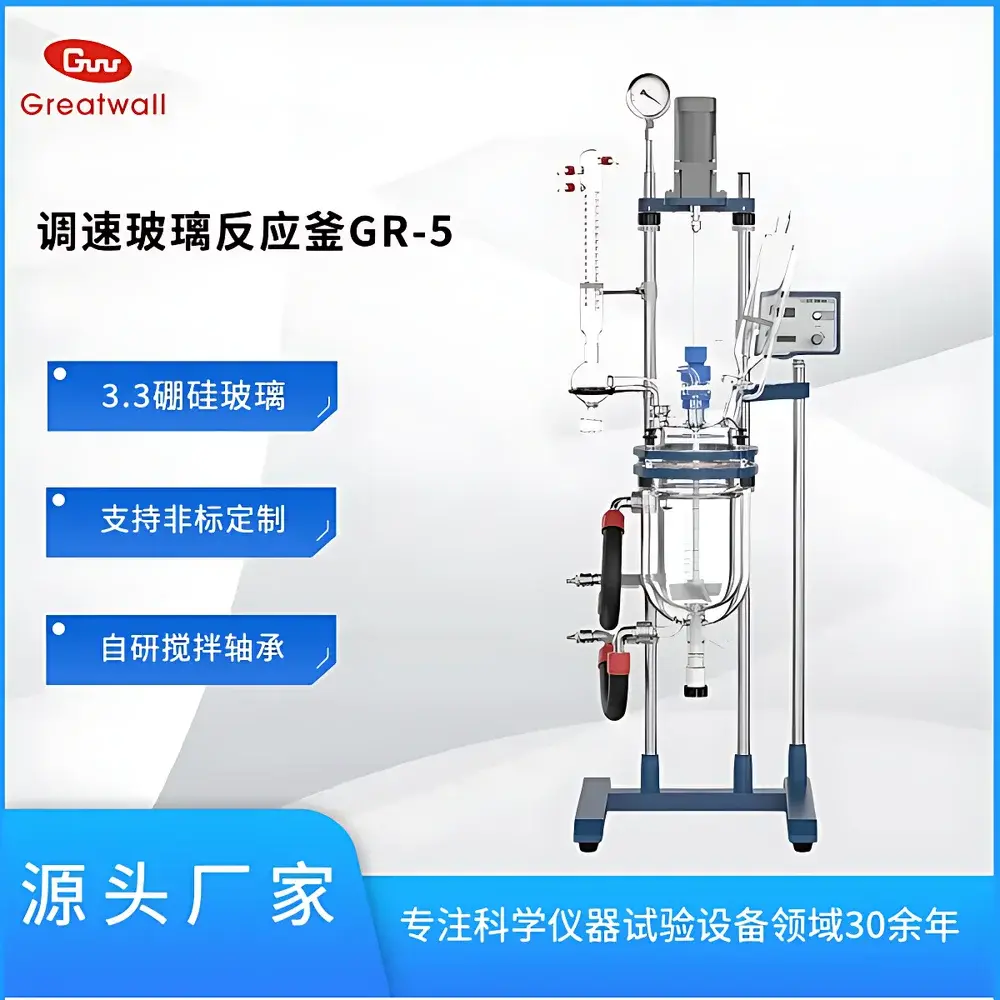
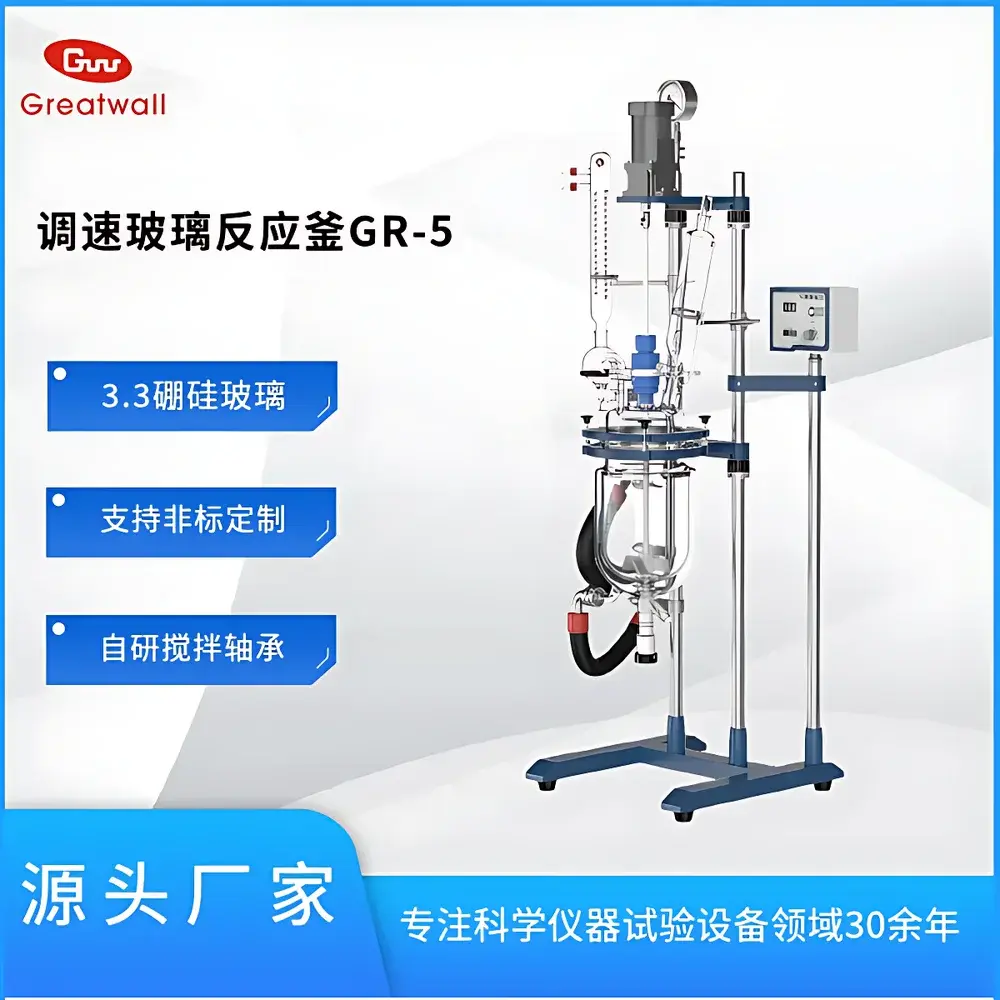
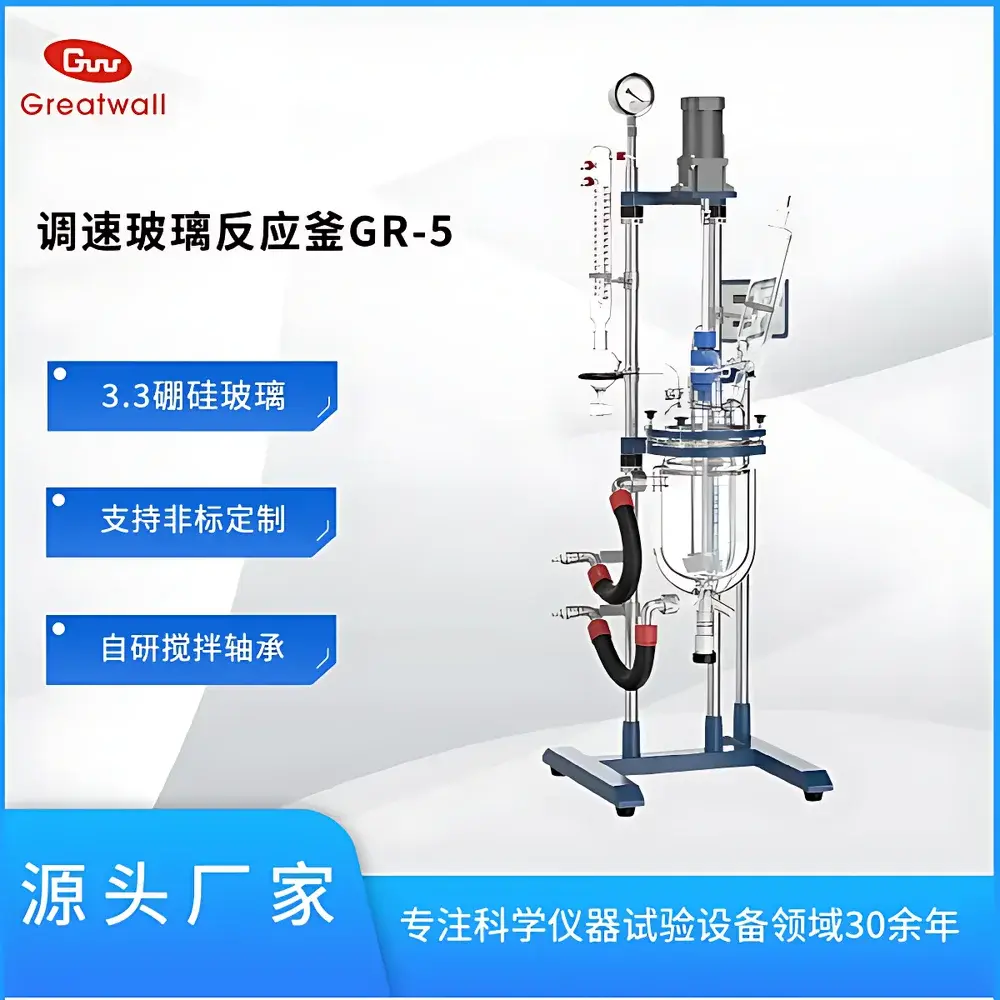
The Great Wall GR-5 Variable-Speed Glass Reactor
| Brand | The Great Wall |
|---|---|
| Origin | Henan, China |
| Manufacturer Type | Direct Manufacturer |
| Product Category | Domestic |
| Model | GR-5 |
| Instrument Classification | Reactor |
| Volume Class | Small-Scale |
| Operating Pressure | Low-Pressure (Vacuum to Atmospheric) |
| Capacity | 5 L |
| Glass Material | Borosilicate 3.3 |
| Temperature Range | −80 °C to +200 °C |
| Jacket Pressure Rating | ≤ 0.03 MPa |
| Thermal Shock Resistance | 80 °C |
| Stirring Speed Range | 50–500 rpm |
| Speed Accuracy | ±1 rpm |
| Motor Power | 90 W |
| Drive Type | Three-Phase Asynchronous Motor with Frequency Converter Control |
| Sealing System | Vacuum-Compatible Mechanical Seal with PTFE Components |
| Stirrer Configuration | Single-Layer Four-Inclined-Blade Open Turbine |
| Stirrer Shaft & Blades | 06Cr19Ni10 Stainless Steel Core with Full PTFE Cladding |
| Jacket Inlet/Outlet | Rc 3/4 Threaded Fittings with Stainless Steel Insulated Flexible Hoses |
| Condenser Length | 435 mm |
| Condenser Surface Area | ~0.045 m² |
| Condenser Joint Size | 29/32 |
| Dropping Funnel Capacity | 500 mL (29/32 Joint) |
| Temperature Sensor | PT100, Digital Display, ±0.1 °C Accuracy |
| Frame Material | 06Cr19Ni10 Stainless Steel + Powder-Coated Carbon Structural Steel + Powder-Coated Aluminum Alloy |
| Overall Dimensions (W×D×H) | ~650 × 550 × 1600 mm |
| Net Weight | ~34 kg |
Overview
The Great Wall GR-5 Variable-Speed Glass Reactor is an engineered laboratory-scale reaction system designed for controlled synthesis, reflux, distillation, and multi-step chemical processes under vacuum or inert atmosphere. Built around a seamless borosilicate 3.3 glass vessel (5 L nominal capacity, 0.65 L minimum effective stirring volume), the reactor operates across an extended thermal range of −80 °C to +200 °C—enabling cryogenic reactions, high-boiling solvent handling, and temperature-sensitive catalytic transformations. Its low-pressure design supports operation from full vacuum (−0.1 MPa) up to ambient pressure, making it suitable for solvent removal, degassing, and gas-phase reaction monitoring. The jacketed double-wall construction (3 L jacket volume) allows precise thermal management via external circulators; jacket pressure is rated to ≤ 0.03 MPa to ensure safe integration with standard heating/cooling units. All wetted surfaces—including the釜盖, condenser, dropping funnel, and receiving components—are fabricated from chemically inert borosilicate 3.3 glass, ensuring compatibility with aggressive reagents including strong acids, alkalis, halogenated solvents, and organometallics.
Key Features
- Borosilicate 3.3 glass construction throughout—meets ISO 3585 standards for hydrolytic resistance (Class 1), thermal shock tolerance (ΔT = 80 °C), and long-term stability under thermal cycling.
- Vacuum-rated mechanical seal with PTFE-stator and stainless-steel rotor—designed for continuous operation at ≤10⁻² mbar without lubricant contamination or leakage.
- Variable-speed stirring drive: 90 W three-phase asynchronous motor with frequency converter control (50–500 rpm), digitally displayed with ±1 rpm resolution and repeatable torque delivery across viscosity ranges.
- PTFE-clad 06Cr19Ni10 (AISI 304 equivalent) stirrer shaft and four-inclined-blade open turbine impeller—optimized for radial flow, efficient mixing in low-to-medium viscosity media, and minimal shear-induced degradation.
- Stress-relieved jacket fluid connections using Rc 3/4 stainless steel insulated flexible hoses—eliminates mechanical strain on glass flanges during thermal expansion/contraction cycles.
- Top-mounted inclined discharge valve (φ25 mm outlet) with PTFE-sealed plug—enables complete, residue-free emptying without disassembly.
- Modular 5-port borosilicate glass lid (central 50# + dual 29/32 + S35 + 24/29) supporting simultaneous condensation, addition, sampling, temperature sensing, and inert gas purging.
- Robust frame assembly combining food-grade stainless steel (06Cr19Ni10), powder-coated structural carbon steel, and anodized aluminum alloy—corrosion-resistant, static-dissipative, and compliant with ISO 14644-1 Class 8 cleanroom maintenance protocols.
Sample Compatibility & Compliance
The GR-5 is routinely deployed in synthetic organic chemistry, pharmaceutical process development, and fine chemical R&D where material compatibility, trace metal control, and reproducible thermal profiles are critical. Its all-glass fluid path ensures zero leachable metals—meeting USP and EP 3.2.1 requirements for glassware used in API intermediate synthesis. The system supports GLP-compliant documentation when paired with validated temperature and speed logging (via optional RS485 interface). While not intrinsically rated for explosion-proof environments, its vacuum integrity and leak-tight mechanical seal conform to ASTM E2877-13 guidelines for low-pressure reaction apparatus safety verification. All electrical components comply with IEC 61010-1:2010 for laboratory equipment safety, including overcurrent protection, grounding continuity, and dielectric strength testing.
Software & Data Management
The GR-5 operates as a stand-alone analog-digital hybrid platform. Real-time parameters—including stirring speed (digital LED display, ±1 rpm), bath temperature (PT100 sensor, ±0.1 °C), and operating time—are locally monitored without embedded firmware. For integrated data acquisition, the unit features a configurable RS485 port (Modbus RTU protocol) compatible with third-party SCADA systems (e.g., LabVIEW, DeltaV, Ignition) and LIMS interfaces. When connected to a validated data logger, the system supports 21 CFR Part 11–compliant audit trails—including user login timestamps, parameter change logs, and electronic signature capture—when deployed in regulated GMP environments. No proprietary software is required; configuration is performed via front-panel keypad navigation with password-protected calibration mode.
Applications
- Catalytic hydrogenation and palladium-coupling reactions under nitrogen/argon blanket.
- Low-temperature lithiation and Grignard formation at −78 °C using dry ice/acetone baths.
- Solvent-free esterification and transesterification with in situ water removal via vacuum.
- Photochemical reactions using side-arm quartz jackets (retrofittable).
- Controlled crystallization studies with real-time turbidity and temperature correlation.
- Scale-down process validation for kilo-lab reactors—maintaining identical surface-to-volume ratio (≈0.85 m²/m³) and impeller tip speed consistency.
FAQ
What is the maximum allowable vacuum level for continuous operation?
The GR-5 is rated for sustained operation at −0.1 MPa (100 mbar absolute) with no deformation or seal failure when properly assembled and temperature-stabilized.
Can the reactor be used with hydrofluoric acid or hot concentrated phosphoric acid?
No. Although borosilicate 3.3 resists most chemicals, it is not resistant to HF, hot concentrated H₃PO₄, or alkaline solutions above pH 12 at elevated temperatures. Consult Corning PYREX® Chemical Resistance Guide for specific exposure limits.
Is the mechanical seal replaceable in-house without specialized tools?
Yes. The seal cartridge is modular and field-replaceable using standard Allen keys and a torque wrench; full replacement procedure requires <15 minutes and is documented in the EN/ISO 21647-compliant service manual.
Does the system include temperature control hardware?
No. The GR-5 is a reactor core only—it requires external heating/cooling circulators (e.g., Huber, Julabo, or PolyScience) connected via the Rc 3/4 jacket ports.
What certifications accompany shipment for EU or US customs clearance?
Each unit ships with CE Declaration of Conformity (2014/30/EU EMC & 2014/35/EU LVD), RoHS 2011/65/EU compliance statement, and ISO 9001:2015 manufacturing certificate issued by SGS China.



