
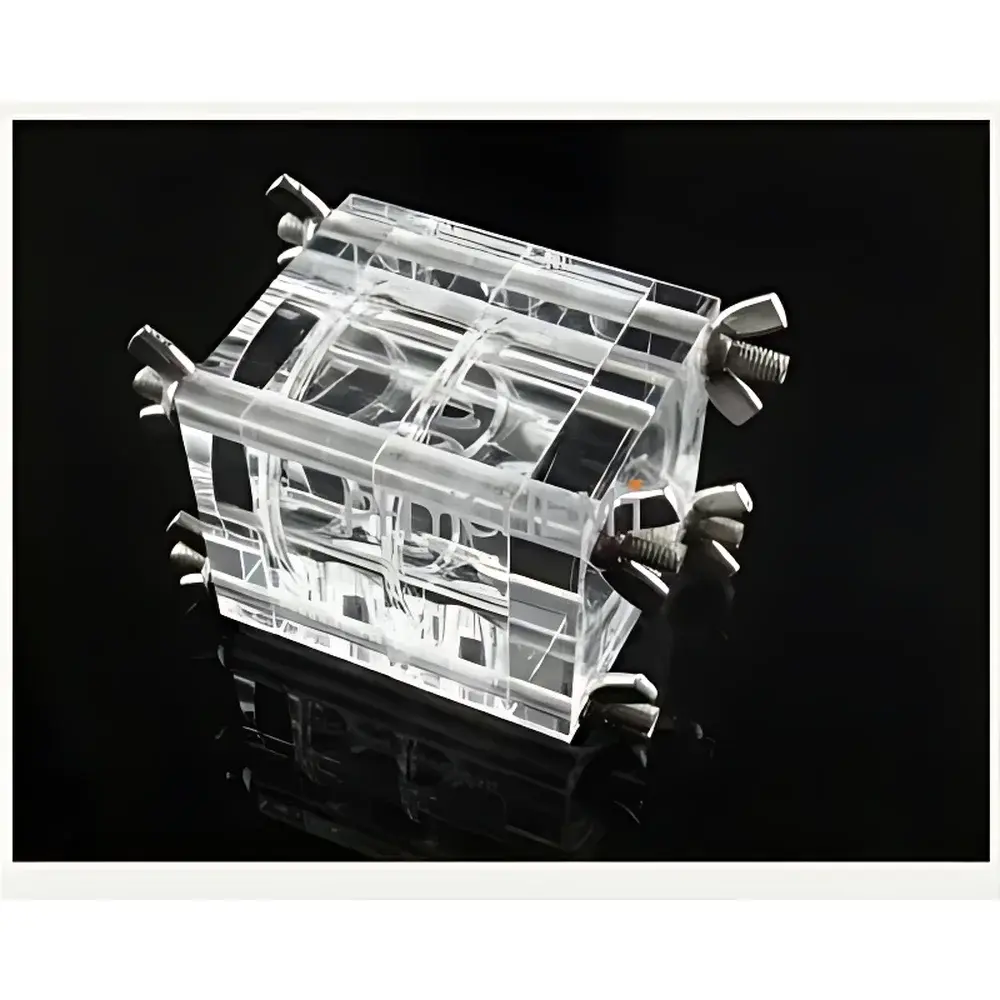
Standard MFC Reactor
| Origin | Hong Kong |
|---|---|
| Manufacturer Type | Distributor |
| Model | Standard MFC Reactor |
| Pricing | Upon Request |
Overview
The Standard MFC Reactor is a purpose-engineered laboratory-scale bioreactor system designed specifically for the development, characterization, and optimization of microbial fuel cells (MFCs). It operates on electrochemical principles where exoelectrogenic bacteria oxidize organic substrates at the anode, generating electrons transferred to a cathode via an external circuit—enabling simultaneous wastewater treatment and bioelectricity generation. This reactor supports controlled anaerobic–aerobic interface management, precise electrode positioning, and reproducible electrochemical boundary conditions essential for fundamental research in bioelectrochemistry, extracellular electron transfer (EET) mechanisms, and biofilm-electrode interactions.
Key Features
- Modular stainless-steel and borosilicate glass construction ensures chemical resistance, thermal stability, and optical clarity for real-time biofilm observation.
- Tool-free disassembly design enables rapid access to internal components—including anode/cathode chambers, proton exchange membrane (PEM) housing, and reference electrode ports—minimizing downtime between experimental runs.
- Hermetic sealing achieved via silicone O-rings and precision-machined flanges guarantees leak-tight operation under both ambient and elevated pressure conditions, critical for maintaining strict anaerobic environments at the anode compartment.
- Autoclavable up to 121 °C for 20 minutes (ISO 17665-1 compliant), supporting full sterilization without component degradation or dimensional shift—essential for sterile inoculation and contamination-sensitive studies.
- Customizable internal volume ranging from 50 mL to 2 L, with scalable electrode surface area ratios (anode:cathode) and standardized 1/4″ NPT and Swagelok-compatible ports for integration with potentiostats, gas flow controllers, and online pH/DO sensors.
Sample Compatibility & Compliance
The reactor accommodates diverse inocula—including activated sludge, sediment-derived consortia, and defined pure cultures—and supports liquid-phase substrates (e.g., acetate, glucose, wastewater effluents) as well as solid-phase biofilms grown on carbon cloth, graphite felt, or 3D-printed conductive scaffolds. All wetted materials comply with USP Class VI biocompatibility standards and are non-leaching under physiological and mildly acidic operating conditions (pH 5.0–8.5). The design conforms to ASTM D3971 (standard practice for electrochemical testing of bioelectrochemical systems) and supports GLP-aligned documentation workflows when paired with validated data acquisition systems.
Software & Data Management
While the reactor itself is hardware-only, its standardized electrical and fluidic interfaces facilitate seamless integration with third-party instrumentation: potentiostats (e.g., BioLogic SP-300, Gamry Interface 1010E), programmable logic controllers (PLCs), and SCADA platforms. Time-synchronized voltage, current, pH, temperature, and dissolved oxygen data can be logged at ≤1 Hz resolution using LabVIEW, Python-based PySerial/DAQmx drivers, or MATLAB Instrument Control Toolbox. Audit trails, user access logs, and electronic signatures may be implemented per FDA 21 CFR Part 11 requirements when deployed within regulated research environments.
Applications
- Quantitative evaluation of Coulombic efficiency, power density, and internal resistance in single-chamber and dual-chamber MFC configurations.
- Long-term biofilm maturation studies under continuous or fed-batch operation, including electrochemical impedance spectroscopy (EIS) mapping across operational cycles.
- Comparative assessment of electrode materials, membrane types (Nafion, Sulfonated Polyether Ether Ketone), and catholyte compositions (air-cathodes, ferricyanide, oxygen reduction catalysts).
- Integration into multi-reactor arrays for parallel parameter screening—e.g., substrate concentration gradients, hydraulic retention time (HRT) variation, or temperature ramping protocols aligned with ISO 16269-6 statistical design guidelines.
- Training platform for graduate-level courses in environmental biotechnology, sustainable energy engineering, and electrochemical biosensor development.
FAQ
Is the reactor compatible with standard potentiostats and data acquisition systems?
Yes—the anode and cathode terminals feature gold-plated banana jacks and 2-mm pin headers conforming to IEEE 488.2 mechanical specifications, enabling direct connection to most commercial electrochemical workstations.
Can the reactor be operated under pressurized or vacuum conditions?
It is rated for static pressures from −0.5 bar to +0.3 bar gauge; sustained operation outside this range requires optional reinforced flange kits and pressure-rated viewports.
What documentation is provided with the system?
Each unit ships with a material compliance certificate (RoHS, REACH), dimensional drawings (PDF and STEP), autoclave validation guidance, and a traceable calibration record for all machined components.
Do you offer OEM integration support for custom sensor embedding?
Yes—custom porting, embedded Pt100 RTD sleeves, and microfluidic interconnects can be incorporated during manufacturing upon submission of mechanical interface specifications.



