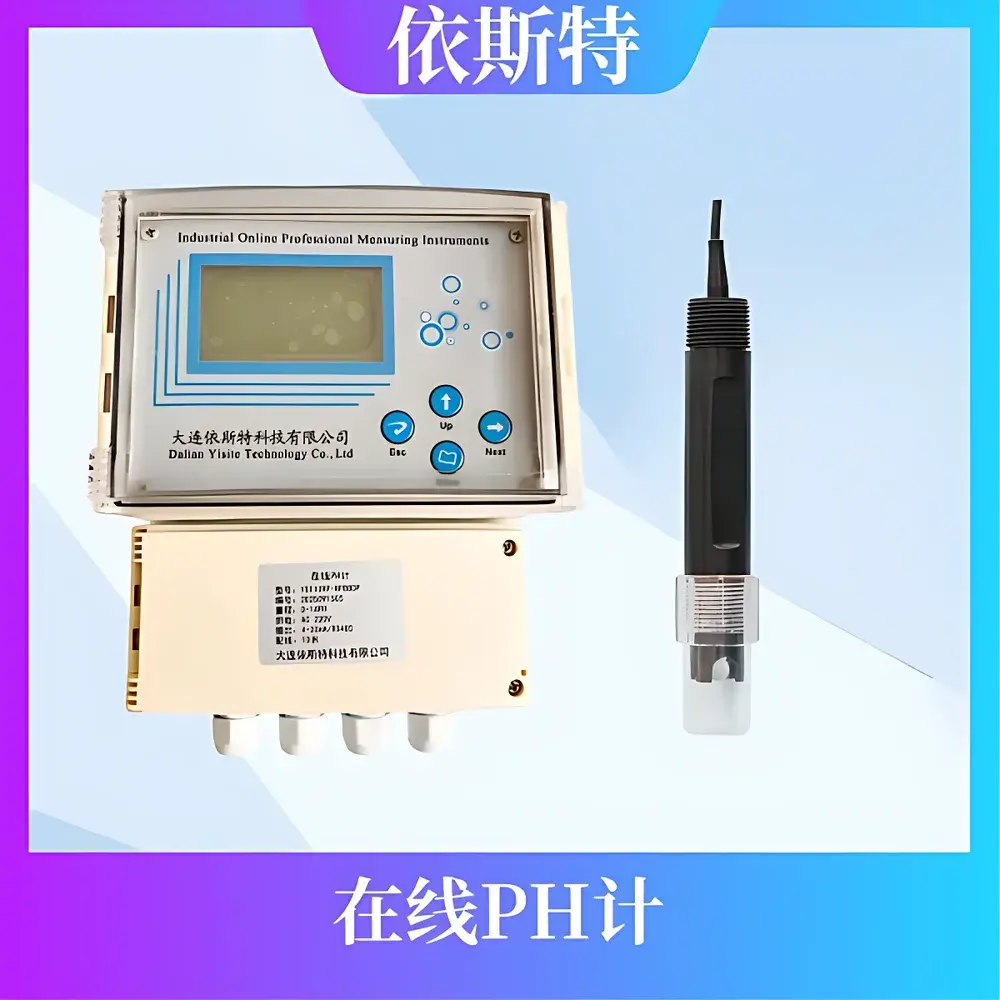
YST109B-HP880 Online Flow-Through pH/ORP Meter
| Brand | YST (Dalian Yisite) |
|---|---|
| Origin | Liaoning, China |
| Model | YST109B-HP880 |
| Measurement Range | pH 0–14, ORP −2000 to +2000 mV |
| Accuracy | ±0.02 pH (high-precision mode), ±0.1 pH (standard mode) |
| Temperature Compensation | 0–99.9 °C (reference 25 °C) |
| Output Signals | 4–20 mA (2-wire), RS485 (Modbus RTU) |
| Power Supply | 24 VDC (wide-range input), solar-compatible |
| Media Compatibility | Aqueous solutions, weakly corrosive liquids (pH 2–12), suspensions |
| Drift Stability | ±0.02 pH/24 h |
| Enclosure Rating | IP65 to IP67 |
| Response Time | <30 s (standard), <5 s (fast-response configuration) |
| Data Logging | 30-day local storage |
| Auto-Calibration | Supported |
Overview
The YST109B-HP880 Online Flow-Through pH/ORP Meter is an industrial-grade process analytical instrument engineered for continuous, real-time monitoring of hydrogen ion activity (pH) and oxidation-reduction potential (ORP) in flowing aqueous streams. Based on the electrochemical principle of the glass electrode cell—comprising a pH-sensitive glass membrane and a stable reference electrode—the device measures the Nernstian potential difference generated across the sensing interface. This analog signal is conditioned, temperature-compensated using a built-in Pt1000 or thermistor sensor, and converted into a high-fidelity digital pH and ORP output. Designed for integration into closed-loop control systems, the YST109B-HP880 operates reliably under dynamic flow conditions with minimal maintenance, making it suitable for applications where regulatory compliance, process consistency, and long-term measurement stability are critical.
Key Features
- Electrochemical Sensing Architecture: Dual-electrode configuration (glass pH electrode + Ag/AgCl or calomel reference) ensures robust Nernst response across full pH 0–14 range; optional antimony electrodes available for harsh or HF-containing media.
- Intelligent Temperature Compensation: Automatic temperature correction referenced to 25 °C, with linear or non-linear algorithms compliant with ISO 7027 and ASTM D1293, minimizing thermal drift in variable-temperature processes.
- Industrial Signal Outputs: Simultaneous 4–20 mA analog output (HART-compatible wiring) and isolated RS485 Modbus RTU interface enable seamless integration with PLCs, DCS, SCADA, and cloud-based IIoT platforms.
- Ruggedized Process Housing: Die-cast aluminum body with silicone-sealed cable entries; rated IP65 as standard, upgradable to IP67 for submersion-prone installations such as wet wells or open-channel flumes.
- Low-Maintenance Operation: Supports two-point (4.01/7.00/10.01) or single-point auto-calibration routines; onboard diagnostics detect electrode aging, junction clogging, and asymmetry voltage drift per IUPAC-recommended practice.
- Environmental Resilience: Optical isolation on all digital interfaces suppresses EMI from VFDs, welding equipment, and high-voltage motors; operating ambient temperature range: −20 °C to +60 °C.
Sample Compatibility & Compliance
The YST109B-HP880 is validated for use with potable water, wastewater, surface water, cooling tower make-up, boiler feedwater, and weakly aggressive chemical streams (pH 2–12). It complies with electromagnetic compatibility requirements per EN 61326-1 (industrial environment) and meets mechanical safety standards per EN 61000-6-2/-6-4. While not certified to SIL or ATEX, its intrinsic design supports deployment in non-hazardous Zone 2 areas when installed with appropriate conduit and grounding. For regulated environments—including municipal drinking water treatment (US EPA Method 150.1, ISO 10523) and pharmaceutical water systems (USP <791>, EP 2.2.3)—the meter supports audit-ready data logging with time-stamped calibration records and event-triggered alarms, aligning with GLP/GMP documentation expectations.
Software & Data Management
The embedded firmware supports configurable data logging at user-defined intervals (1 s to 1 h), retaining up to 30 days of pH, ORP, temperature, and diagnostic parameters in non-volatile memory. All stored records include UTC timestamps, calibration history, and error flags (e.g., “low slope”, “high impedance”). Via Modbus register mapping, third-party SCADA systems can extract raw millivolt values, compensated pH, temperature-corrected ORP, and status bits for predictive maintenance. Optional cloud gateway modules (MQTT/HTTPS) enable secure TLS 1.2 transmission to AWS IoT Core or Azure IoT Hub, supporting remote firmware updates and over-the-air configuration changes—fully traceable under FDA 21 CFR Part 11-compliant audit trails when paired with validated platform software.
Applications
- Municipal Wastewater Treatment: Real-time pH monitoring at bioreactor inlets/outlets to maintain optimal nitrification/denitrification conditions (pH 6.8–8.0) and prevent sludge bulking.
- Drinking Water Production: Closed-loop control of coagulant (e.g., alum, ferric chloride) and disinfectant (chlorine, chlorine dioxide) dosing based on raw water pH fluctuations.
- Surface Water Quality Networks: Fixed-station deployment at river discharge points, estuaries, and reservoir intakes for early pollution detection (e.g., acid mine drainage, industrial effluent).
- Industrial Cooling Systems: Corrosion mitigation through continuous pH and ORP tracking in recirculating cooling towers, enabling automated acid/base dosing to sustain Langelier Saturation Index (LSI) targets.
- Rural & Decentralized Water Schemes: Solar-powered operation with low-power sleep modes (<1.5 W avg.) supports off-grid monitoring in remote villages and agricultural catchments.
FAQ
What is the recommended calibration frequency for continuous operation?
Calibration interval depends on process severity: weekly for clean potable water; every 3–5 days for wastewater or high-suspended-solids streams. The device logs calibration events and alerts users when slope deviation exceeds ±5% of theoretical Nernst value (59.16 mV/pH at 25 °C).
Can the YST109B-HP880 be used in seawater or brine applications?
Not without modification: standard glass electrodes exhibit alkaline error above pH 10 and sodium error in high-ionic-strength media (>50 g/L TDS). For marine applications, consult YST for specialized low-drift pH electrodes with lithium glass formulations.
Does the meter support automatic temperature compensation with external PT100 sensors?
Yes—the unit accepts external RTD inputs via dedicated terminals, allowing independent temperature measurement upstream/downstream of the flow cell to improve compensation accuracy in thermally stratified pipelines.
Is Modbus register documentation publicly available?
Full Modbus RTU register map (holding/input registers, coil addresses, scaling factors) is provided in the technical manual upon purchase and is compatible with standard Modbus polling tools such as QModMaster and Simply Modbus.
How is electrode lifetime defined and monitored?
Electrode service life is assessed via three metrics: asymmetry potential (should remain within ±30 mV in pH 7 buffer), electrode slope (≥95% of theoretical at installation), and response time (≤30 s to 90% of final value). All are continuously tracked and reported in diagnostic registers.
Related Products