
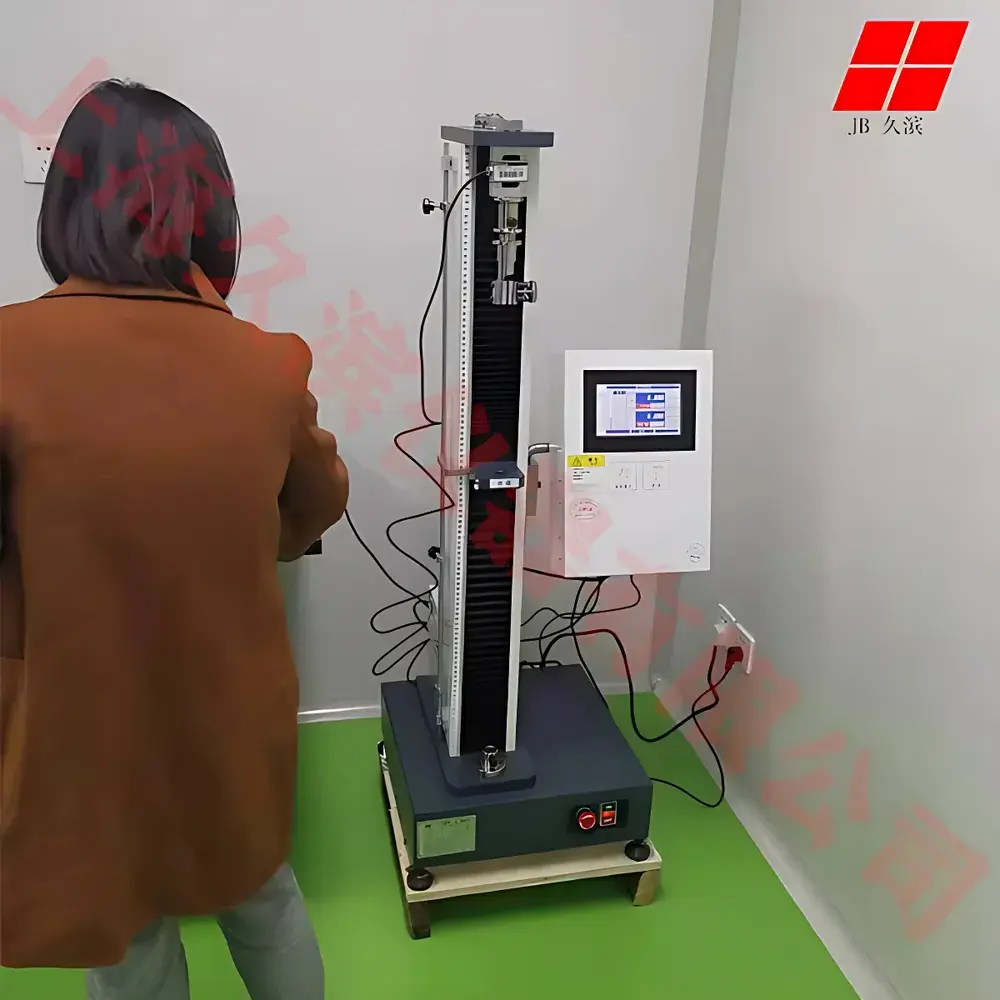
Jiubin JB-126A 2 kN Electromechanical Universal Testing Machine
| Brand | Jiubin |
|---|---|
| Origin | Shanghai, China |
| Model | JB-126A |
| Load Capacity | 2 kN |
| Type | Electromechanical Universal Testing Machine |
| Compliance | GB/T 16491, ISO 6892-1, ASTM E4, ASTM D638, ASTM D790 |
| Software | Jiubin TestMaster v3.2 (Windows-based, GLP-compliant data logging) |
| Drive System | Precision ball-screw + servo motor |
| Control Mode | Closed-loop digital PID control |
| Position Resolution | ≤ 0.001 mm |
| Load Accuracy | ±0.5% of full scale |
| Crosshead Speed Range | 0.001–500 mm/min (adjustable in 0.001 mm/min increments) |
| Data Sampling Rate | Up to 100 Hz |
| Safety Features | Dual-channel mechanical limit switches, emergency stop, overload protection |
Overview
The Jiubin JB-126A is a precision-engineered 2 kN electromechanical universal testing machine designed for static tensile, compressive, flexural, and peel testing of metallic, polymeric, elastomeric, and composite materials in research laboratories, quality control departments, and industrial R&D centers. Based on the fundamental principles of axial force application and displacement-controlled loading, the system employs a high-rigidity dual-column frame, preloaded ball-screw transmission, and a digitally regulated AC servo drive to ensure stable load application and high positional fidelity. Its modular load cell architecture supports traceable calibration per ISO/IEC 17025 requirements, and the machine conforms to key international test standards including ISO 6892-1 (metallic tensile testing), ASTM D638 (plastics tensile properties), ASTM D790 (flexural properties of plastics), and GB/T 16491 (Chinese national standard for universal testing machines). The JB-126A is not intended for high-cycle fatigue or dynamic impact applications; it is optimized for quasi-static mechanical characterization under controlled environmental conditions.
Key Features
- 2 kN capacity load frame with rigid cast-iron base and hardened steel columns, engineered for minimal deflection (<0.02 mm under full load)
- High-resolution load measurement using a temperature-compensated S-type load cell (accuracy ±0.5% FS, repeatability <0.2% FS)
- Digital closed-loop PID control enabling precise crosshead speed regulation from 0.001 to 500 mm/min in 0.001 mm/min increments
- Integrated optical encoder feedback for real-time position tracking with ≤0.001 mm resolution
- Standardized grip interface compatible with wedge-action, pneumatic, and hydraulic fixtures (M6–M12 thread adaptability)
- Comprehensive safety architecture: dual independent mechanical limit switches, hardware-triggered emergency stop circuit, and automatic overload cutoff
- Modular design supporting future upgrades including extensometer integration (contact/non-contact), environmental chamber coupling (-40°C to +200°C), and multi-axis alignment kits
Sample Compatibility & Compliance
The JB-126A accommodates specimens ranging from thin polymer films (≥0.05 mm thickness) to machined metal coupons (up to 200 mm gauge length, 25 mm width, 10 mm thickness). Standard test configurations include dog-bone tensile bars (ASTM D638 Type I–V), rectangular flexural beams (ASTM D790), and compression cylinders (ASTM C39). All mechanical components comply with RoHS Directive 2011/65/EU. Calibration certificates are issued per ISO/IEC 17025-accredited procedures, and the system supports audit-ready documentation for GLP and GMP environments. Test reports generated by TestMaster v3.2 include embedded metadata (operator ID, timestamp, environmental conditions, calibration validity), satisfying traceability requirements under FDA 21 CFR Part 11 when configured with user authentication and electronic signature modules.
Software & Data Management
TestMaster v3.2 is a Windows-based, bilingual (English/Chinese) software platform developed specifically for Jiubin mechanical testers. It provides real-time graphical monitoring of force–displacement, stress–strain, and load–time curves with configurable sampling rates up to 100 Hz. The software supports automated test sequencing, batch processing of identical specimen sets, and customizable report templates compliant with ISO 14289-1 (PDF/A-1a) archival standards. Raw data export is available in CSV, XML, and proprietary .JBT formats; all files retain embedded calibration coefficients and instrument configuration logs. Audit trail functionality records every parameter change, test initiation, and result modification with user ID and timestamp — essential for regulatory submissions in pharmaceutical (USP , ICH Q5E), automotive (ISO 17025-accredited lab audits), and academic integrity frameworks.
Applications
- Tensile property evaluation of thermoplastics (PP, PE, ABS), elastomers (NR, SBR, TPU), and engineering composites (CFRP, GFRP)
- Yield strength, ultimate tensile strength, elongation at break, and modulus determination per ASTM D638 and ISO 527
- Flexural testing of rigid plastics and laminates per ASTM D790 and ISO 178
- Compression testing of foams, rubbers, and sintered metals per ASTM D3574 and ISO 844
- Adhesion strength assessment of coated metals and laminated packaging via 90°/180° peel tests (ASTM D903)
- Quality conformance verification in Tier-1 automotive supply chains (e.g., interior trim, gasket materials, battery housing polymers)
- Material screening for medical device components (ISO 10993-12 compliant sample preparation support)
FAQ
What is the maximum specimen height accommodated by the JB-126A?
The standard test space allows up to 800 mm between grips; optional extended-height columns increase this to 1,200 mm.
Does the system support extensometer integration?
Yes — both clip-on axial extensometers (ASTM E83 Class B-1) and non-contact video extensometers can be connected via USB or analog output interfaces.
Is calibration traceable to national metrology institutes?
Factory calibration is traceable to CNAS-accredited reference standards; end-user recalibration services are available through Jiubin’s authorized service centers in Shanghai, Beijing, and Shenzhen.
Can TestMaster v3.2 generate PDF reports compliant with FDA 21 CFR Part 11?
Yes — when deployed with Windows Active Directory authentication, digital certificate signing, and enabled audit trail logging, the software meets electronic record and signature requirements for regulated industries.
What environmental conditions are recommended for optimal performance?
Operational ambient range: 10–35°C, relative humidity ≤80% non-condensing; vibration isolation is recommended for sub-1 N resolution testing.



