
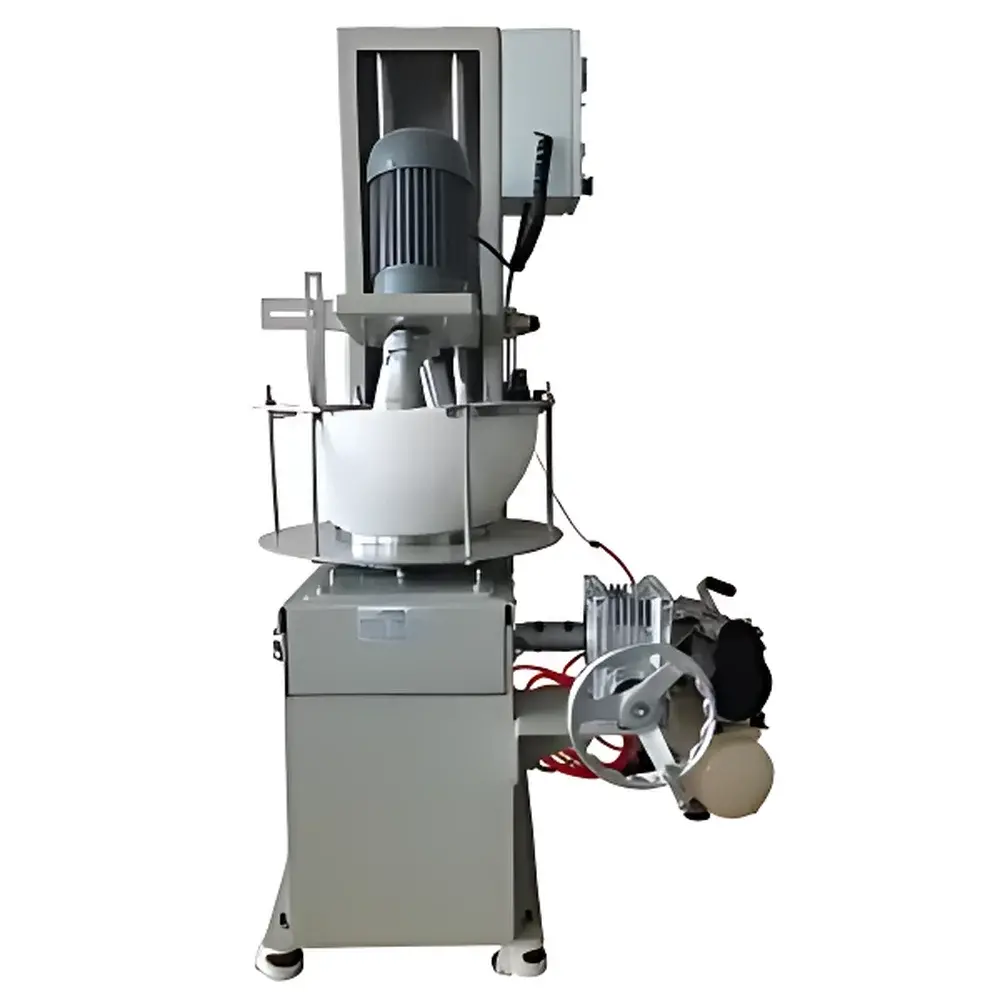
Jiubin JB-400 Pneumatically Actuated Ceramic Mortar Grinder
| Brand | Jiubin |
|---|---|
| Origin | Shanghai, China |
| Model | JB-400 |
| Grinding Mechanism | Triple-rod ceramic mortar system |
| Drive | Adjustable-speed motor with pneumatic vertical lift |
| Sample Type | Hard and brittle solids (e.g., ceramics, carbides, minerals, pharmaceutical tablets) |
| Output Particle Size | < 10 µm (D90) |
| Material Contact Parts | Fully ceramic (Al₂O₃ or ZrO₂-lined mortar and pestles) |
| Compliance | Designed for GLP-compliant lab environments |
| Safety | Integrated pneumatic pressure regulation (0.4–0.7 MPa), oil-mist lubrication unit, emergency stop circuit |
Overview
The Jiubin JB-400 Pneumatically Actuated Ceramic Mortar Grinder is an industrial-grade, semi-automated laboratory grinding system engineered for reproducible, low-contamination size reduction of hard, brittle, and temperature-sensitive materials. It operates on the principle of controlled mechanical attrition within a stationary ceramic mortar, where three synchronized ceramic pestles rotate and orbit under precise pneumatic vertical actuation—ensuring uniform compressive and shear forces across the sample bed. Unlike rotary ball mills or jaw crushers, this mortar-based architecture minimizes heat generation (< 8 °C temperature rise during 5-min dry grinding of SiC), prevents metallic contamination, and delivers narrow particle size distributions essential for downstream characterization (e.g., XRD, SEM, BET surface area analysis) and formulation development (e.g., pharmaceutical suspensions, ceramic green bodies, conductive pastes). Its design targets laboratories requiring batch consistency in microgrinding applications where conventional equipment fails due to wear, overheating, or cross-contamination.
Key Features
- Triple-ceramic-pestle configuration with independent orbital motion and synchronized vertical descent, enabling high-energy yet low-shear comminution
- Pneumatically driven vertical lift mechanism (0.4–0.7 MPa regulated air supply) ensures repeatable contact force without hydraulic fluid leakage or motor overload risk
- Full-ceramic wet/dry grinding chamber: Al₂O₃ (99.5%) or Y-TZP (zirconia) mortar and pestles—chemically inert, wear-resistant, and suitable for aggressive media (e.g., HF-containing slurries, organic solvents)
- Variable-speed motor (50–300 rpm) coupled with adjustable orbital radius permits optimization of impact frequency versus residence time for diverse feed materials
- Integrated scraper assembly automatically clears residual material from mortar walls between cycles, reducing carryover and improving batch-to-batch reproducibility
- Manual tilt-and-pour discharge via hand-cranked flip mechanism ensures complete sample recovery (>98% yield for 5 g batches) without disassembly
- Mobile base with locking casters facilitates repositioning within fume hoods or cleanroom-compatible lab layouts
Sample Compatibility & Compliance
The JB-400 accommodates dry or slurry-fed samples up to 500 g per batch, including silicon carbide, tungsten carbide, fused quartz, dental zirconia blocks, lithium cobalt oxide cathode powders, and freeze-dried biologics. Its all-ceramic pathway meets USP particulate matter requirements for parenteral excipient grinding and satisfies ISO 14644-1 Class 7 cleanroom compatibility when operated inside laminar flow enclosures. While not certified to CE or UL standards as a standalone unit, its control cabinet complies with IEC 61000-6-2/6-4 EMC immunity/emission limits. The system supports audit-ready operation under GLP and GMP frameworks: all parameter settings (speed, duration, pressure) are manually logged, and optional RS-232/Modbus RTU interface enables integration into LIMS-controlled workflows.
Software & Data Management
The JB-400 operates via a dedicated local control panel with LED display and tactile membrane switches—no embedded software or firmware. Parameter recording (grinding time, motor speed, cycle count) is performed manually in lab notebooks or external electronic lab notebooks (ELNs). For automated data capture, third-party PLCs or SCADA systems may interface via its dry-contact start/stop terminals and analog 4–20 mA pressure feedback output. No proprietary drivers or cloud connectivity are provided; this design prioritizes operational simplicity, cybersecurity isolation, and long-term serviceability in regulated QC/QA labs.
Applications
- Preparation of sub-10 µm reference standards for laser diffraction (ISO 13320) and dynamic image analysis (ISO 13322-2)
- Homogenization of ceramic raw material blends prior to sintering trials
- Particle size refinement of active pharmaceutical ingredients (APIs) for inhalable dry powder formulations
- Dispersion-assisted wet grinding of conductive carbon black in battery electrode slurries
- Size reduction of geological core samples for geochemical XRF/XRD analysis without Fe/Ni contamination
- Processing of dental restorative composites and glass ionomer cements under ISO 4049 compliance conditions
FAQ
What materials are compatible with the ceramic mortar system?
Alumina (Al₂O₃) and yttria-stabilized zirconia (Y-TZP) components withstand pH 1–14, temperatures up to 1200 °C (inert atmosphere), and abrasion from Mohs 9+ materials—including boron nitride, silicon nitride, and synthetic diamond.
Can the JB-400 perform cryogenic grinding?
No—it lacks integrated cooling channels or LN₂ porting. For cryo-grinding, pre-chilled samples may be loaded, but sustained sub-zero operation is not supported.
Is validation documentation available for GMP use?
Factory test reports (FAT) include dimensional verification, pressure decay tests, and no-load torque profiling. IQ/OQ protocols must be developed in-house per user’s SOPs; no pre-validated templates are supplied.
What maintenance intervals are recommended?
Lubrication of pneumatic regulators and oil-mist units every 200 operating hours; visual inspection of ceramic surfaces for microcracking every 500 cycles; replacement of O-rings and pneumatic seals annually or after 1000 cycles.



