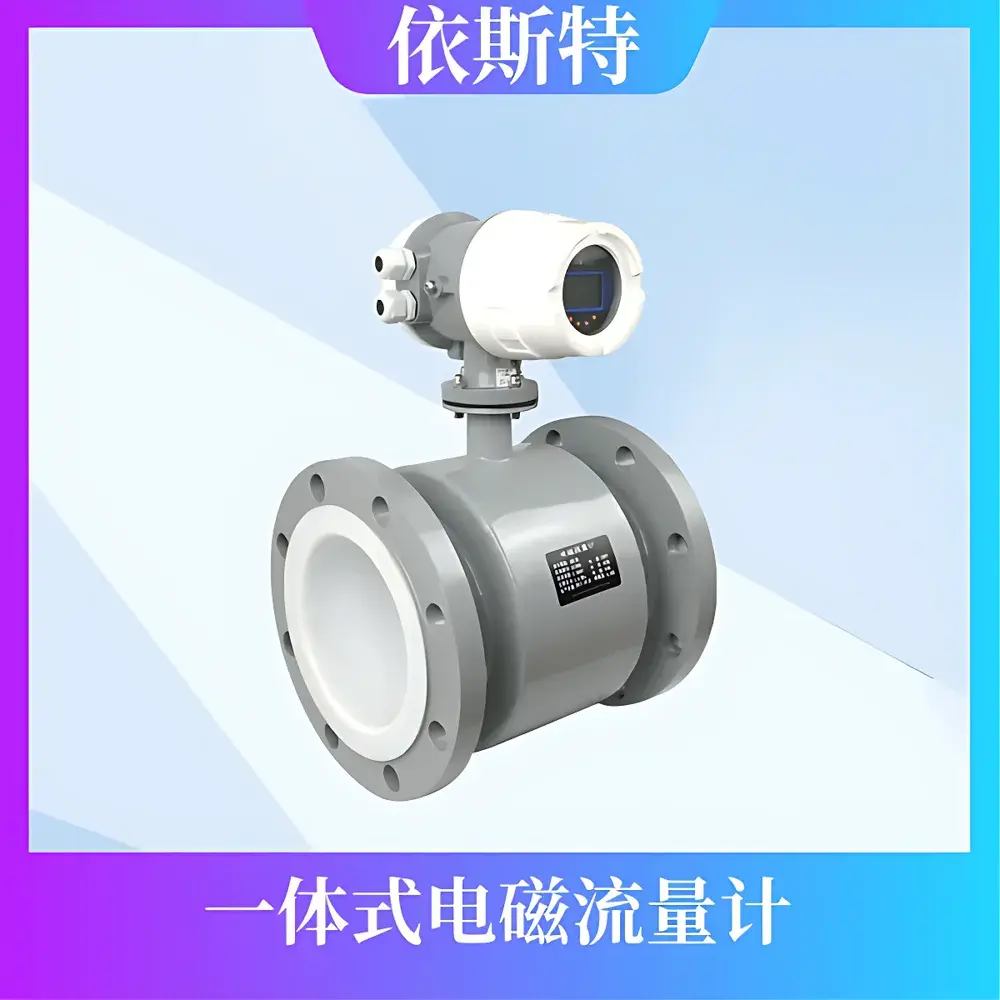
YST Electromagnetic Flowmeter YST183F-A50XL
| Brand | YST |
|---|---|
| Origin | Liaoning, China |
| Model | YST183F-A50XL |
| Nominal Pipe Size | DN50 (50–55 mm ID) |
| Flow Velocity Range | 0.1–10 m/s |
| Volumetric Flow Range (DN50 full pipe) | 0.000785–0.0785 m³/h |
| Accuracy | ±0.5% FS (standard conditions), ±1.0% FS (with suspended solids) |
| Conductivity Requirement | ≥5 μS/cm |
| Operating Temperature | −20°C to +150°C (medium), −25°C to +60°C (ambient) |
| Max Working Pressure | ≤1.6 MPa |
| Electrode Materials | 316L stainless steel (standard), Hastelloy C-276, titanium |
| Lining Materials | PTFE (acid/alkali/heat resistant), chloroprene rubber (abrasion resistant, for wastewater) |
| Output Signals | 4–20 mA DC analog, RS485 Modbus RTU |
| Power Supply | 220 V AC or 24 V DC |
| Enclosure Rating | IP65 (standard), IP68 (optional, submersible) |
| Relative Humidity | ≤95% RH (non-condensing) |
Overview
The YST Electromagnetic Flowmeter YST183F-A50XL is an insertion-type electromagnetic flow measurement device engineered specifically for agricultural irrigation infrastructure. It operates on Faraday’s law of electromagnetic induction: when a conductive liquid flows through a magnetic field generated by the sensor’s excitation coils, a voltage proportional to the average fluid velocity is induced across orthogonal electrodes. This principle enables contactless, obstruction-free volumetric flow measurement—ideal for low-pressure, open-channel-adjacent, or retrofit irrigation pipelines where minimal pressure loss and mechanical integrity are critical. Designed for permanent installation in DN50 nominal-diameter piping systems (with internal diameters ranging from 50 to 55 mm), the YST183F-A50XL delivers stable, drift-free measurements across a wide velocity range (0.1–10 m/s), supporting both intermittent and continuous irrigation scheduling. Its non-intrusive insertion architecture eliminates the need for pipe cutting or bypass loops, making it suitable for brownfield deployment in active irrigation networks without service interruption.
Key Features
- Insertion-mount design: Enables rapid field installation and maintenance without pipeline isolation or system shutdown—critical for operational continuity in seasonal irrigation cycles.
- Low-pressure-loss profile: Probe geometry optimized for central insertion into the pipe cross-section, minimizing flow disturbance and eliminating throttling effects common in orifice or turbine-based meters.
- Material-configurable wetted parts: Standard 316L stainless steel electrodes and PTFE lining provide broad compatibility with potable water, nutrient solutions, and mildly corrosive agrochemicals; optional Hastelloy C-276 electrodes and titanium variants extend service life in high-chloride or acidic fertilizer applications.
- Dual-output interface: Simultaneous 4–20 mA analog output for PLC/SCADA integration and RS485 serial communication (Modbus RTU protocol) for bidirectional data exchange with edge gateways or cloud telemetry platforms.
- Environmental resilience: IP65-rated electronics housing for outdoor mounting; IP68-rated probe variant available for submerged installation in manholes, sump chambers, or flood-prone lateral lines—fully compliant with IEC 60529 ingress protection standards.
Sample Compatibility & Compliance
The YST183F-A50XL is validated for use with electrically conductive liquids exhibiting minimum conductivity of 5 µS/cm—encompassing freshwater, reclaimed irrigation return flows, nitrogen-phosphorus-potassium (NPK) solutions, and diluted acid/base treatments commonly deployed in fertigation systems. It is not suitable for hydrocarbons, distilled water, or deionized solutions. The device complies with electromagnetic compatibility requirements per IEC 61326-1 (industrial environments) and meets basic safety criteria under IEC 61010-1 for measurement/control equipment. While not certified to ISO 4064 or OIML R49 for fiscal metering, its ±0.5% FS accuracy under laminar-to-turbulent transitional flow conditions aligns with ASTM D1941 (Standard Test Method for Flow Measurement in Open Channels Using Tracer Techniques) and supports GLP-aligned irrigation water accounting practices.
Software & Data Management
The flowmeter itself operates as a standalone transducer without embedded firmware-based configuration software. Configuration—including damping time, flow direction detection, zero calibration, and unit selection—is performed via local HART-compatible handheld communicators or Modbus register writes using standard industrial configuration tools (e.g., ModScan, QModMaster). All parameter changes are retained in non-volatile memory. For remote monitoring, the 4–20 mA output interfaces directly with programmable logic controllers (PLCs) or RTUs in irrigation control cabinets, while the RS485 port enables time-synchronized batch reporting (e.g., hourly flow totals, peak demand timestamps) to SCADA servers or IoT platforms such as ThingsBoard or Ignition. Audit trails for calibration events and configuration modifications are maintained externally within the host system, satisfying basic traceability requirements under USDA NRCS EQIP documentation guidelines.
Applications
- Real-time flow monitoring at mainline, submain, and lateral take-off points in surface and pressurized irrigation networks
- Fertigation dosing verification and nutrient delivery accountability in greenhouse and orchard drip systems
- Water balance auditing across multi-parcel farms participating in groundwater sustainability programs (e.g., SGMA, EU Water Framework Directive reporting)
- Leak detection via baseline deviation analysis in aging canal-to-pipe transfer infrastructure
- Integration with solar-powered telemetry nodes for off-grid operation in remote rural distribution zones
FAQ
Is this flowmeter suitable for measuring non-conductive fluids such as oil or pure water?
No. The YST183F-A50XL requires a minimum liquid conductivity of 5 µS/cm. It cannot measure hydrocarbons, distilled water, or glycol-based antifreeze solutions.
Can the probe be calibrated in situ without removing it from the pipe?
Yes. Zero calibration can be executed remotely via Modbus command or locally using the front-panel buttons when the pipe is full and static—no fluid isolation required.
What is the maximum allowable upstream/downstream straight pipe length for accurate measurement?
For insertion-type EMFs, no strict straight-run requirements apply. However, installation should avoid locations immediately downstream of elbows, valves, or tees; a minimum of 5D upstream and 2D downstream is recommended for optimal velocity profile symmetry.
Does the device support pulse output or totalizer functionality?
Yes. Cumulative volume totalization is implemented internally and accessible via Modbus register mapping (e.g., Holding Register 40001–40004); the 4–20 mA output can also be scaled to represent totalized flow over user-defined intervals.
Is explosion-proof certification available for use in hazardous agricultural storage areas?
Not natively. The standard YST183F-A50XL carries no ATEX, IECEx, or UL HazLoc certification. For classified zones, external intrinsic safety barriers must be applied to the 4–20 mA loop per IEC 60079-11.