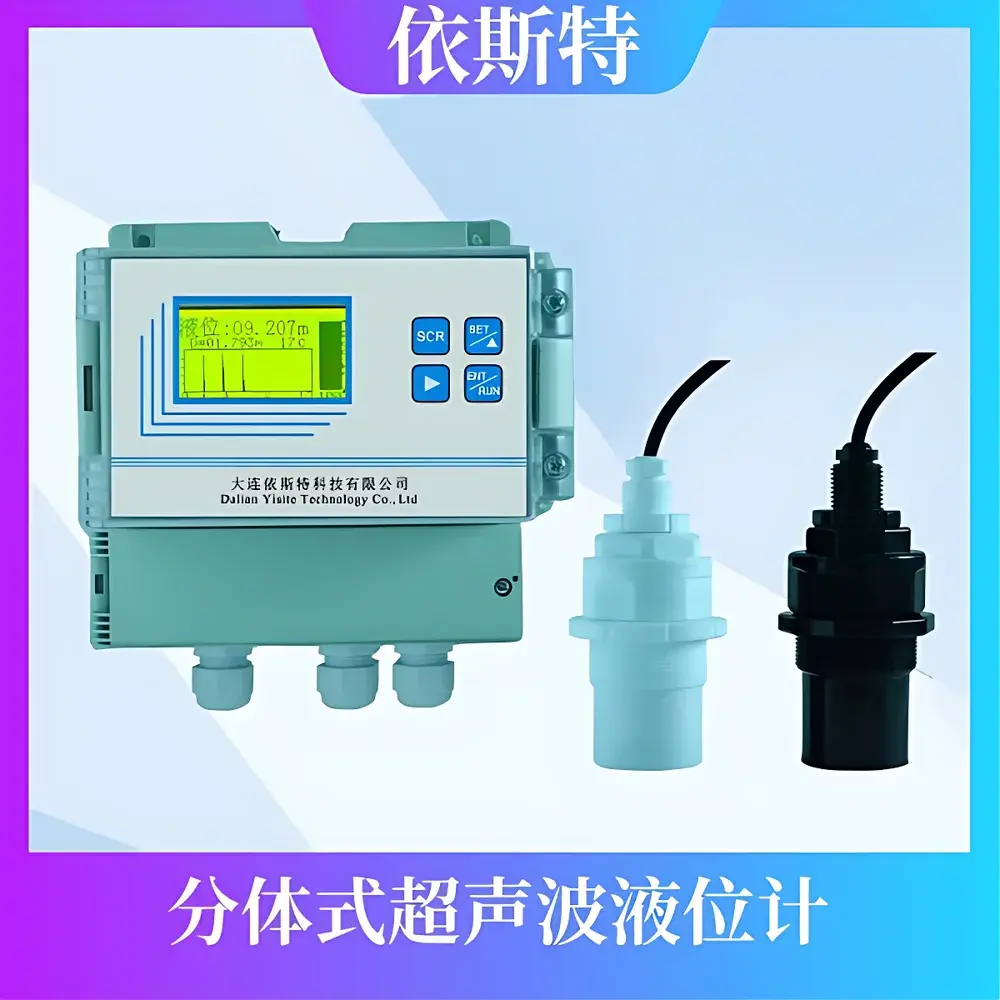
YST940F-1CY10 Split-Type Ultrasonic Level Transmitter for Agricultural Irrigation Channels (10 m Range)
| Brand | YST (Dalian Yist) |
|---|---|
| Origin | Liaoning, China |
| Model | YST940F-1CY10 |
| Measuring Range | 0–10 m |
| Output | 4–20 mA & RS485 |
| IP Rating | IP68 (Transducer) |
| Operating Temperature | −40 °C to +85 °C |
| Power Supply | DC 12–24 V |
| Transducer Material | Corrosion-Resistant Alloy |
| Principle | Non-Contact Ultrasonic Time-of-Flight Distance Measurement |
Overview
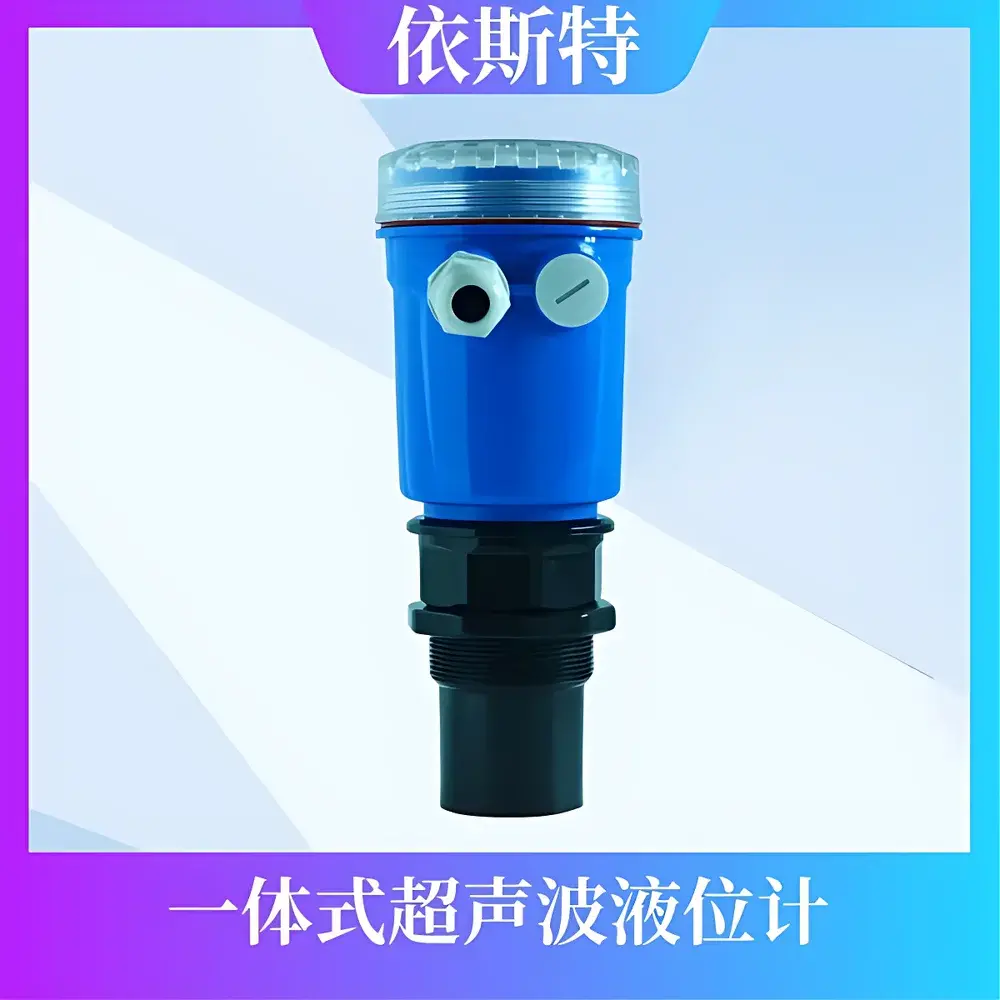
The YST940F-1CY10 is a purpose-engineered split-type ultrasonic level transmitter designed specifically for continuous, non-invasive liquid level monitoring in open-channel agricultural irrigation systems. Based on the time-of-flight (ToF) principle, it emits high-frequency ultrasonic pulses (typically 50 kHz) from a remotely mounted transducer positioned above the water surface; the elapsed time between pulse emission and echo return is precisely measured and converted into distance using calibrated sound velocity—compensated in real time by an integrated temperature sensor. This compensation is critical in field environments where ambient and water-surface temperature fluctuations, humidity, and surface foam or vapor can significantly affect acoustic propagation speed. The device delivers stable, repeatable measurements across dynamic flow conditions typical of earthen or concrete-lined irrigation channels—without requiring immersion, mechanical contact, or structural modification to the channel infrastructure.
Key Features
- Split-architecture design: Physically separates the ultrasonic transducer (IP68-rated, submersible-capable) from the electronics housing, enabling optimal placement—transducer mounted directly over the channel, electronics housed in dry, accessible locations such as control cabinets or sheltered enclosures.
- Environmental resilience: Transducer housing constructed from corrosion-resistant alloy with epoxy-sealed electronics; rated IP68 for prolonged exposure to moisture, dust, and intermittent submersion—validated under simulated irrigation field conditions including silt-laden spray and seasonal freeze-thaw cycles.
- Wide operational envelope: Functional across −40 °C to +85 °C ambient temperatures, supporting deployment in arid, temperate, and cold-climate irrigation zones—from Xinjiang’s continental deserts to Heilongjiang’s seasonal frost belts.
- Dual-output interface: Simultaneous 4–20 mA analog output (HART-compatible signal conditioning optional) and RS485 Modbus RTU digital communication—enabling direct integration with SCADA systems, PLCs, or cloud-based irrigation management platforms without protocol translation gateways.
- Onboard temperature compensation: Integrated Pt1000-grade thermal sensor continuously adjusts sound velocity calculation, minimizing measurement drift caused by diurnal air/water temperature gradients—a known source of error in uncorrected ultrasonic systems deployed in open channels.
Sample Compatibility & Compliance
The YST940F-1CY10 is validated for use with natural and engineered irrigation waters containing suspended solids, organic debris, and variable turbidity—common in furrow, ditch, and main-canal applications. It does not require stilling wells or stilling pipes, nor is it sensitive to minor surface ripples or low-velocity flow-induced turbulence. While not certified to IEC 61508 (SIL) or ATEX/IECEx standards, its construction and performance align with functional safety expectations for non-critical process monitoring per ISO 55000-based asset management frameworks. For regulatory traceability in government-funded irrigation modernization projects (e.g., China’s National Water Conservancy Modernization Plan), the device supports audit-ready configuration logging and firmware version reporting via Modbus register access—facilitating GLP-aligned data integrity practices in public-sector water resource management.
Software & Data Management
Configuration and diagnostics are performed locally via rotary encoder or remotely via Modbus RTU commands. All calibration parameters—including zero offset, span, damping factor, and temperature compensation coefficients—are stored in non-volatile memory with write-protection logic to prevent accidental overwrite. The 4–20 mA loop output is linearized against full-scale range (0–10 m), with configurable fail-safe modes (e.g., up-scale/down-scale current hold on signal loss). When integrated into larger telemetry networks, the device supports timestamped data packeting at user-defined intervals (1–300 seconds), compatible with MQTT brokers and LoRaWAN gateways via external protocol converters. Raw echo waveform data is not exposed—consistent with industry-standard embedded ultrasonic transmitters focused on metrological reliability rather than diagnostic waveform analysis.
Applications
- Real-time stage monitoring in primary, secondary, and tertiary irrigation canals for automated gate control and flow estimation (via Manning’s equation integration)
- Water balance accounting across multi-outlet distribution structures in command-area irrigation schemes
- Integration with soil moisture sensor networks to trigger demand-based irrigation scheduling algorithms
- Remote verification of manual gate operations in decentralized farmer-managed irrigation systems (FMIS)
- Long-term hydrological trend analysis in watershed-scale agricultural water productivity studies
FAQ
Does the YST940F-1CY10 require recalibration after installation?
No—factory calibration is retained across power cycles and environmental shifts due to onboard temperature compensation and EEPROM-stored coefficients. Field verification using a known reference level (e.g., staff gauge) is recommended during commissioning but not routine recalibration.
Can it operate reliably in highly turbid or algae-covered water surfaces?
Yes—ultrasonic ToF measurement is unaffected by water clarity, color, or suspended solids, as it relies solely on the air–water interface reflection. Surface scum or floating vegetation may attenuate signal strength but rarely causes complete failure if transducer mounting height remains within nominal beam angle tolerance.
Is the RS485 interface galvanically isolated?
Yes—the digital interface includes opto-isolated RS485 transceivers with transient voltage suppression (TVS), meeting IEC 61000-4-5 surge immunity requirements for outdoor industrial deployments.
What is the minimum measurable distance and dead zone?
The transducer has a 0.3 m blind zone; reliable measurement begins at ≥0.3 m below the transducer face. Total usable range remains 0.3–10.0 m under standard atmospheric conditions.
How is mounting alignment verified during installation?
The transducer includes a built-in bubble level and adjustable mounting bracket with ±5° pitch/yaw fine-tuning. Beam divergence is 6° (half-angle), allowing ±150 mm lateral tolerance at 10 m range without significant signal loss.