
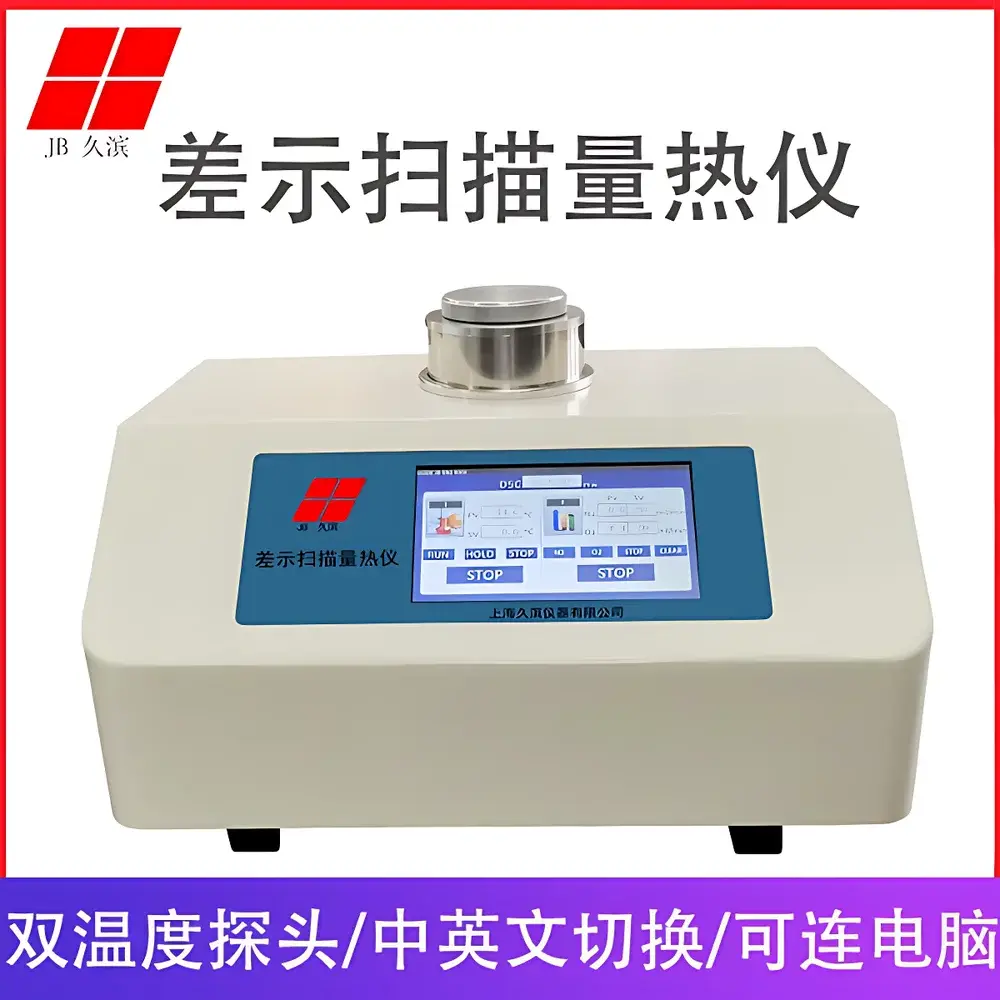
JB-DSC-800 Differential Scanning Calorimeter
| Brand | Jiubin Instruments |
|---|---|
| Origin | Shanghai, China |
| Model | JB-DSC-800 |
| Sample Capacity | Single |
| Instrument Type | DSC |
| Temperature Range | Ambient to 1050 °C |
| Temperature Accuracy | ±0.1 °C |
| Heating/Cooling Rate | 0.1–100 °C/min |
| DSC Sensitivity | 0.001 mW |
| DSC Resolution | 0.01 mW |
| Temperature Repeatability | ±0.1 °C |
| Temperature Stability | ±0.01 °C |
| Temperature Resolution | 0.01 °C |
| Atmosphere Control | Dual-gas (N₂/O₂) with digital mass flow meters (0–200 mL/min) |
| Power Supply | 220 V, 50 Hz |
| Operating Environment | 20–25 °C, 55–75% RH |
Overview
The JB-DSC-800 Differential Scanning Calorimeter is a high-stability, research-grade thermal analysis instrument engineered for precise quantification of heat flow differences between a sample and inert reference as a function of temperature or time. Based on the heat-flux DSC principle, it measures endothermic and exothermic transitions—including glass transitions (Tg), crystallization (Tc), melting (Tm), solid-solid phase changes, oxidative induction time (OIT), and reaction enthalpies—with traceable accuracy under controlled atmospheres. Designed for laboratories requiring compliance with international thermal analysis standards, the JB-DSC-800 supports method development and routine QC testing in polymer science, pharmaceutical formulation, metallurgy, and advanced materials R&D. Its operational envelope—spanning ambient to 1050 °C with programmable heating/cooling rates from 0.1 to 100 °C/min—enables characterization across a broad spectrum of thermally activated phenomena, including high-temperature ceramic sintering behavior and polymer degradation kinetics.
Key Features
- Ceramic furnace architecture with indirect conductive heating: ensures exceptional temperature uniformity, minimizes radiative thermal pulsation, and delivers superior baseline stability compared to resistive coil-based systems.
- Dual platinum resistance temperature detectors (RTDs): independently monitor sample and reference positions, enabling high repeatability in temperature measurement (±0.1 °C) and minimizing positional drift effects.
- Integrated digital mass flow controllers (MFCs): support fully automated, real-time switching between N₂ and O₂ atmospheres (0–200 mL/min range), with pressure tolerance up to 0.5 MPa and optional third-channel purge gas input for enhanced sample protection.
- 7-inch, 24-bit color TFT touchscreen interface: displays real-time parameters—including sample temperature, setpoint, DSC signal (μW), gas flow rates, and system status—without reliance on external PCs during operation.
- USB 2.0 communication protocol with auto-reconnect functionality: guarantees uninterrupted data acquisition and enables seamless integration into networked lab environments, even after transient host disconnections.
- Onboard calibration suite: includes certified Sn standard reference material and one-click calibration routines for both temperature and enthalpy, traceable to NIST-traceable standards and compliant with ISO 11357 and ASTM E794.
- Full bidirectional control: instrument operation can be initiated and monitored either via the embedded touch interface or through PC-based software—supporting Windows 2000 through Windows 10 and adaptive display scaling for laptops and desktop workstations.
Sample Compatibility & Compliance
The JB-DSC-800 accommodates standard aluminum, gold-plated aluminum, and high-temperature ceramic crucibles (e.g., alumina, platinum), supporting sample masses from 0.5 mg to 50 mg depending on thermal inertia requirements. It meets essential regulatory expectations for thermal analysis instrumentation used in GLP and GMP environments: raw data files include full audit trails (operator ID, timestamp, method name, calibration history), and software supports user-defined electronic signatures per FDA 21 CFR Part 11 when deployed with validated configurations. The system conforms to key thermal analysis standards including ISO 11357 (all parts), ASTM E793 (enthalpy), ASTM E1356 (Tg determination), and GB/T 19466 (Chinese national standard for polymer DSC testing). Oxidative Induction Time (OIT) measurements comply with GB/T 17391–1998 and GB/T 19466.3–2004 for polyolefin stability assessment.
Software & Data Management
The included thermal analysis software provides comprehensive data acquisition, visualization, and post-processing capabilities. It supports multi-step temperature programs (ramp-hold-ramp, isothermal, modulated DSC-like sequences), automatic peak detection with customizable baselines, and quantitative calculation of onset, peak, and offset temperatures; enthalpy (J/g); and transition widths. All gas flow values, temperature readings, and DSC signals are logged at ≥10 Hz resolution and stored in structured binary + CSV dual-format databases for long-term archival and third-party analysis interoperability. Software export modules generate PDF reports with embedded metadata (instrument ID, calibration date, operator, environmental conditions), suitable for internal documentation and external audit submission. Raw data integrity is preserved via write-once file handling and checksum verification upon save.
Applications
- Thermal characterization of thermoplastics and thermosets: determination of Tg, Tm, Tc, degree of crystallinity, and curing kinetics using isoconversional methods.
- Oxidative stability evaluation of polyolefins, lubricants, and bio-based polymers via OIT and Oxidative Onset Temperature (OOT) protocols.
- Pharmaceutical solid-state analysis: detection of polymorphic transitions, amorphous content quantification, and excipient–API compatibility screening.
- Metallurgical phase diagram validation: identification of eutectic points, solidus/liquidus temperatures, and latent heat of fusion in alloys and intermetallics.
- Quality control of battery electrode materials: assessment of SEI formation exotherms, cathode thermal runaway thresholds, and binder decomposition profiles.
- Research into nanocomposite thermal behavior: dispersion effects on polymer matrix transitions and filler-induced nucleation kinetics.
FAQ
What calibration standards are supplied with the JB-DSC-800?
Certified tin (Sn) reference material is included for temperature and enthalpy calibration; additional standards (In, Zn, Bi) are available as optional accessories.
Does the instrument support cooling below ambient temperature?
No—the JB-DSC-800 operates from ambient to 1050 °C and does not integrate mechanical or liquid nitrogen cooling; low-temperature capability requires external cryo-accessories not covered by standard configuration.
Can the software generate 21 CFR Part 11-compliant reports?
Yes—when installed on a validated Windows environment with configured user roles, electronic signatures, and audit trail logging enabled, the software meets core technical requirements for regulated submissions.
Is the furnace design compatible with corrosive or reactive atmospheres?
The ceramic furnace and stainless-steel gas manifold support inert (N₂, Ar) and oxidizing (O₂) atmospheres up to 0.5 MPa; halogenated or strongly reducing gases (e.g., H₂, NH₃) require custom sealing and are not recommended without prior consultation.
How is baseline stability maintained over extended runs?
Baseline stability (±0.01 °C drift over 30 min at 500 °C) is achieved via symmetrical thermal design, dual RTD feedback, and active furnace temperature compensation algorithms embedded in the PID controller firmware.



