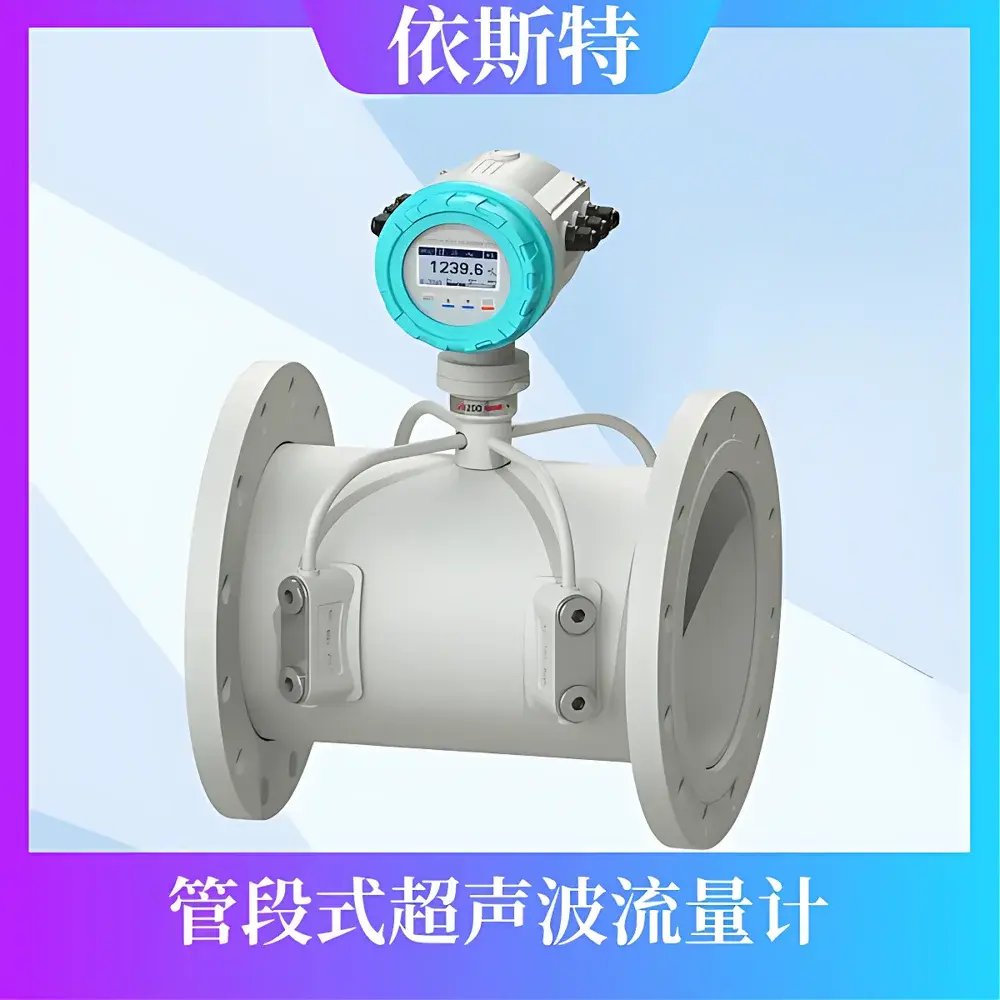
YST Ultrasonic Flow Meter for Municipal Water Supply – Model YST305D80BF223
| Brand | YST |
|---|---|
| Origin | Liaoning, China |
| Model | YST305D80BF223 |
| Measurement Principle | Transit-Time Ultrasonic Method |
| Accuracy | ±1% of reading |
| Repeatability | <0.5% |
| Flow Velocity Range | 0 to ±10 m/s |
| Volumetric Flow Range (Water) | 5–500 m³/h |
| Turndown Ratio | 1:200 |
| Pipe Diameter Compatibility | DN15–DN3000 |
| Acceptable Pipe Materials | Steel, stainless steel, cast iron, PVC (with or without lining) |
| Fluid Compatibility | Single-phase, acoustically conductive liquids (e.g., potable water, seawater) |
| Fluid Temperature Range | −30 °C to +160 °C |
| Fluid Turbidity Limit | ≤10,000 ppm |
| Air Bubble Tolerance | Low |
| Operating Ambient Temperature (Transmitter) | −20 °C to +60 °C |
| Humidity Limit | ≤85% RH |
| Sensor Immersion Rating | IP68, submersible up to 2 m depth |
| Output Signals | 4–20 mA (load ≤1 kΩ, accuracy 0.1%), OCT pulse output |
| Communication | RS485, Modbus RTU protocol |
| Power Supply | DC 8–36 V |
| Power Consumption | 1.5 W |
| Data Retention | Non-volatile memory with battery backup |
Overview
The YST Ultrasonic Flow Meter for Municipal Water Supply – Model YST305D80BF223 is a clamp-on, transit-time ultrasonic flow measurement system engineered specifically for continuous, non-intrusive volumetric flow monitoring in pressurized potable water distribution networks. Unlike intrusive mechanical or electromagnetic meters, this device operates on the principle of acoustic time-of-flight differential measurement: two ultrasonic transducers—mounted externally on opposite sides of the pipe—alternately transmit and receive high-frequency sound pulses across the flowing medium. The difference in upstream and downstream transit times is directly proportional to the average axial velocity of the fluid. Coupled with real-time cross-sectional area calculation (based on user-input pipe geometry and material), the instrument computes volumetric flow rate with traceable metrological integrity. Designed for long-term deployment in unattended outdoor environments—including valve chambers, pump stations, and buried meter pits—the YST305D80BF223 supports stable operation under variable hydraulic conditions, including low-flow regimes, intermittent flow, and transient pressure events common in aging municipal infrastructure.
Key Features
- Non-invasive, clamp-on installation using standard flanged pipe sections (compliant with GB/T 9119–2000); no pipeline shutdown, cutting, or welding required.
- High-precision transit-time ultrasonic measurement architecture with IEEE 754 32-bit floating-point computation engine for robust signal processing under noisy acoustic conditions.
- Wide dynamic range: turndown ratio of 1:200 ensures reliable measurement from low-flow leakage detection (as low as 5 m³/h) to high-capacity trunk main monitoring (up to 500 m³/h).
- Multi-material pipe compatibility: validated performance on carbon steel, stainless steel, ductile iron, and thermoplastic pipes—including lined and coated variants—without recalibration.
- Integrated environmental resilience: transmitter rated IP65; sensor housing IP68 with continuous submersion capability up to 2 meters depth and extended thermal tolerance (−30 °C to +160 °C).
- Low-power architecture (1.5 W typical) with non-volatile memory and internal backup power, preserving configuration and historical flow logs during grid outages.
Sample Compatibility & Compliance
The YST305D80BF223 is validated for use with single-phase, homogeneous aqueous fluids exhibiting sufficient acoustic impedance contrast and minimal suspended gas content—specifically potable water, reclaimed water, and low-salinity seawater (turbidity ≤10,000 ppm, negligible entrained air). It is not suitable for slurries, highly aerated liquids, or multi-phase flows. While not certified to ISO 4064 or OIML R49 for legal metrology applications, its measurement repeatability (<0.5%) and accuracy (±1% of reading) align with industry best practices for non-revenue water (NRW) management per AWWA M36 guidelines. The device supports audit-ready data logging and meets functional requirements for integration into SCADA and smart water platform architectures compliant with IEC 62443-3-3 cybersecurity frameworks.
Software & Data Management
The embedded firmware supports dual-mode operation: local configuration via integrated keypad and LCD, or remote commissioning via Modbus RTU over RS485. All operational parameters—including pipe ID, wall thickness, liner type, fluid sound speed, and zero-offset calibration—are stored in protected EEPROM with write-cycle logging. Historical flow data (hourly/daily averages, peak/minimum values, totalized volume) are retained for ≥18 months without external storage. The 4–20 mA analog output is configurable as linear or square-root scaled flow, while the OCT pulse output enables direct interfacing with legacy PLCs and mechanical totalizers. Data export is supported via ASCII serial dump or CSV file generation through optional USB-to-RS485 adapters—facilitating import into GIS-integrated asset management systems (e.g., ArcGIS Utility Network) and NRW analytics platforms.
Applications
- Zonal flow monitoring for district metered area (DMA) boundary validation and real-time leak detection.
- Performance verification of pumping stations and pressure-reducing valves.
- Post-construction commissioning and hydraulic model calibration of new trunk mains and branch networks.
- Temporary flow auditing during pipe rehabilitation or pressure management trials.
- Long-term trend analysis of seasonal demand patterns and consumption forecasting.
- Integration with AI-driven anomaly detection engines for early warning of pipe bursts or unauthorized abstractions.
FAQ
Is this flow meter suitable for custody transfer applications?
No. The YST305D80BF223 is intended for operational monitoring and non-revenue water management—not fiscal metering. It does not carry MID, ANSI C12, or OIML certification required for revenue-grade billing.
Can it be installed on pipes with internal linings or coatings?
Yes. The device accommodates common pipe linings (cement mortar, epoxy, polyurethane) when correct acoustic velocity and thickness parameters are entered during setup.
What is the minimum required straight-pipe length upstream/downstream?
For optimal accuracy, ≥10D upstream and ≥5D downstream are recommended. However, field validation shows acceptable performance down to 5D upstream in constrained vaults when using the built-in flow profile correction algorithm.
Does it support HART or wireless communication protocols?
No. Communication is limited to RS485 Modbus RTU and analog/pulse outputs. Wireless telemetry requires external gateway hardware.
How often does it require calibration verification?
Per AWWA M36 recommendations, field verification using portable ultrasonic reference meters is advised every 24 months—or following major hydraulic modifications to the monitored section.