
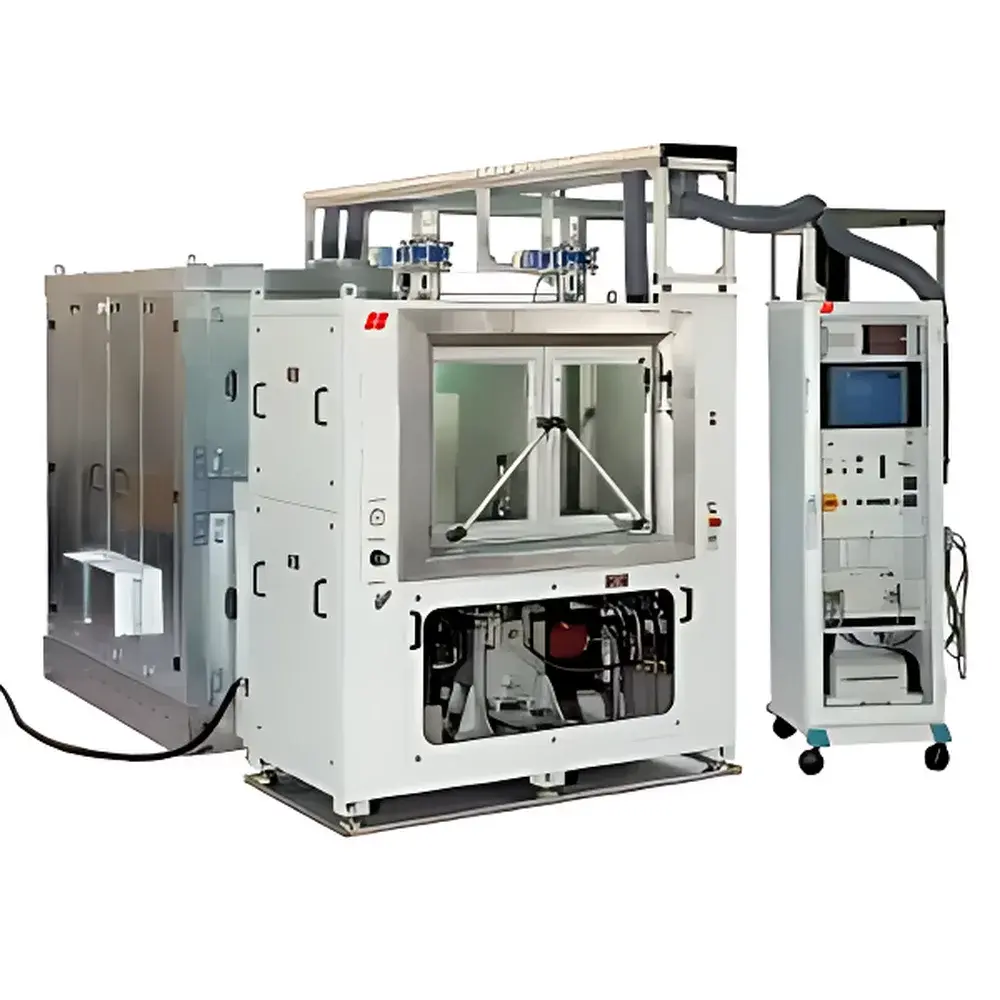
Jiubin JB-99 Multi-Function Pressure Pulse Test System
| Brand | Jiubin |
|---|---|
| Origin | Shanghai, China |
| Model | JB-99 |
| Pressure Range (Pulse) | 0–40 MPa |
| Burst Pressure Capacity | 0–500 MPa |
| Pulse Frequency | 0–5 Hz |
| Test Waveforms | Square, Trapezoidal, Triangular, Sine (customizable) |
| Fluid Temperature Range | −60 °C to +200 °C |
| Environmental Chamber Range | −70 °C to +155 °C |
| Cycle Life Capability | >2 million cycles |
| Test Media | Water, Hydraulic Oil, Ethylene Glycol Solutions, Compressed Air, Vacuum |
| Compliance | ISO 6802, ISO 6803, SAE J157, SAE J2044, BS EN ISO 6803, GB/T 5568, GB 7939, GB/T 12722, GB 16897, GB/T 5563, GB/T 10544, GB/T 15560 |
Overview
The Jiubin JB-99 Multi-Function Pressure Pulse Test System is an engineered platform for high-fidelity evaluation of pressure integrity, fatigue resistance, and thermal-mechanical reliability in fluid-conveying components. Designed around a modular architecture, it integrates hydraulic pulse generation, environmental conditioning, and synchronized data acquisition to replicate real-world service conditions—including cyclic loading, thermal transients, and combined mechanical stress states. The system operates on the principle of controlled pressure waveform generation via servo-controlled hydraulic actuators or pneumatic intensifiers, enabling precise reproduction of industry-standard pulse profiles (e.g., square, trapezoidal, sinusoidal) across defined frequency and amplitude envelopes. Its core function is to subject test specimens—such as heat exchangers, hydraulic hose assemblies, automotive brake lines, and coolant manifolds—to accelerated life testing under rigorously defined boundary conditions, supporting both R&D validation and production QA/QC workflows.
Key Features
- Modular subsystem integration: independent yet interoperable pressure pulse, environmental chamber, and optional vibration modules—configurable per test protocol requirements.
- Dual-mode pressure control: hydraulic circuit supports liquid media (water, oil, glycol mixtures) with pulse range up to 40 MPa; gas circuit enables positive/negative pressure cycling using compressed air or vacuum sources, extendable to 500 MPa burst capacity via high-pressure intensification.
- Precision waveform synthesis: programmable pulse generator delivers repeatable waveforms (square, trapezoidal, triangular, sine) with adjustable rise/fall times, dwell periods, and frequency (0–5 Hz), traceable to ISO/SAE waveform definitions.
- Thermal management system: dual-zone temperature control—fluid path regulated from −60 °C to +200 °C; ambient chamber independently controlled from −70 °C to +155 °C—enabling coupled thermal-pressure cycling per ASTM D395 or ISO 13477 protocols.
- Robust mechanical enclosure: stainless steel interior chamber with powder-coated structural frame; integrated pressure relief valves, rupture discs, and real-time overpressure cutoff logic compliant with PED 2014/68/EU safety directives.
- Centralized HMI and PC-based control: industrial-grade PLC with touchscreen interface; Windows-based test software provides real-time pressure waveform visualization, cycle counting, fault logging, and automated report generation (PDF/CSV) with audit-trail capability.
Sample Compatibility & Compliance
The JB-99 accommodates a broad spectrum of pressure-rated components, including but not limited to: metal-braided hydraulic hoses, rubber/plastic cooling ducts, aluminum or stainless steel heat exchanger cores, EV battery coolant manifolds, and automotive HVAC evaporator assemblies. Fixture adaptability supports custom mounting interfaces, multi-specimen parallel testing, and variable port configurations (NPT, JIC, ORFS, ISO 8434). All operational modes align with internationally recognized standards for pressure endurance and fatigue assessment—including ISO 6802 (metal-reinforced hose), ISO 6803 (hydraulic pulse without flexing), SAE J2044 (automotive hydraulic hose fatigue), GB/T 12722 (hydraulic pulse flex testing), and GB 16897 (brake hose qualification). System calibration procedures follow ISO/IEC 17025 principles, with documented traceability to national metrology institutes.
Software & Data Management
The embedded test management software supports full lifecycle test execution: parameter definition, sequence programming, real-time monitoring, pass/fail evaluation against user-defined thresholds (e.g., leakage rate ≤ 0.5 mL/min, pressure decay < 0.1% per 1000 cycles), and post-test statistical analysis. Data acquisition records pressure vs. time waveforms at ≥1 kHz sampling resolution, synchronized with temperature, cycle count, and alarm events. Export formats include CSV (for MATLAB/Python analysis), PDF test certificates (with digital signature support), and XML for LIMS integration. Audit trail functionality complies with FDA 21 CFR Part 11 requirements, ensuring electronic record integrity through user authentication, action logging, and immutable timestamping. Software updates are delivered via secure HTTPS channel with SHA-256 verification.
Applications
This system serves critical validation functions across multiple engineering domains: automotive Tier-1 suppliers use it for DOE-driven durability mapping of coolant circuits under thermal shock; aerospace manufacturers qualify fuel line assemblies per MIL-DTL-87939; medical device firms verify integrity of IV tubing manifolds under pulsatile flow; and energy sector clients assess subsea hydraulic control lines per API RP 17E. It further supports failure mode analysis (FMA) by correlating microstructural degradation (observed via post-test SEM/EDS) with cumulative cycle history, enabling predictive maintenance modeling and Weibull-based reliability estimation.
FAQ
What pressure media are supported?
Water, mineral-based hydraulic oils, ethylene glycol/water mixtures, compressed air, and vacuum—all configurable via dedicated fluid/gas manifolds with material-compatible wetted parts (316L SS, FKM, PTFE).
Can the system perform combined environmental and pressure cycling?
Yes—simultaneous control of fluid temperature (−60 °C to +200 °C) and chamber ambient (−70 °C to +155 °C) enables ISO 13477-compliant thermal-pressure coupling protocols.
Is the software compliant with regulatory data integrity requirements?
Yes—the system implements 21 CFR Part 11-compliant audit trails, electronic signatures, and role-based access control, validated per GAMP 5 guidelines.
What is the maximum test duration per run?
Unlimited runtime—tested continuously for >30 days at 3 Hz pulse frequency with full data logging and thermal stability maintained within ±0.5 °C.
How is calibration maintained across extended operation?
Onboard reference transducers (0.1% FS accuracy) auto-zero before each test; annual third-party calibration includes pressure, temperature, and timing channel verification per ISO/IEC 17025.
Related Products



