
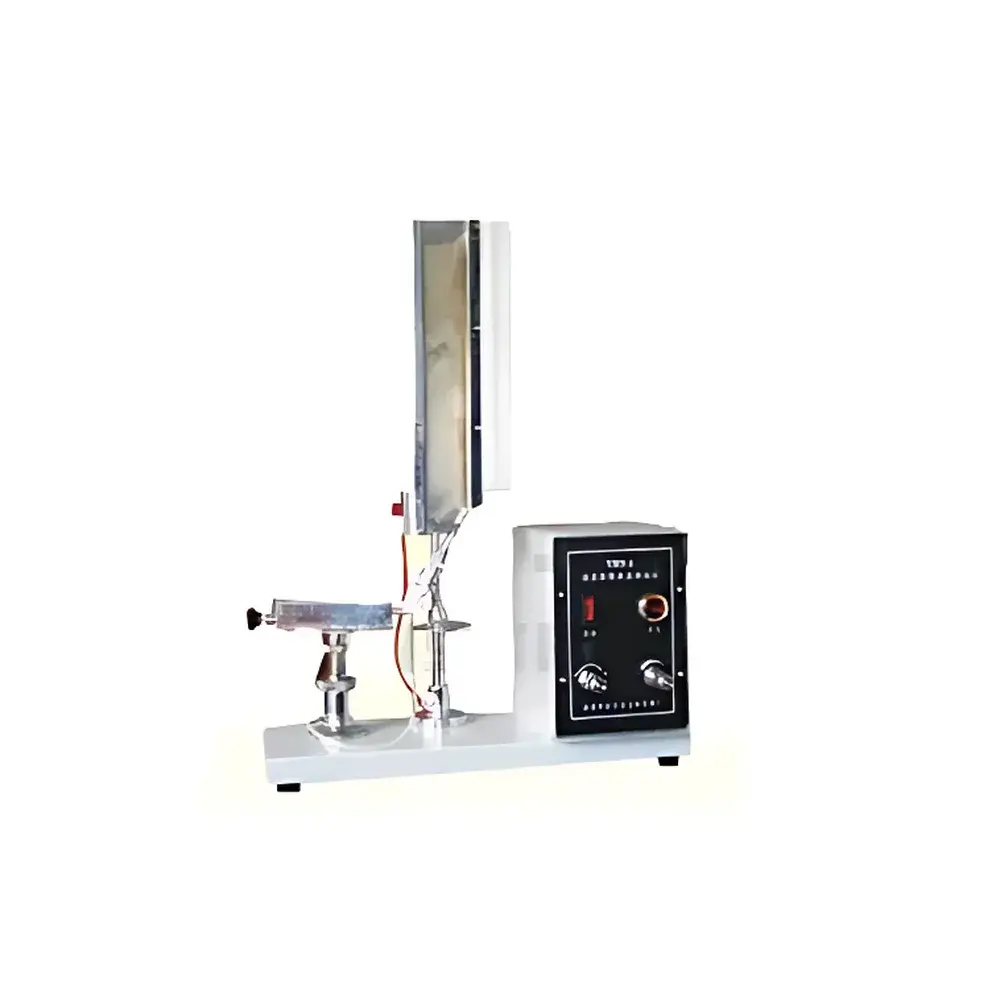
JB-319B Vertical Burning Tester for Rigid Foam Plastics
| Brand | Jiubin Instruments |
|---|---|
| Model | JB-319B |
| Origin | Shanghai, China |
| Applicable Standard | GB/T 8333–2008 |
| Burner Inner Diameter | Φ9.5 ± 0.5 mm |
| Burner Length | 102 mm |
| Adjustable Flame Height | 20–175 mm |
| Maximum Flame Temperature | 1100 °C (Bunsen burner flame at 960 °C ± 20 °C) |
| Timing Range | 0–99 min 99 sec (flame application & afterflame duration) |
| Gas Supply | Liquefied Petroleum Gas (LPG) or Town Gas |
| Air Adjustment Port | Integrated |
| Compliance | GB/T 8333–2008 (equivalent to ISO 5657:1997 for vertical flame propagation on rigid cellular plastics) |
| Warranty | 12-month parts and labor coverage |
Overview
The JB-319B Vertical Burning Tester is a precision-engineered apparatus designed to evaluate the flame propagation behavior of rigid cellular plastic materials under controlled vertical orientation conditions. It operates in strict accordance with GB/T 8333–2008, the Chinese national standard for determining the vertical burning characteristics of rigid foam plastics — a specification technically aligned with ISO 5657:1997. The instrument employs a calibrated Bunsen-type burner with defined geometry (inner diameter 9.5 ± 0.5 mm, length 102 mm) and integrated air adjustment capability to ensure reproducible flame stoichiometry. Combustion performance is assessed by measuring key fire-response parameters including ignition time, flame spread distance, afterflame duration, and whether self-extinguishment occurs within specified time limits following flame removal. This test method provides critical comparative data for material classification in low-risk applications such as interior insulation, packaging, and non-structural components where limited flame spread is mandated.
Key Features
- Precision-machined brass Bunsen burner with traceable dimensional tolerances (Φ9.5 ± 0.5 mm inner diameter, 102 mm length) and adjustable primary air intake for consistent flame morphology
- Digitally programmable timing system with independent dual-channel control: flame application duration and post-removal afterflame observation window both adjustable from 0 to 99 minutes 99 seconds in 1-second increments
- Flame height continuously adjustable between 20 mm and 175 mm using calibrated micrometer-scale positioning; verified against thermocouple-measured peak temperature profile (960 °C ± 20 °C at reference point)
- Gas supply compatibility with standardized liquefied petroleum gas (LPG) or town gas per GB/T 13611; includes pressure regulator interface and leak-tested delivery tubing
- Stainless steel test chamber with observation window, specimen holder fixture conforming to GB/T 8333 specimen dimensions (250 mm × 90 mm × actual thickness), and drip pan for molten residue collection
- Compliance-ready design: all mechanical and operational parameters align with audit requirements for GLP-regulated laboratories performing fire safety qualification testing
Sample Compatibility & Compliance
The JB-319B is validated exclusively for rigid polyurethane (PUR), phenolic (PF), and polystyrene (PS) foam specimens meeting the dimensional and density specifications outlined in GB/T 8333–2008. Specimens must be conditioned at 23 °C ± 2 °C and 50% ± 5% RH for minimum 48 hours prior to testing. The apparatus does not support flexible foams, elastomeric materials, or composite laminates. Regulatory alignment includes full technical equivalence to ISO 5657:1997 Annex A (vertical flame propagation on rigid cellular plastics). While not certified to UL 94 V-0/V-1/V-2 or ASTM D3014, its methodology serves as a foundational screening tool for internal material development and pre-compliance assessment prior to formal third-party certification.
Software & Data Management
The JB-319B operates via embedded microcontroller-based logic with no proprietary software dependency. All timing functions, status indicators (flame-on, flame-off, extinguishment detection), and manual override controls are implemented in hardware with LED feedback. Test records—including specimen ID, conditioning history, flame height setting, applied duration, observed afterflame time, and pass/fail determination per GB/T 8333 criteria—are documented manually in laboratory notebooks or exported to LIMS-compatible CSV templates provided in the included English-language operation guide. Audit trails meet basic GLP documentation requirements; optional integration with external data acquisition systems (e.g., USB-connected timers or thermal imaging loggers) is supported via standard 0–5 V analog output ports.
Applications
- Quality control release testing of rigid foam insulation boards in building materials manufacturing
- Comparative flammability screening during polymer formulation development (e.g., halogen-free flame retardant efficacy evaluation)
- Supplier qualification for automotive interior trim components requiring limited vertical flame spread
- Educational laboratory instruction on fire physics fundamentals and standardized combustion test methodology
- Pre-submission verification for regulatory dossiers targeting CCC (China Compulsory Certification) or CE marking under Construction Products Regulation (CPR) Annex ZA
FAQ
What gas types are compatible with the JB-319B burner system?
Liquefied petroleum gas (LPG) and town gas (natural gas substitute) are supported per GB/T 13611 specifications. Propane-only or butane-only configurations require recalibration of air-to-fuel ratio and are not covered under standard validation.
Is the JB-319B compliant with international standards beyond GB/T 8333?
Its physical configuration and test protocol are technically equivalent to ISO 5657:1997, Clause A. It is not configured for ASTM D3014, UL 94, or EN ISO 11925-2 vertical ignition testing due to divergent specimen geometry and burner positioning requirements.
Can the instrument be used for flexible foam materials?
No. GB/T 8333 explicitly restricts applicability to rigid cellular plastics with compressive strength ≥ 0.1 MPa. Flexible foams exhibit uncontrolled deformation under vertical orientation and invalidate flame spread measurement validity.
Does the unit include calibration certification?
The JB-319B ships with a factory verification report confirming burner dimensions, timing accuracy (±0.5 sec over 60-min interval), and flame height repeatability (±1 mm at 50 mm setpoint). NIST-traceable calibration certificates are available as a separate service.
What maintenance intervals are recommended?
Burner tip inspection and cleaning every 50 test cycles; pressure regulator servicing annually; full functional verification against GB/T 8333 Annex B every 12 months or after any component replacement affecting flame geometry or timing fidelity.



