
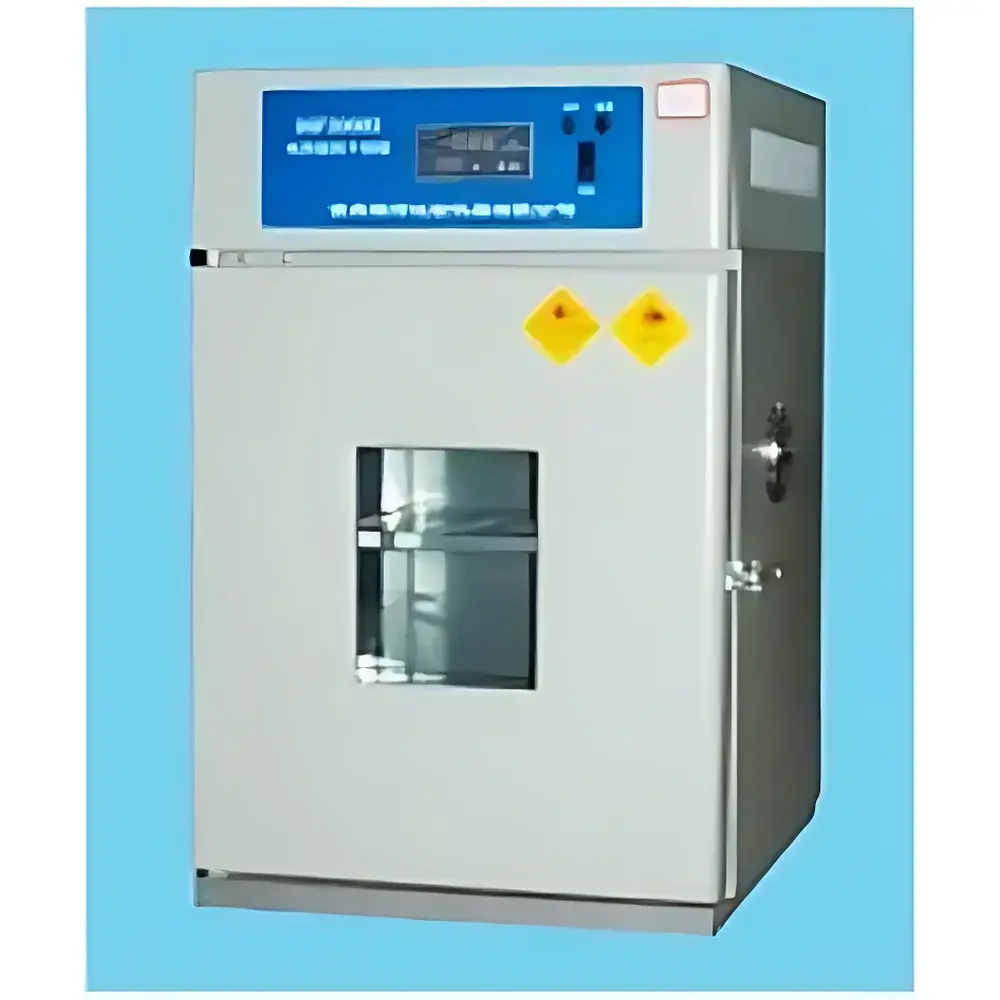
JB-2301 High-Temperature Aging Test Chamber by Jiubin Instruments
| Brand | Jiubin Instruments |
|---|---|
| Origin | Shanghai, China |
| Model | JB-2301 |
| Temperature Range | RT to 300 °C |
| Interior Dimensions (W×D×H) | 600 mm × 500 mm × 750 mm |
| Temperature Uniformity | ±2 °C (loaded) / ≤3 °C (unloaded) |
| Temperature Stability | ±0.5 °C |
| Heating Rate | ≥3 °C/min (non-linear) |
| Control Resolution | 0.1 °C |
| Timer Range | 000:01–999:99 h:min |
| Drive Motor | 1/4 HP |
| Safety Protections | Overtemperature, Overload, Leakage Current |
| Alarm | Audible Buzzer |
| Heating Power | 3.2 kW |
Overview
The JB-2301 High-Temperature Aging Test Chamber is an engineered environmental test system designed for accelerated thermal aging evaluation of polymeric materials—including elastomers, thermoplastics, rubber compounds, and cable insulation—under controlled, uniform elevated temperature conditions. Based on the principle of Arrhenius kinetics, the chamber enables laboratory simulation of long-term ambient exposure by applying elevated temperatures to accelerate oxidative degradation processes. At a stabilized test temperature of 70 °C, the JB-2301 facilitates time-compressed assessment equivalent to approximately six months of outdoor atmospheric aging—providing QC laboratories, R&D departments, and material certification bodies with a reproducible, standardized method for evaluating thermal stability, embrittlement onset, tensile retention loss, and surface cracking propensity. The unit employs forced-air convection via a rear-mounted centrifugal blower and optimized ducted airflow routing to ensure homogeneous thermal distribution across the working volume. A motor-driven rotating turntable (1/4 HP, continuous-duty) ensures uniform thermal exposure of all sample surfaces during extended test cycles—eliminating positional bias and enhancing inter-sample comparability.
Key Features
- Forced-air thermal convection system with adjustable air velocity and directional flow optimization for ±2 °C temperature uniformity (loaded) and ≤3 °C (unloaded)
- Microprocessor-based PID temperature controller with 0.1 °C setpoint resolution and real-time deviation monitoring
- Robust stainless-steel interior chamber (600 × 500 × 750 mm W×D×H) with reinforced double-wall construction and high-density mineral wool insulation
- Integrated rotating sample platform driven by a maintenance-free 1/4 HP induction motor—programmable rotation speed (0–6 rpm) optional via firmware upgrade
- Tempered glass observation window with dual-layer sealing and anti-fog coating for non-intrusive visual inspection without thermal interruption
- Comprehensive safety architecture: independent overtemperature cut-off (mechanical backup), earth leakage protection (30 mA sensitivity), motor overload relay, and automatic power disconnect on fault detection
- Front-panel digital timer (000:01–999:99 h:min) with auto-termination and audible alarm (85 dB @ 1 m)
Sample Compatibility & Compliance
The JB-2301 accommodates standard ASTM D573, ISO 188, and GB/T 3512 test specimens—including dumbbell-shaped tensile strips (Type 1 or 2), O-rings, compression set plugs, and insulated wire segments—mounted on perforated stainless-steel trays or suspended via non-reactive hooks. Its operational envelope (RT to 300 °C) supports both low-temperature pre-conditioning and high-temperature degradation studies per UL 1581 Section 1000, IEC 60811-2-1, and MIL-STD-202 Method 108. The chamber’s thermal performance complies with ASTM E2209 requirements for uniformity verification in aging ovens. All electrical components meet CE marking directives (2014/35/EU Low Voltage Directive and 2014/30/EU EMC Directive). Optional calibration certificates traceable to NIM (National Institute of Metrology, China) are available upon request for GLP/GMP-regulated environments.
Software & Data Management
While the JB-2301 operates as a standalone instrument with front-panel control, it features RS-485 Modbus RTU communication capability (optional interface module) for integration into centralized lab monitoring systems. When connected, users can log real-time chamber temperature, setpoint, elapsed time, and alarm status at user-defined intervals (1–60 s) using third-party SCADA or LIMS platforms. Data export is supported in CSV format. For audit-trail compliance in regulated settings, optional firmware enables event logging—including operator ID (via keypad entry), parameter changes, door openings, and safety-triggered shutdowns—in alignment with FDA 21 CFR Part 11 requirements when paired with validated electronic signature protocols.
Applications
- Accelerated aging of automotive rubber seals, brake hoses, and under-hood plastic components per SAE J2236
- Thermal endurance testing of PVC, XLPE, and EPR insulation in power cables (IEC 60502-2)
- Stability screening of adhesives, sealants, and potting compounds prior to qualification
- Pre-qualification aging for medical device polymer housings (ISO 10993-12)
- Quality conformance verification of recycled polymer batches against virgin material baselines
- Supporting failure analysis investigations where thermal history is suspected as a root cause
FAQ
What standards does the JB-2301 support for thermal aging validation?
It is configured to execute test protocols aligned with ASTM D573, ISO 188, GB/T 3512, and IEC 60811-2-1—with optional verification reports meeting ASTM E2209 uniformity criteria.
Can the rotation speed of the turntable be adjusted?
Standard configuration operates at fixed rotational speed; variable-speed control (0–6 rpm) is available via optional firmware and drive module upgrade.
Is external data logging possible without purchasing additional hardware?
No—the RS-485 interface and Modbus-enabled data acquisition module must be ordered separately for serial communication and remote logging.
Does the chamber include NIST-traceable calibration documentation?
Factory calibration is performed using NIM-traceable references; full ISO/IEC 17025-certified calibration reports are available as a value-added service.
What is the maximum safe operating duration for unattended operation?
The unit supports continuous operation up to 999 hours and 59 minutes; however, periodic visual inspection and preventive maintenance (e.g., filter cleaning, door gasket integrity check) are recommended every 200 operational hours.



