
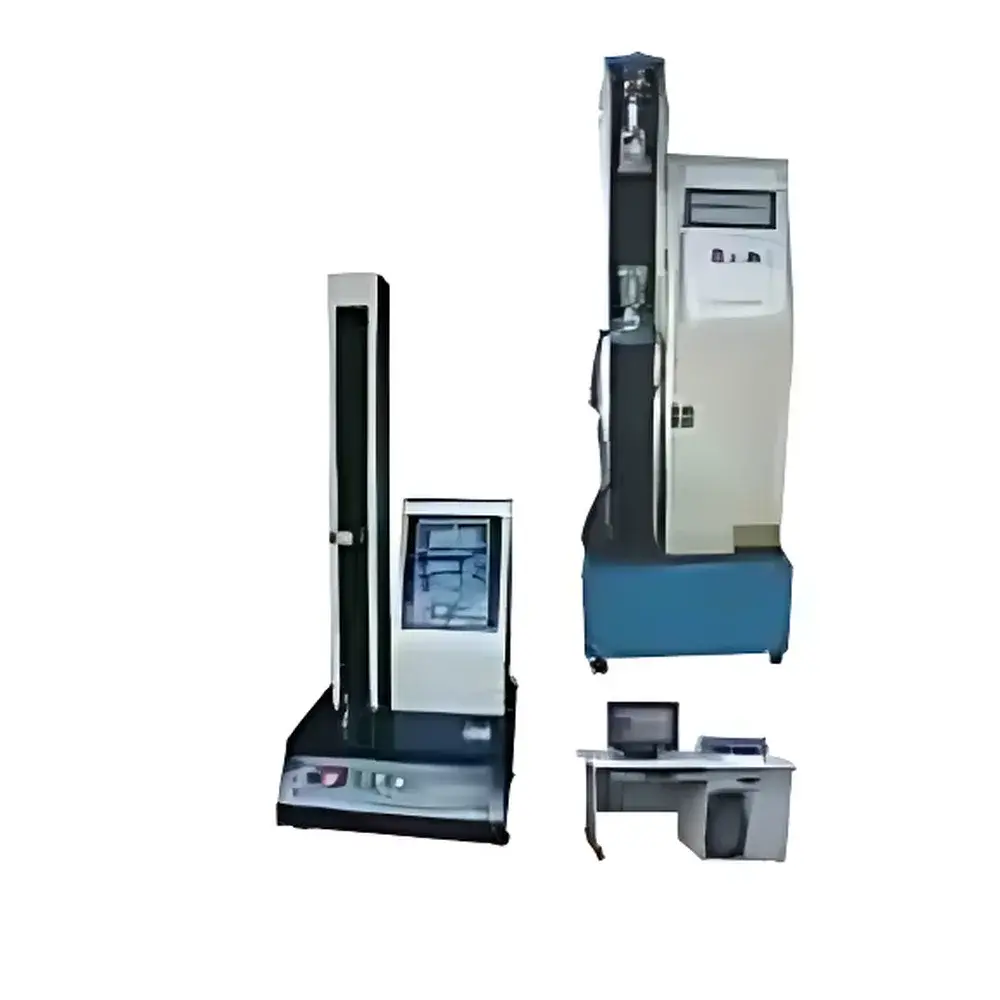
JB-125 Universal Tensile Testing Machine by Jiubin Instruments
| Brand | Jiubin Instruments |
|---|---|
| Origin | Taiwan |
| Model | JB-125 |
| Load Capacity | 0–200 kg (user-selectable) |
| Load Cell Accuracy | ≤0.5% FS |
| Effective Test Width | 380 mm |
| Max Stroke | 900 mm |
| Test Speed Range | 0.001–500 mm/min (infinitely variable) |
| Displacement Resolution | 1/200,000 |
| Displacement Accuracy | ±0.005% of reading |
| Drive System | Servo motor (Japan) + AC motor (Taiwan) |
| Mechanical Transmission | Precision ball screw (Taiwan) + High-strength backlash-free screw (Korea) |
| Safety Features | Upper/lower mechanical limits, emergency stop button |
| Display | Dual-mode — PC-based software interface + embedded microcomputer display |
| Power Supply | 220 V, 50 Hz |
| Net Weight | 180 kg |
| Dimensions (W×D×H) | 450 × 450 × 1200 mm |
| Unit Options | g, kg, N, kN, lb, lbf |
Overview
The JB-125 Universal Tensile Testing Machine is an electromechanical materials testing system engineered for precision mechanical property characterization of elastomeric, polymeric, and composite materials—including natural and synthetic rubber, artificial leather, textiles, footwear components, wire & cable insulation, metallic terminals, and flexible packaging substrates. Based on quasi-static uniaxial loading principles per ASTM D412, ISO 37, ISO 179, and GB/T 528 standards, the system applies controlled tensile, compression, peel, tear, flexural, and shear forces to specimens while continuously recording load-displacement data. Its dual-drive architecture—integrating a high-response servo motor for dynamic protocol execution and a robust AC motor for sustained low-speed stability—ensures consistent force application across the full speed range (0.001–500 mm/min), enabling both slow-strain-rate compliance evaluation and rapid failure mode analysis.
Key Features
- High-fidelity load measurement using a U.S.-sourced precision load cell with ≤0.5% full-scale accuracy and 1/200,000 internal resolution, traceable to NIST-equivalent calibration protocols.
- Bi-directional mechanical limit switches and a certified emergency stop circuit compliant with IEC 60204-1 safety standards, ensuring operator protection during over-travel or overload events.
- Dual-position displacement sensing architecture combining encoder-based position feedback and high-resolution strain amplification, achieving ±0.005% displacement linearity over the 900 mm effective stroke.
- Modular mechanical train featuring Taiwanese-sourced ground ball screws and Korean-sourced preloaded backlash-free lead screws, delivering repeatable positioning and minimal hysteresis in cyclic loading applications.
- Configurable test platform supporting interchangeable fixtures—including pneumatic wedge grips, roller clamps, peel jigs, and three-point bending assemblies—enabling standardized and custom test method implementation.
- Integrated dual-display operation: real-time microcomputer panel for standalone setup and monitoring, plus full-featured PC-based control software for advanced test sequencing and post-processing.
Sample Compatibility & Compliance
The JB-125 accommodates flat, tubular, and irregular cross-section specimens up to 380 mm wide and 25 mm thick, with standard grip jaw openings adjustable from 0–35 mm. It supports specimen geometries defined in ASTM D638 (tensile bars), ASTM D1876 (T-peel), ASTM D882 (thin films), ISO 2285 (rubber strips), and QB/T 2715 (synthetic leather). All firmware and hardware design elements conform to CE Machinery Directive 2006/42/EC requirements. Data acquisition and reporting modules are structured to support GLP-compliant documentation practices, including user-accessible audit trails, electronic signature fields, and timestamped raw data export in CSV and XML formats—facilitating alignment with FDA 21 CFR Part 11 readiness when deployed in regulated quality assurance environments.
Software & Data Management
The proprietary Windows-based testing software provides ISO 17025-aligned test method templates for tensile strength, elongation at break, modulus (100%, 200%, 300%), tear resistance (Trouser, Graves), peel adhesion, and compressive yield. Real-time curve overlay allows comparative analysis of up to 16 concurrent tests; statistical summaries include mean, SD, CV%, and Weibull distribution fitting. Raw data files retain native resolution without interpolation, and all test parameters—including speed ramp profiles, dwell durations, and trigger thresholds—are fully editable and version-controlled. Export options include PDF reports with embedded metadata (operator ID, calibration date, environmental conditions), Excel-compatible datasets, and image-captured stress–strain curves with customizable axis scaling and annotation layers.
Applications
- Rubber compound development: quantifying cure-state-dependent modulus transitions and permanent set behavior under cyclic extension.
- Synthetic leather QC: evaluating surface coating adhesion via 90° and 180° peel tests, and substrate tensile integrity after aging or humidity exposure.
- Footwear component validation: measuring outsole flex fatigue, upper material burst resistance, and heel counter stiffness.
- Automotive interior trim: assessing seam strength in stitched vinyl composites and compression recovery of foam-laminated substrates.
- Medical device tubing: determining burst pressure, radial compliance, and kink resistance per ISO 8536-4 protocols.
- Electrical insulation verification: validating tensile retention of cross-linked polyethylene (XLPE) and ethylene propylene diene monomer (EPDM) after thermal aging.
FAQ
What calibration standards does the JB-125 support?
The system accepts third-party calibration certificates traceable to national metrology institutes (e.g., NML, NIST, PTB) and includes built-in zero-balance and span-check routines for daily verification.
Can the JB-125 perform multi-step programmed tests?
Yes—the software supports up to 10 programmable segments per test sequence, including ramp-hold-relax cycles, strain-controlled creep tests, and load-controlled stress relaxation protocols.
Is the test software compatible with LIMS integration?
Raw data exports comply with ASTM E1382 and ISO/IEC 17025 Annex A3 requirements, enabling direct ingestion into common LIMS platforms via configurable ODBC drivers and RESTful API endpoints.
What is the recommended maintenance interval for mechanical components?
Ball screw lubrication and drive belt tension verification are advised every 500 operational hours; annual recalibration of the load cell and displacement encoder is recommended for GMP-aligned operations.
Does the JB-125 meet ISO 5893 mechanical testing equipment requirements?
Yes—the frame stiffness (≥150 kN/mm), alignment tolerance (<0.02 mm/m), and transverse deflection performance satisfy ISO 5893 Class II specifications for universal testing machines.



