
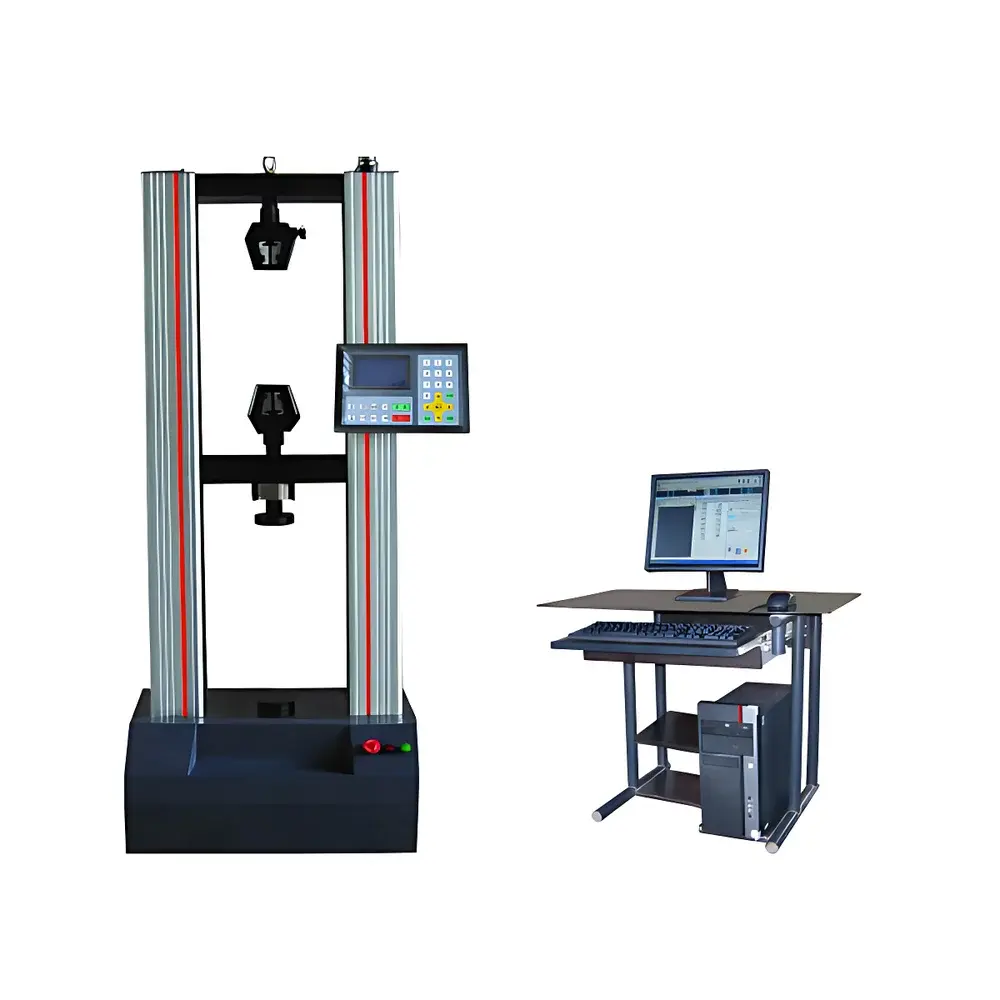
Jiubin Instruments JB-120A Electromechanical Universal Testing Machine
| Brand | Jiubin Instruments |
|---|---|
| Origin | Shanghai, China |
| Model | JB-120A |
| Maximum Test Load | 100 kN |
| Accuracy Class | 0.5 |
| Load Resolution | 0.001 N |
| Load Accuracy | ±0.05% |
| Speed Range | 0.001–500 mm/min |
| Effective Stroke | ~1000 mm |
| Displacement Encoder Resolution | 1000 P/R (±0.005%) |
| Control System | Full-digital triple-closed-loop (force, displacement, strain) with adaptive PID algorithm |
| Power Supply | 380 V AC |
| Weight | 860 kg |
| Dimensions (W×D×H) | 1200 × 650 × 1800 mm |
Overview
The Jiubin Instruments JB-120A Electromechanical Universal Testing Machine is a precision-engineered static mechanical testing system designed for high-fidelity tensile, compression, bending, peel, shear, and cyclic loading characterization of metallic and non-metallic materials. It operates on the principle of electromechanical force application via a servo-controlled ball-screw actuation system, coupled with real-time digital feedback from high-stability load cells, optical encoders, and extensometer-compatible strain measurement channels. The machine complies with fundamental mechanical test methodology standards including ISO 6892-1 (tensile testing of metals), ASTM E4 (load verification), ASTM E8/E8M (tensile properties), ISO 178 (flexural properties), ISO 1183 (density), and ISO 527 (plastics tensile testing). Its modular architecture supports GLP-compliant operation when integrated with audit-trail-enabled software and calibrated traceable standards.
Key Features
- Triple-closed-loop digital control system (force, displacement, and strain) using adaptive neuron-based PID algorithms—enabling seamless, impact-free mode switching between control types without signal discontinuity or overshoot.
- High-resolution data acquisition: 1/300,000 internal resolution across full load range; load accuracy maintained at ±0.05% of reading; displacement fidelity at ±0.005% (Japanese encoder).
- Dual-display interface: Simultaneous real-time visualization via industrial-grade touchscreen panel and Windows-based PC workstation—both capable of independent test initiation and parameter configuration.
- Full-featured test software with bilingual (English/Chinese) GUI, supporting automated calculation of yield strength (upper/lower), tensile/compressive strength, Young’s modulus, elongation at break, proof stress (e.g., Rp0.2), energy absorption (net, return, total), bending modulus, and custom-defined breakpoints (e.g., X% offset, X% load, X% extension).
- Comprehensive safety architecture: Overload emergency stop, programmable upper/lower travel limits, earth-leakage circuit interruption, automatic unloading upon test completion, and hardware-enforced interlock logic.
- Standardized USB-based peripheral connectivity (excluding power input), enabling plug-and-play integration of environmental chambers, video extensometers, acoustic emission sensors, or digital microscopes.
- Configurable report generation with embedded metadata (operator ID, calibration certificate ID, timestamp, instrument serial number), exportable in PDF, CSV, and XML formats for LIMS or ELN ingestion.
Sample Compatibility & Compliance
The JB-120A accommodates specimens ranging from ultra-thin polymer films (<10 µm) to structural steel coupons (up to 100 kN ultimate load). Standard夹具 (grips) include wedge-action pneumatic grips for metals, rubber-faced clamps for elastomers, peel fixtures (90°/180°), shear plates, ring crush adapters, and compression platens conforming to ISO 7500-1 and ASTM E238. Optional accessories—such as hydraulic wedge grips, high-temperature furnace kits (−70°C to +1000°C), or digital video extensometry systems—are available under custom engineering agreements. All test methods executed on this platform may be validated against ISO/IEC 17025 requirements when paired with certified reference materials and documented calibration records traceable to NIM (China) or NIST (USA).
Software & Data Management
The proprietary JiubinTest v5.x software suite runs natively on Windows 10/11 (64-bit) and implements role-based access control with password-protected user profiles. Audit trail functionality logs all critical actions—including test parameter edits, calibration events, data exports, and report modifications—with immutable timestamps and operator identifiers. Raw data files are stored in binary-encoded .JBD format (with ASCII-export capability), ensuring integrity during long-term archival. Backup policies support scheduled mirroring to network drives or cloud storage endpoints compliant with GDPR and HIPAA data residency rules. Software validation documentation (IQ/OQ/PQ protocols) is provided upon request for regulated environments operating under FDA 21 CFR Part 11 or EU Annex 11 guidelines.
Applications
This system serves as a core characterization tool in QC laboratories, R&D centers, and third-party testing facilities across aerospace (composite layup validation), automotive (seat belt webbing, airbag fabric, brake hose tensile integrity), medical device manufacturing (suture tensile strength, catheter kink resistance, orthopedic implant fatigue pre-screening), packaging (seal peel strength, corrugated board crush resistance), and advanced materials development (graphene-reinforced polymers, biodegradable films, shape-memory alloys). Its flexibility extends to teaching labs for mechanical engineering curricula where students perform standardized experiments aligned with ABET learning outcomes.
FAQ
Does the JB-120A meet ISO 17025 accreditation requirements for accredited testing laboratories?
Yes—when operated with certified calibration certificates, documented uncertainty budgets, and validated test methods, the JB-120A supports ISO/IEC 17025:2017 clause 6.4 (equipment) and 7.2 (method validation) compliance.
Can the system integrate with an existing LIMS or MES platform?
Yes—the software provides OPC UA and RESTful API interfaces for bidirectional data exchange with laboratory information management systems and manufacturing execution systems.
What is the recommended recalibration interval for the load cell and displacement encoder?
Per ISO 7500-1, annual verification is standard; however, high-throughput labs performing >200 tests/week should implement quarterly interim checks using traceable deadweight standards.
Is remote diagnostics and firmware update supported?
Yes—secure TLS-encrypted remote access is enabled via optional VPN tunneling; firmware updates are delivered through digitally signed packages with SHA-256 checksum verification.
Are test method templates preloaded for common standards like ASTM D638 or ISO 527?
Yes—over 42 standardized method templates are included out-of-the-box, fully configurable for specimen geometry, rate profiles, hold segments, and pass/fail criteria.



