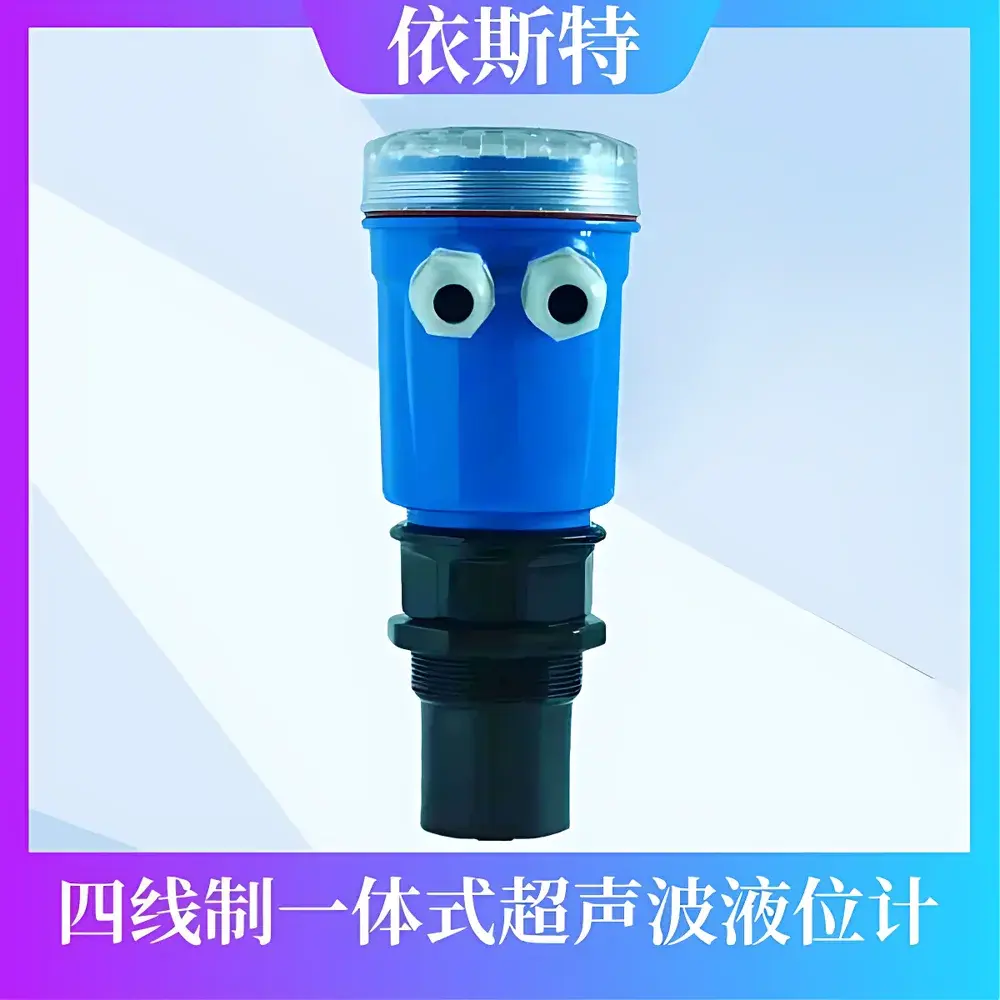
YST920CY30 Integrated Ultrasonic Level Meter – YST (Dalian Yist)
| Brand | YST (Dalian Yist) |
|---|---|
| Origin | Liaoning, China |
| Model | YST920CY30 |
| Measuring Range | 0–30 m |
| Accuracy | ≤0.5% FS |
| Resolution | 1 cm |
| Operating Frequency | 20–40 kHz |
| Response Time | ≤1 s |
| IP Rating | IP66 |
| Output Interfaces | RS485, 4–20 mA |
| Power Supply | 12–24 VDC or 220 VAC |
| Operating Temperature | −20 °C to +60 °C |
| Housing Material | Aluminum Alloy |
Overview
The YST920CY30 Integrated Ultrasonic Level Meter is an industrial-grade, non-contact level sensing solution engineered specifically for municipal water and wastewater infrastructure applications. It operates on the time-of-flight (ToF) principle: a piezoelectric transducer emits high-frequency ultrasonic pulses (20–40 kHz) toward the liquid surface; the reflected echo is detected, and the elapsed propagation time—combined with the speed of sound in air—is used to compute distance to the surface. This acoustic measurement method eliminates physical contact with process media, making it inherently suitable for aggressive, fouling-prone, or chemically variable environments typical in stormwater collection basins, primary clarifiers, equalization tanks, and reservoirs. Designed for continuous, unattended operation in outdoor and semi-enclosed civil infrastructure, the device delivers stable, repeatable level data under dynamic hydraulic conditions—including rapid level changes during peak-flow events—without drift or sensor degradation from biofilm, sludge adhesion, or chemical corrosion.
Key Features
- True integrated architecture: Transducer, signal processing electronics, and enclosure are factory-assembled as a single unit—no separate transmitter housing or field wiring between probe and electronics—reducing installation complexity and failure points.
- Robust environmental resilience: IP66-rated aluminum alloy housing resists corrosion, UV exposure, rain, dust, and mechanical impact; operational temperature range (−20 °C to +60 °C) supports deployment across diverse climatic zones without external thermal shielding.
- Dual analog & digital output: Simultaneous 4–20 mA current loop (HART-compatible) and RS485 Modbus RTU interface enable seamless integration into legacy SCADA systems and modern IIoT platforms—supporting both real-time control signals and periodic telemetry uploads.
- Intelligent signal conditioning: Built-in temperature compensation algorithm corrects for ambient air temperature variations that affect sound velocity, ensuring consistent accuracy across seasonal extremes without requiring external temperature sensors.
- Adaptive echo processing: Digital filtering and echo gain adjustment mitigate interference from foam, vapor, condensation, and turbulent surface conditions—common in open-channel flow monitoring and biological treatment basins.
- Low-power operational profile: Optimized for 12–24 VDC supply (typical consumption <1.2 W), enabling compatibility with solar-battery backup configurations in remote pump stations or off-grid monitoring nodes.
Sample Compatibility & Compliance
The YST920CY30 is validated for use with non-pressurized, open-top or vented containment structures containing municipal wastewater, stormwater runoff, clarified effluent, raw influent, and potable water reservoirs. It is not rated for pressurized vessels, vacuum service, or highly volatile organic solvents. While not certified to IEC 61508 (SIL) or ATEX/IECEx standards, its design aligns with functional safety principles applicable to Class I, Division 2 (CID2) environments per NEC Article 500 when installed per manufacturer guidelines. The device meets electromagnetic compatibility (EMC) requirements per EN 61326-1:2013 for industrial environments and conforms to RoHS Directive 2011/65/EU. Its analog output complies with NAMUR NE43 standard signal limits, and digital communication adheres to Modbus RTU v1.1 specification (ANSI/ISA-50.02). For regulatory reporting contexts, the instrument supports audit-ready data logging when paired with compliant supervisory software meeting FDA 21 CFR Part 11 electronic record requirements.
Software & Data Management
Configuration and diagnostics are performed via USB-to-RS485 adapter using YST’s proprietary PC-based utility (Windows 10/11 compatible), which enables full parameterization—including damping factor, blanking distance, measurement averaging window, and fail-safe output behavior. Field configuration is also supported through handheld HART communicators (e.g., Rosemount 375/475). Raw level values, status flags (e.g., “Signal Lost”, “Temperature Out of Range”), and diagnostic logs (transducer health, echo amplitude history) are accessible over Modbus registers. When integrated into centralized SCADA or cloud-based asset management platforms (e.g., Ignition, Siemens Desigo CC, or Azure IoT Hub), the meter contributes time-stamped, context-tagged measurements to time-series databases—enabling trend analysis, predictive maintenance scheduling, and automated alarm escalation workflows aligned with ISO 55001 asset management frameworks.
Applications
- Real-time level monitoring in municipal stormwater pump station wet wells and lift stations—enabling automatic pump staging and flood mitigation logic.
- Continuous level tracking in primary sedimentation tanks, aeration basins, and final clarifiers to optimize sludge blanket depth control and dissolved oxygen dosing.
- Reservoir and elevated tank level supervision for drinking water distribution networks—supporting pressure zone management and leakage detection analytics.
- Open-channel flow estimation (when combined with calibrated weir or flume geometry) in combined sewer overflow (CSO) monitoring networks.
- Remote telemetry nodes in distributed drainage infrastructure where wired power and network connectivity are constrained.
FAQ
What is the maximum recommended mounting height above liquid surface?
For optimal signal integrity and minimal beam divergence, the transducer should be installed no more than 0.5 m above the maximum expected liquid level, with clear line-of-sight and avoidance of obstructions within the 12° beam angle.
Can this device measure through foam or heavy vapor layers?
It can tolerate light to moderate foam and condensate; however, persistent thick foam (>5 cm) or dense steam may attenuate the acoustic signal—application-specific testing is advised in such cases.
Is calibration required after installation?
No field calibration is needed—the device is factory-calibrated against traceable acoustic standards; only configuration of empty/full reference points and temperature offset is required during commissioning.
Does it support Modbus TCP or wireless protocols like LoRaWAN?
The native interface is RS485 Modbus RTU; integration with Modbus TCP or LoRaWAN requires an external protocol gateway or edge controller.
What is the expected service life under continuous outdoor operation?
With proper mounting and periodic visual inspection/cleaning of the transducer face every 6–12 months, the unit demonstrates >8 years of reliable service in typical municipal deployments, based on accelerated life testing and field return rate data (MTBF >70,000 hours).