
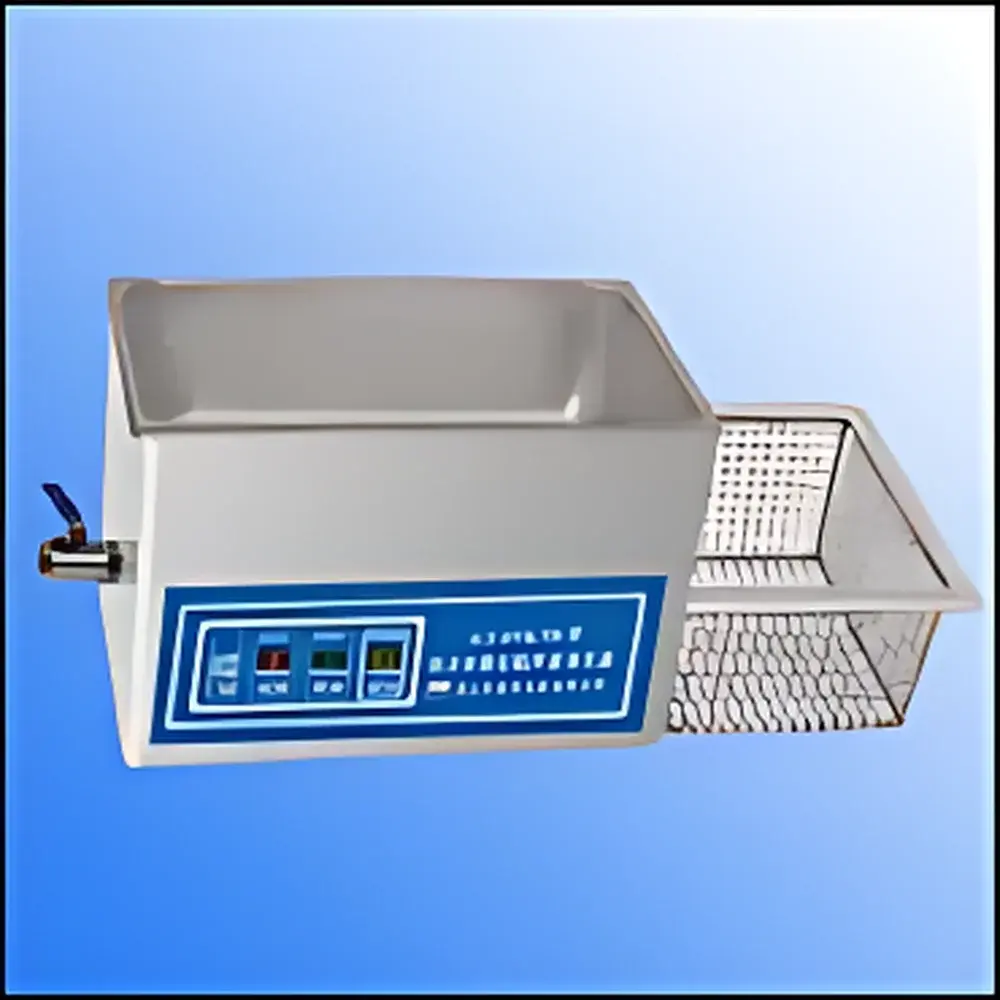
KQ-500DE / KQ-500DB / KQ-500DA / KQ-500DV Benchtop Digital Ultrasonic Cleaner
| Origin | Shanghai, China |
|---|---|
| Manufacturer Type | Authorized Distributor |
| Origin Category | Domestic (PRC) |
| Model Series | KQ-500DE / KQ-500DB / KQ-500DA / KQ-500DV |
| Price | USD 1,480 (FOB Shanghai) |
| Tank Capacity | 22.5 L (KQ-500 variants) / 27 L (KQ-500DV) |
| Ultrasonic Frequency | 40 kHz |
| Ultrasonic Power Output | 500 W (adjustable 40–100%) |
| Heating Power | 1000 W (KQ-500DB/DE/DV) |
| Temperature Range | 20–80 °C |
| Timer Range | 1–480 min |
| Tank Dimensions (L×W×H) | 500×300×150 mm (DA/DB/DE) or 500×300×180 mm (DV) |
| External Dimensions | 530×320×360 mm (DA/DB) / 530×320×380 mm (DE) / 610×410×380 mm (DV) |
| Construction | 304 Stainless Steel Tank & Housing |
| Standard Accessories | Stainless Steel Mesh Basket, Acrylic Lid with Sound-Dampening Seal (DE/DV), Drain Valve (DA/DB/DE/DV), Low-Level & Over-Temperature/Over-Current Protection Circuitry |
Overview
The KQ-500 Series benchtop digital ultrasonic cleaners are engineered for precision cleaning, degassing, dispersion, emulsification, and cell lysis in regulated laboratory environments. Utilizing high-stability 40 kHz piezoelectric transducers bonded directly to the stainless steel tank base, these units generate uniform cavitation fields across the entire cleaning chamber. The integrated digital control system enables repeatable parameter programming—critical for method standardization in QC/QA workflows, academic research, and pre-analytical sample preparation. Unlike analog predecessors, the KQ-500 series implements microcontroller-based firmware with non-volatile memory to retain user-defined protocols, operational history, and real-time sensor feedback—including tank temperature, water level, and power delivery status.
Key Features
- Digital display interface showing real-time and set values for ultrasonic power (40–100% adjustable), heating temperature (20–80 °C), timer (1–480 min), and cumulative operating hours (up to 999,999 h)
- Intelligent safety architecture: automatic shutdown triggered by low liquid level detection, over-temperature (≥85 °C), over-current, or over-voltage conditions
- Corrosion-resistant 304 stainless steel tank (500 × 300 × 150 mm or 180 mm depth) and housing, fully welded and passivated per ASTM A967
- High-efficiency transducer array delivering 500 W total acoustic output at 40 kHz; each transducer rated at 50 W nominal power
- Optional vapor recovery module (KQ-500DV model) compliant with OSHA 29 CFR 1910.1200 for handling volatile solvents in enclosed environments
- Sound-dampening acrylic lid with silicone gasket (standard on KQ-500DE and KQ-500DV) reduces ambient noise to ≤55 dB(A) at 1 m distance
- Drain valve (brass body, EPDM seal) installed on KQ-500DA, KQ-500DB, KQ-500DE, and KQ-500DV models for rapid solution exchange
- Stainless steel mesh basket (304 grade, argon-welded construction) included as standard equipment
Sample Compatibility & Compliance
The KQ-500 platform supports a broad range of sample types—including glassware, metal components, printed circuit boards, optical lenses, surgical instruments, and biological specimens—without compromising structural integrity or surface finish. Its 40 kHz frequency is optimized for removal of sub-micron particulates, organic residues, and thin oxide layers while minimizing erosion risk to delicate substrates. All models comply with IEC 61000-6-3 (EMC emission limits) and IEC 61000-6-2 (immunity requirements). The KQ-500DE and KQ-500DV variants meet ISO 13485 design control documentation standards for medical device manufacturing support applications. When operated with aqueous or low-toxicity solvent baths, the system aligns with CLSI EP25-A guidelines for cleaning validation in clinical laboratories.
Software & Data Management
While the KQ-500 series operates via embedded firmware without external PC connectivity, its internal logging architecture records critical operational metadata—including date/time stamps, total run time, number of cycles executed, and fault event codes (e.g., E01 = low water, E03 = overheat). This audit-ready data stream satisfies GLP and GMP documentation requirements under FDA 21 CFR Part 11 when paired with laboratory notebook entries. Firmware revision tracking and factory calibration logs are accessible via service mode (PIN-protected), enabling traceability during regulatory inspections. For integration into centralized lab management systems, optional RS-232 or USB-to-serial adapters support ASCII protocol transmission of status registers and alarm flags.
Applications
- Pre-analytical cleaning of HPLC vials, GC autosampler trays, and ICP-MS sample introduction components
- Removal of polishing compounds and flux residues from semiconductor wafers and MEMS devices
- Disaggregation of aggregated protein solutions and homogenization of tissue lysates prior to electrophoresis
- Decontamination of reusable pipette tips, forceps, and biopsy tools in pathology labs
- Extraction of metabolites from plant matrices using ethanol or methanol-based sonication protocols
- Ultrasonic-assisted cleaning of fiber optic connectors and photonic test fixtures
- Accelerated aging studies of coatings and adhesives via controlled cavitation-induced stress
FAQ
What is the maximum allowable solvent temperature during heated operation?
The system maintains stable thermal control up to 80 °C; exceeding this threshold triggers immediate cutoff and error code E03.
Can the KQ-500DE be used with flammable solvents such as acetone or hexane?
Only the KQ-500DV variant—with its certified vapor recovery system, explosion-proof heater enclosure, and sealed transducer housing—may be operated with Class I flammable liquids per NFPA 30 guidelines.
Is the stainless steel tank electropolished for pharmaceutical-grade cleanliness?
Standard tanks feature mechanical polish (Ra ≤ 0.8 µm); electropolishing (Ra ≤ 0.3 µm) and ASME BPE surface finish certification are available as factory-installed options.
How often should transducer performance be verified?
We recommend quarterly verification using a calibrated hydrophone per ASTM E1001, especially after >500 h of cumulative use or following exposure to aggressive chemistries.
Does the unit support multi-step cleaning protocols with sequential heating and sonication phases?
Yes—the programmable timer allows cascaded sequences (e.g., 10 min degas at 40 °C → 20 min sonicate at 60 °C → 5 min rinse cycle), stored as named methods in non-volatile memory.



