
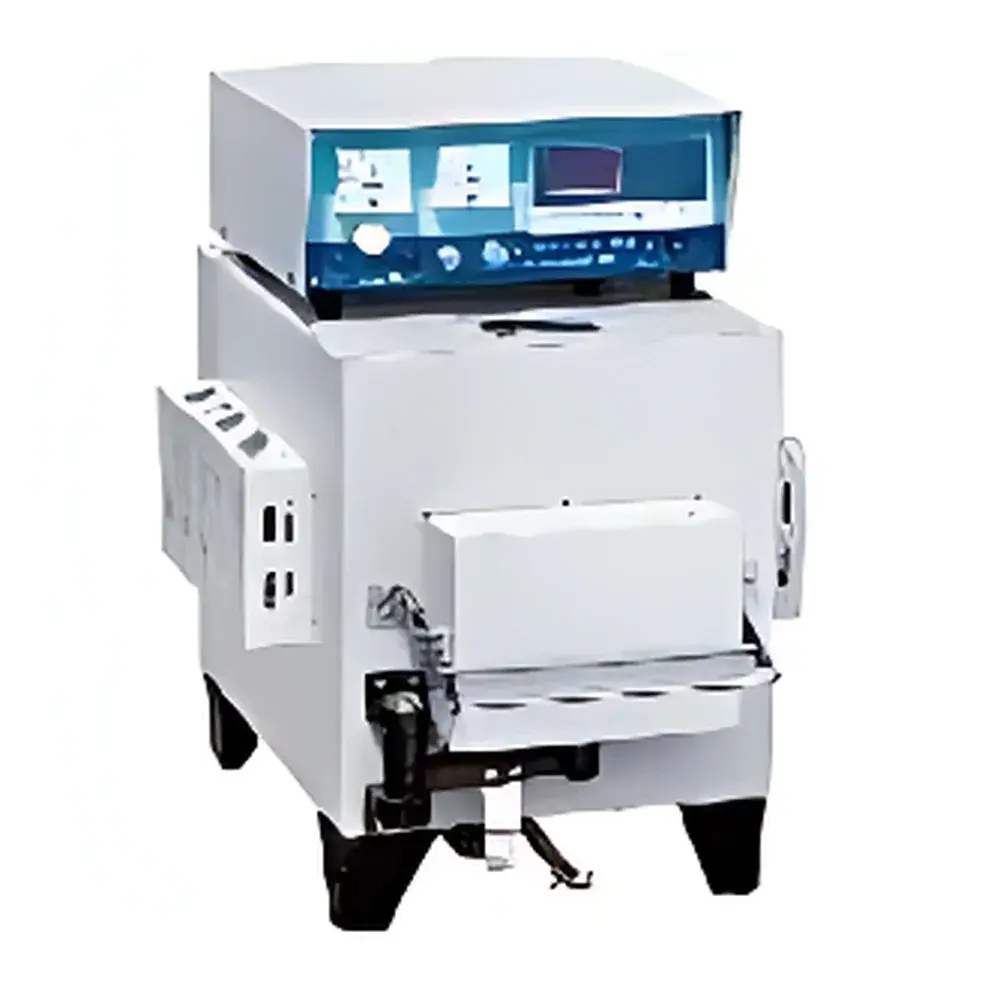
SK-2.5-13 High-Temperature Box-Type Muffle Furnace
| Origin | Shanghai, China |
|---|---|
| Manufacturer Type | Authorized Distributor |
| Origin Category | Domestic (PRC) |
| Model | SK-2.5-13 |
| Rated Temperature | 1300 °C |
| Input Voltage | 220 V AC |
| Power Rating | 2500 W |
| Chamber Configuration | Dual Vertical Tubular Zones (2 × φ22 mm × 180 mm) |
| Compliance | Designed for ASTM E1111, ISO 7888, and GLP-aligned thermal processing workflows |
Overview
The SK-2.5-13 High-Temperature Box-Type Muffle Furnace is a precision-engineered, periodic-duty laboratory furnace designed for controlled thermal treatment of small-volume samples under inert or ambient atmospheric conditions. It operates on resistive heating principles, utilizing dual silicon carbide (SiC) heating elements—mounted vertically within insulated tubular zones—to deliver uniform thermal distribution across its dual-chamber configuration. The furnace achieves and maintains stable setpoint temperatures up to 1300 °C with ±5 °C accuracy over extended dwell periods, making it suitable for applications requiring precise thermal history control, such as sintering of oxide ceramics, annealing of metallic microspecimens, ashing of organic matrices, and pre-conditioning of reference materials prior to XRD or TGA analysis.
Key Features
- Robust structural architecture: Cold-rolled steel outer casing with electrostatic epoxy-polyester powder coating for corrosion resistance and mechanical durability.
- High-efficiency thermal insulation: Composite ceramic fiber lining (density ≥128 kg/m³) between furnace chamber and outer shell minimizes heat loss and surface temperature rise (<60 °C at ambient).
- Dual independent heating zones: Two vertically oriented φ22 mm × 180 mm cylindrical chambers enable parallel processing of separate sample batches or comparative thermal experiments under identical setpoint conditions.
- Standardized thermocouple interface: Equipped with K-type thermocouple input and integrated PID temperature controller featuring ramp-soak programming, overtemperature cut-off (OTC), and real-time digital display (0.1 °C resolution).
- Compliance-ready design: Electrical safety certified to IEC 61000-6-3 (EMC) and IEC 61000-6-4; thermal performance traceable per ISO/IEC 17025 requirements when operated with calibrated reference thermocouples.
Sample Compatibility & Compliance
The SK-2.5-13 accommodates crucibles, boats, and quartz or alumina sample holders compatible with maximum dimensions of φ22 mm diameter and 180 mm length per zone. It supports common laboratory atmospheres—including air, nitrogen, and argon—when used with optional gas inlet ports (not included). The furnace meets foundational requirements for thermal processing in accordance with ASTM E1111 (Standard Practice for Calibration of Laboratory Furnaces), ISO 7888 (Water Quality – Determination of Conductivity), and USP heavy metal testing protocols where controlled ashing is required. Its construction and control logic support audit readiness for GLP environments, including manual logbook documentation of temperature profiles, operator identity, and batch identifiers.
Software & Data Management
While the base SK-2.5-13 operates via standalone analog/digital PID controller, it is compatible with optional RS485 Modbus RTU interface modules (sold separately) for integration into centralized lab management systems. When interfaced, users may export time-stamped temperature logs (timestamp + setpoint + actual reading + status flag) compliant with FDA 21 CFR Part 11 Annex 11 requirements—provided external software enforces electronic signature, audit trail, and role-based access controls. Raw data files are generated in CSV format and retain metadata including firmware version, calibration date, and sensor ID for full traceability.
Applications
- Thermal gravimetric pre-treatment: Controlled ashing of biological tissues, polymers, and environmental filters prior to elemental analysis (ICP-OES, AAS).
- Ceramic sintering: Densification of zirconia, alumina, and hydroxyapatite compacts at 1200–1300 °C under static air conditions.
- Metallurgical conditioning: Stress-relief annealing of small-diameter tool steels, titanium alloys, and Ni-based superalloy coupons.
- Reference material stabilization: Thermal equilibration of NIST-traceable standards before use in calorimetry or dilatometry.
- Method validation: Reproducible thermal cycling for ISO 11358 (polymer thermogravimetry) inter-laboratory comparison studies.
FAQ
What is the maximum recommended continuous operating temperature?
The furnace is rated for sustained operation at 1300 °C; prolonged use above 1250 °C requires quarterly verification of thermocouple drift and element resistance.
Can this model be upgraded for programmable multi-step heating profiles?
Yes—via retrofit with an external programmable controller (e.g., Eurotherm 2404 or Omron E5CC) supporting up to 32 segments, with optional Ethernet/IP communication module.
Is the dual-chamber configuration electrically isolated?
No—the two zones share a common power supply and temperature sensor; independent control requires separate furnaces or custom modification.
Does the unit include a calibration certificate?
Factory calibration is performed at 1000 °C using a NIST-traceable reference thermocouple; a test report is supplied—full ISO/IEC 17025 certification requires third-party calibration service.
What maintenance intervals are recommended for optimal thermal uniformity?
Inspect heating elements and insulation integrity every 200 operational hours; replace ceramic fiber packing if visible cracking or compression exceeds 15% of original thickness.



