
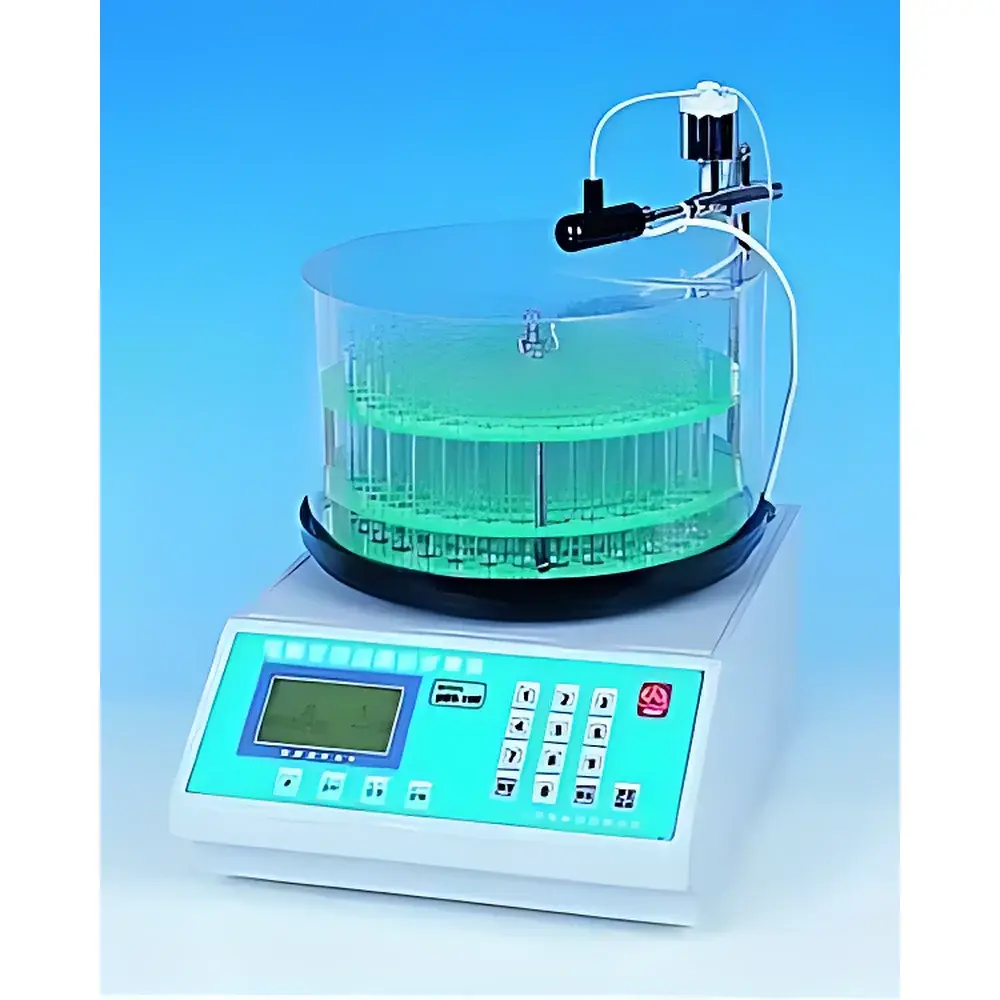
Chu Ding Technology DBS-160N Automated Fraction Collector (Organic-Solvent Compatible)
| Brand | Chu Ding Technology |
|---|---|
| Origin | Shanghai, China |
| Model | DBS-160N |
| Tube Capacity | 160 × 5 mL |
| Timing Range | 1 s – 199 h 59 min 59 s |
| Drop Counting Range | 1–9999 drops |
| Peak Detection Range | 0–100 mV |
| Power-Fail Data Retention | ≥10 years |
| Control System | Microprocessor-based with LCD menu interface |
| Compatibility | Compatible with HL-series peristaltic pumps and TH-series gradient mixers |
| Construction | Chemically resistant housing and fluid path for organic solvents (e.g., chloroform, acetone, methanol, acetonitrile, DMSO) |
Overview
The Chu Ding Technology DBS-160N Automated Fraction Collector is an engineered solution for precise, reproducible fractionation of eluates in liquid-phase chromatographic separations. Designed specifically for laboratories requiring compatibility with aggressive organic solvents—such as acetonitrile, methanol, chloroform, tetrahydrofuran, and dimethyl sulfoxide—the DBS-160N features a chemically inert fluid pathway and sealed electronics architecture to ensure long-term operational integrity under demanding chemical exposure conditions. It operates on three collection modes: time-based, drop-counted, and UV/absorbance-triggered peak collection—enabling synchronization with external detectors (e.g., UV-Vis spectrophotometers or conductivity sensors) via analog voltage input (0–100 mV). Its microprocessor-controlled logic supports both forward and reverse sequential tube indexing, programmable delay intervals between fractions, and real-time status feedback through an integrated LCD interface. The system is routinely deployed in preparative HPLC, gel filtration, ion exchange, and affinity chromatography workflows where solvent resistance, traceability, and repeatability are critical.
Key Features
- Organic-solvent-compatible construction: Fluid-contact components—including tubing connectors, valve manifolds, and sample tray seals—are fabricated from PTFE, PEEK, and chemically stabilized acetal to withstand prolonged exposure to common chromatographic solvents without swelling, leaching, or degradation.
- High-density fraction capacity: Supports up to 160 individual 5 mL collection tubes arranged in two staggered rows, optimizing bench space while maintaining accessibility and minimizing cross-contamination risk during manual retrieval.
- Multi-mode triggering logic: Independent selection of time-based (1 s–199 h 59 min 59 s), drop-counted (1–9999 drops per fraction), or analog signal-triggered (0–100 mV input range) collection protocols—each configurable with user-defined thresholds and hysteresis to suppress noise-induced false triggers.
- Non-volatile memory retention: All method parameters, calibration offsets, and run history are stored in EEPROM with guaranteed data integrity for ≥10 years—even after complete power loss—supporting GLP-compliant recordkeeping and audit readiness.
- Intuitive menu-driven interface: Backlit LCD display with hierarchical navigation, contextual function prompts, and real-time progress indicators (e.g., elapsed time, current tube index, remaining volume estimate) reduce operator training time and minimize protocol deviation.
- Modular integration capability: Standardized analog I/O (TTL-level start/stop, 0–10 V analog input) and mechanical mounting interfaces enable seamless coupling with Chu Ding’s HL-series peristaltic pumps and TH-series gradient mixers—or third-party instrumentation meeting IEC 61000-4 EMC specifications.
Sample Compatibility & Compliance
The DBS-160N is validated for continuous operation with mobile phases containing ≤100% organic solvents commonly used in reversed-phase, normal-phase, and size-exclusion chromatography. It complies with IEC 61326-1 (electromagnetic compatibility for laboratory equipment) and meets IP20 ingress protection requirements for indoor laboratory environments. While not certified for use in explosion-hazardous areas (ATEX/IECEx), its low-power design (≤12 W standby, ≤28 W peak) and absence of internal spark-generating components make it suitable for standard fume hood installations. The device supports method validation documentation per ISO/IEC 17025:2017 clause 7.2.2 (method selection and verification) when paired with traceable calibration standards and defined SOPs.
Software & Data Management
The DBS-160N operates autonomously without proprietary software; however, its analog output signals (fraction trigger pulses, status flags) are compatible with third-party data acquisition systems (e.g., LabVIEW, MATLAB, or Chromatography Data Systems such as Chromeleon or Empower) for timestamp-synchronized logging. All configuration settings—including timing profiles, drop calibration factors, and peak threshold voltages—are stored internally and can be exported via optional RS-232 serial interface (available upon request) for backup and version control. Audit trail functionality is implemented at the firmware level: each parameter change is stamped with date/time and retained in non-volatile memory for ≥10,000 events—meeting foundational expectations for FDA 21 CFR Part 11 compliance when operated within a documented quality management system.
Applications
- Preparative purification of natural products (alkaloids, flavonoids, terpenes) using silica or C18 columns with methanol/chloroform gradients.
- Protein fractionation via size-exclusion chromatography (SEC) in aqueous or guanidine-HCl buffers, followed by SDS-PAGE or mass spectrometry analysis.
- Quality control of synthetic oligonucleotides by ion-pair RP-HPLC with triethylammonium acetate/acetonitrile eluents.
- Metabolite isolation from microbial fermentation broths using mixed-mode chromatography with acetonitrile/water/formic acid mobile phases.
- Automated collection of elution peaks in affinity chromatography workflows involving immobilized metal ion or antibody-based resins regenerated with imidazole or low-pH glycine buffers.
FAQ
Is the DBS-160N compatible with high-pressure HPLC systems?
No—it is designed exclusively for low-to-medium pressure liquid chromatography applications (≤5 bar inlet pressure) and must be used downstream of a pressure-regulating flow cell or after a back-pressure regulator.
Can the tube rack accommodate custom tube sizes or formats?
The standard tray accepts only 12 × 75 mm round-bottom culture tubes (5 mL nominal volume); alternative trays for 1.5 mL microcentrifuge tubes or 15 mL conical tubes are not supported.
Does the unit provide digital communication (e.g., USB or Ethernet)?
Not by default; only analog I/O and optional RS-232 are available. USB/Ethernet connectivity requires external interface modules and is not part of the base configuration.
What maintenance is required for sustained organic solvent compatibility?
Quarterly inspection of O-ring elasticity and visual assessment of tubing discoloration or cracking is recommended; replacement of fluid-path seals every 12 months ensures consistent chemical resistance.
How is calibration of the drop counter performed?
Using a calibrated volumetric pipette and stopwatch, users enter the measured volume per drop (in µL) into the calibration menu—no external hardware or software is needed.



