
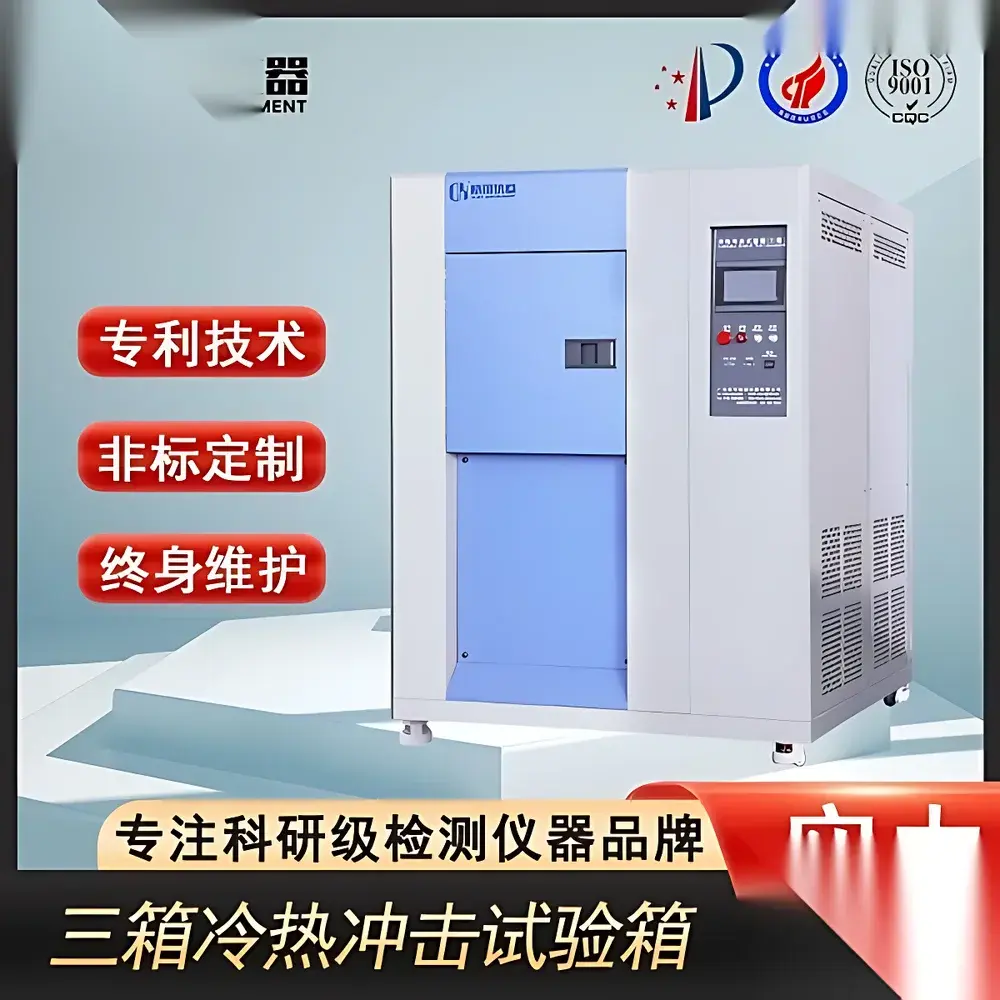
Thermal Shock Test Chamber – Dual- or Tri-Zone Configuration
| Brand | OEM |
|---|---|
| Origin | Imported |
| Manufacturer Type | Authorized Distributor |
| Price | USD 11,200 (FOB) |
| Standards Compliance | IEC 60068-2-14, MIL-STD-810G Method 503.5, ASTM D6987, GB/T 2423.22–2022, GJB 150.5A–2009, QC/T 17–1992, EIA-364-32 |
| Cooling System | Dual-Stage Cascade Refrigeration (Water-Cooled) |
| Temperature Range | –65 °C to +180 °C |
| Transition Time (Typ.) | ≤30 s (–65 °C ↔ +180 °C) |
| Internal Volume Options | 150 L, 300 L, 500 L, 800 L |
| Control Accuracy | ±0.5 °C (Steady State), ±2.0 °C (Transition) |
| Humidity Control | Not Applicable (Dry Thermal Shock Only) |
Overview
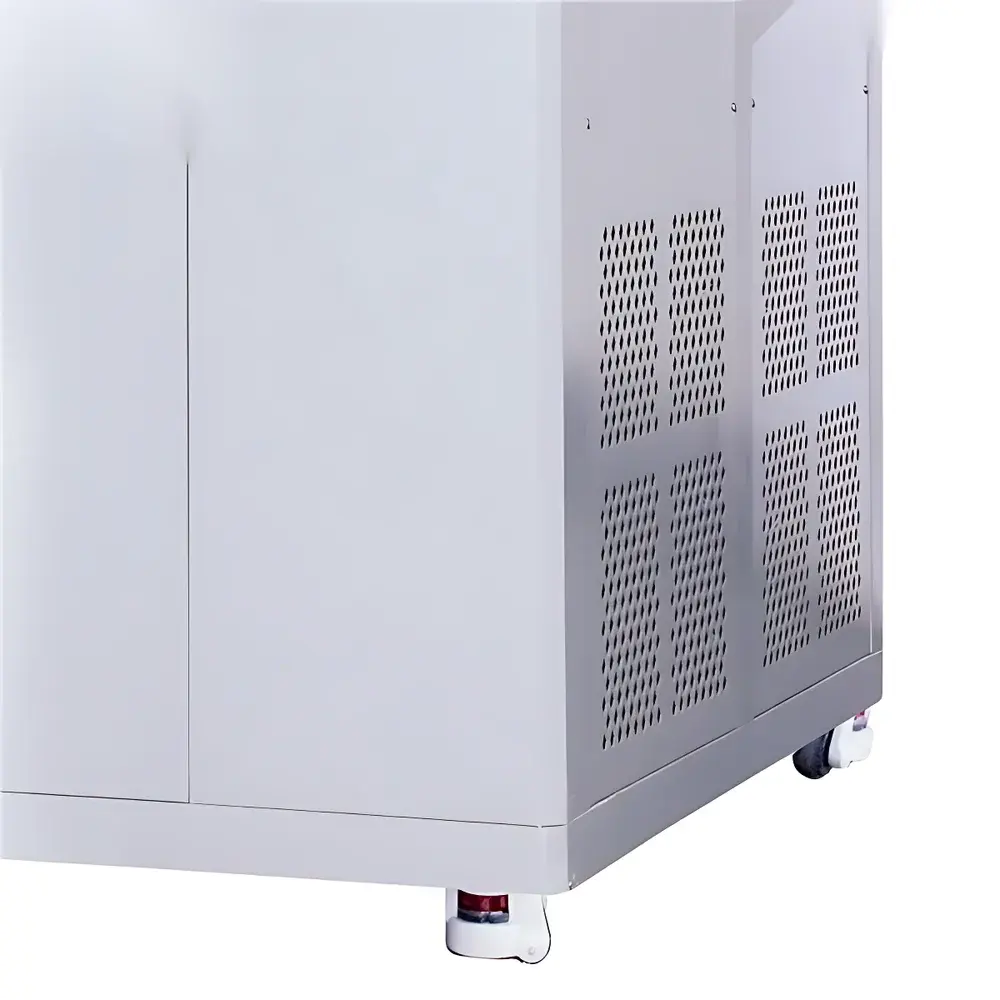
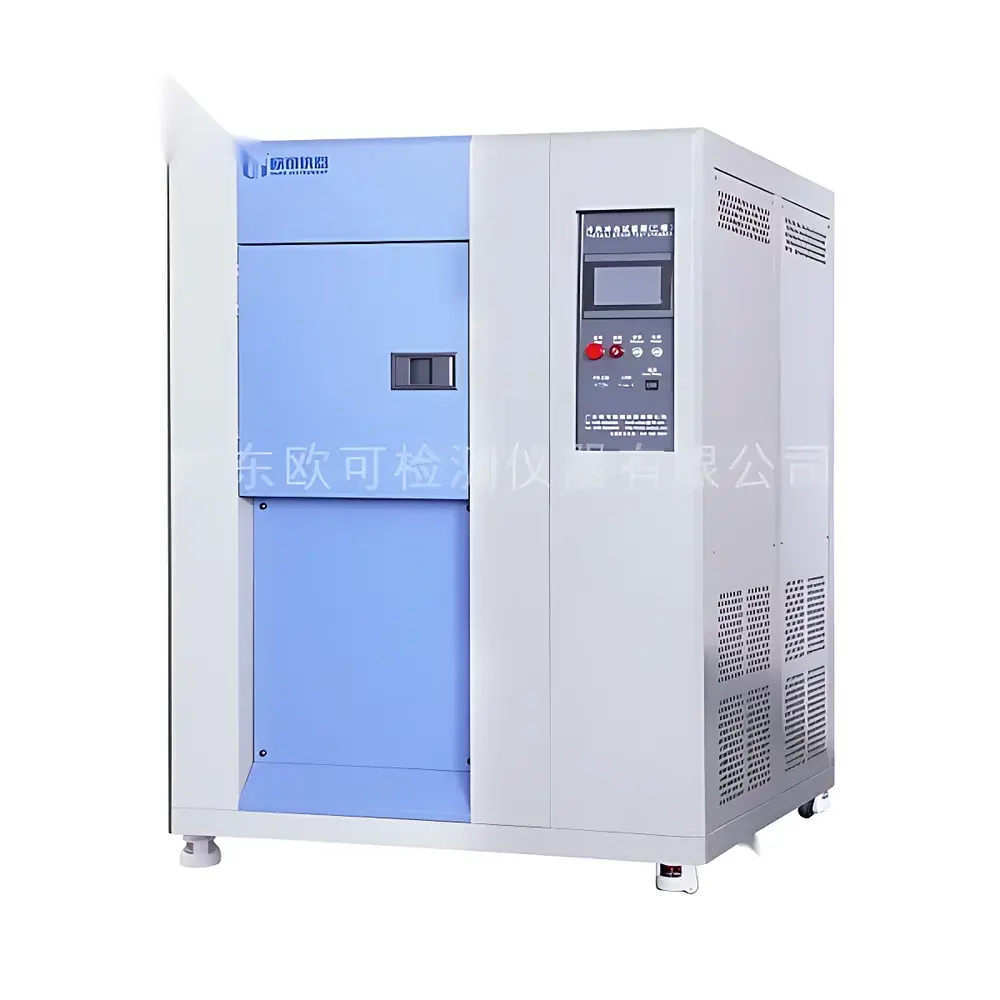
The Thermal Shock Test Chamber is an engineered environmental stress screening (ESS) system designed for accelerated reliability assessment of electronic components, automotive modules, aerospace hardware, and polymeric materials under extreme thermal transients. It operates on the principle of rapid, controlled temperature transition between two or three thermally isolated zones—enabling precise simulation of real-world thermal shock conditions where materials undergo abrupt expansion and contraction. Unlike standard temperature cycling chambers, this system delivers high-fidelity thermal gradients with sub-minute transfer times, facilitating detection of latent defects such as interfacial delamination, solder joint fatigue, coating adhesion loss, and microcrack propagation induced by coefficient-of-thermal-expansion (CTE) mismatch. The chamber complies with internationally recognized test protocols including IEC 60068-2-14 (Test N: Change of Temperature), MIL-STD-810G Method 503.5 (Temperature Shock), and ASTM D6987 (Standard Practice for Environmental Stress Screening of Electronic Equipment), making it suitable for qualification testing in ISO/IEC 17025-accredited laboratories and production QA environments.
Key Features
- Dual-zone (hot/cold) or tri-zone (hot/cold/test) architecture—user-selectable configuration optimized for throughput, repeatability, and specimen accessibility
- Dual-stage cascade refrigeration system utilizing R404A/R23 mixed-refrigerant cycles, enabling stable operation down to –65 °C without liquid nitrogen dependency
- Water-cooled condensing unit requiring external cooling tower (10 m³/h flow rate, 32 °C max inlet temperature)—designed for continuous industrial-grade duty cycles
- Precision PID-controlled air circulation with laminar flow optimization, ensuring uniform temperature distribution (±1.5 °C across working volume per IEC 60068-3-5)
- Robust stainless-steel inner chamber construction with high-density polyurethane insulation (≥150 mm thickness) and double-glazed observation window with anti-fog heating
- Integrated safety interlocks: overtemperature cutoff, refrigerant pressure monitoring, door-open alarm, and emergency power-off circuit per IEC 61000-6-2 EMC requirements
- Compliant with energy regulation standards (EU ErP Directive 2009/125/EC) via adaptive capacity modulation—reducing compressor cycling and extending service life
Sample Compatibility & Compliance
This chamber accommodates test specimens up to 450 mm × 450 mm × 450 mm (W×D×H) in the tri-zone configuration, or full-basket loading in dual-zone lift-basket models (max. payload: 30 kg). It supports standardized sample mounting fixtures per IPC/JEDEC J-STD-020 (moisture sensitivity level pre-conditioning) and AEC-Q200 (automotive passive component qualification). All operational modes—including dwell time, ramp rate, cycle count, and soak duration—are programmable and auditable. The system meets traceability requirements for GLP and GMP-regulated environments: test logs include timestamped temperature profiles, alarm history, operator ID, and calibration certificate references. Full compliance documentation—including Declaration of Conformity (DoC), CE marking file, and factory calibration report—is supplied with each unit.
Software & Data Management
Equipped with a Windows-based control interface (v8.2 firmware), the chamber provides real-time multi-channel data acquisition at 1 Hz sampling resolution. Software features include: automated test sequence scripting (up to 999 steps), configurable pass/fail criteria per cycle, export to CSV/PDF/Excel formats, and role-based user access (admin/operator/viewer). Audit trail functionality satisfies FDA 21 CFR Part 11 requirements—ensuring electronic signatures, immutable log records, and change history for all parameter modifications. Optional integration with LabVantage LIMS or Siemens Desigo CCMS enables centralized fleet monitoring and predictive maintenance alerts based on compressor runtime, refrigerant pressure trends, and thermal stability metrics.
Applications
- Qualification of PCB assemblies and BGA packages per IPC-9701 and JEDEC JESD22-A106B
- Validation of battery module thermal integrity under EV charge/discharge transient conditions (UN 38.3 Section 38.3.4)
- Accelerated aging of optical coatings, elastomeric seals, and composite airframe components per SAE AS5678 and Boeing D6-17487
- Reliability screening of MEMS sensors, RF filters, and optoelectronic transceivers prior to AEC-Q100 stress testing
- Material science research on phase transformation kinetics in shape-memory alloys and polymer blends under cyclic thermal loading
FAQ
What is the difference between two-zone and three-zone thermal shock configurations?
The two-zone design uses a movable test basket that transfers samples between hot and cold chambers; it offers faster transitions but limits specimen size and requires mechanical actuation. The three-zone system maintains separate hot, cold, and test chambers—allowing static placement of large or fragile samples while achieving comparable thermal rates through high-velocity air transfer ducts.
Does this chamber support humidity-controlled thermal shock?
No. This model is configured exclusively for dry thermal shock testing. For combined temperature/humidity stress, refer to our THS-800 series Environmental Stress Screening Chambers compliant with IEC 60068-2-30 (damp heat, cyclic).
Is on-site installation and commissioning included?
Yes—standard delivery includes mechanical/electrical hook-up verification, refrigerant charging validation, temperature uniformity mapping (per IEC 60068-3-5), and operator training. Cooling tower integration support is provided remotely or on-site upon request.
How often does the system require recalibration?
Annual traceable calibration is recommended. Built-in sensor diagnostics flag drift exceeding ±0.3 °C against reference RTDs, triggering automatic alert to designated QA personnel.
Can test profiles be exported for regulatory submission?
Yes—each test run generates a digitally signed PDF report containing raw temperature/time data, equipment ID, calibration status, environmental conditions, and operator credentials—fully compliant with ISO/IEC 17025 Clause 7.8.2 and FDA eCTD Module 5.3.5.2 requirements.



