
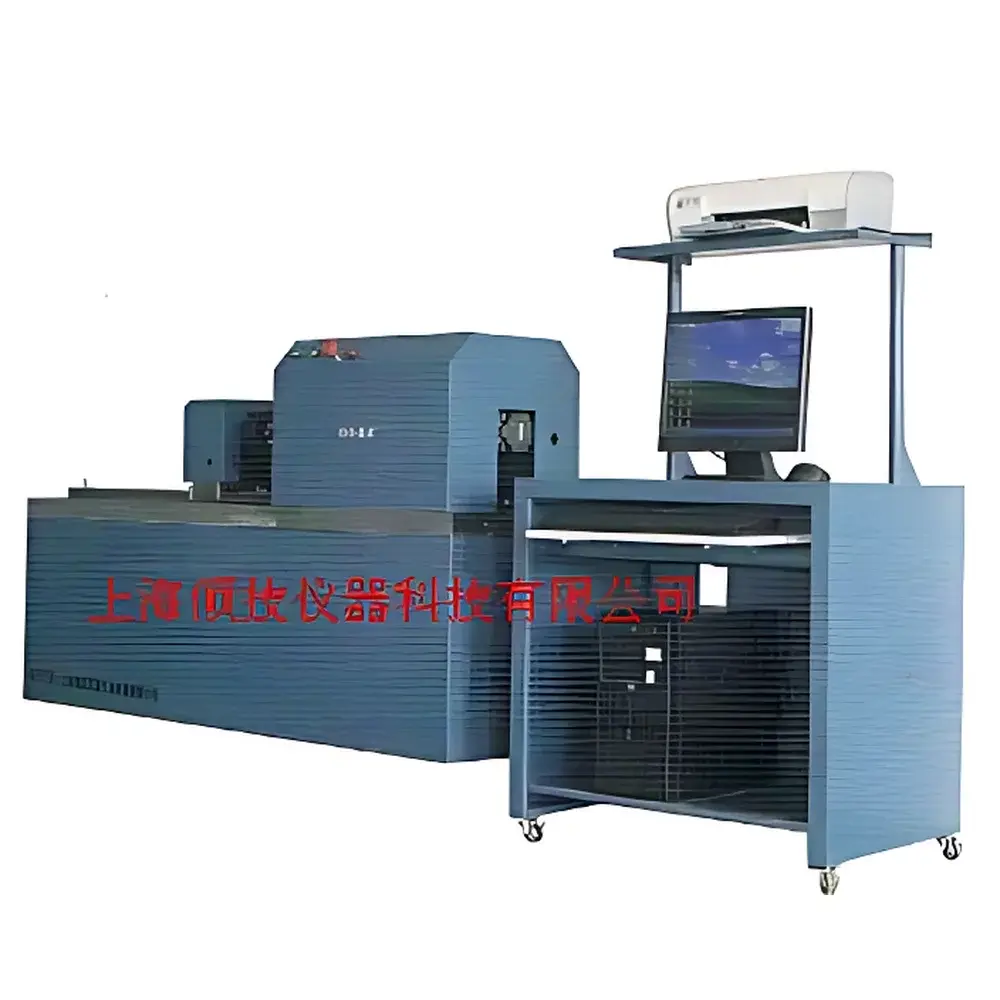
QJNZ Series Torsion Testing Machine by Qingji
| Brand | Qingji |
|---|---|
| Origin | Shanghai, China |
| Model | QJNZ |
| Max Torque Capacity | 0–10,000 N·m |
| Torque Measurement Accuracy | ±0.5% |
| Torque Resolution | 1/350,000 (full-scale, no range switching) |
| Angular Displacement Range | 0 to ±100,000° |
| Angular Measurement Accuracy | ±0.5% |
| Angular Resolution | ±0.001° |
| Angular Precision | 0.009° |
| Torsion Speed Range | 0.01–1,000 °/min (infinitely variable) |
| Speed Accuracy | ±0.2% of indicated value |
| Gauge Length Adjustment | up to 1,500 mm |
| Specimen Clamping Diameter | Φ8–Φ40 mm (expandable) |
| Dimensions (L×W×H) | 2800 × 4700 × 1250 mm |
| Weight | 1,500 kg |
| Compliance | GB/T 9370–1999, GB/T 239–1999, JJG 269–1981 |
Overview
The QJNZ Series Torsion Testing Machine by Qingji is a high-precision electromechanical system engineered for static and quasi-static torsional characterization of metallic, non-metallic, and composite materials. It operates on the principle of controlled angular displacement or torque-controlled loading, enabling measurement of torsional strength, shear modulus (G), non-proportional torque stress, and torsional fatigue behavior under standardized boundary conditions. Designed for laboratory and industrial quality control environments, the system delivers traceable, repeatable torsional data aligned with fundamental mechanics-of-materials theory—particularly applicable to specimens governed by Saint-Venant’s torsion assumptions and isotropic linear elastic response within the proportional limit.
Key Features
- High-resolution torque transduction with full-scale resolution of 1/350,000 and no internal range switching—ensuring consistent sensitivity across the entire 50–5,000 N·m operational window.
- Precision angular encoder with ±0.001° resolution and absolute accuracy of 0.009°, supporting reliable determination of shear modulus via slope analysis of the linear elastic region in torque–twist curves.
- Infinitely variable torsion speed control from 0.01 to 1,000 °/min, with closed-loop feedback maintaining speed stability within ±0.2% of setpoint—critical for strain-rate-sensitive material evaluation per ASTM E143 or ISO 7888.
- Modular fixture architecture accommodating cylindrical specimens from Φ8 mm to Φ40 mm (customizable beyond), with adjustable parallel jaw spacing up to 1,500 mm to meet diverse specimen aspect-ratio requirements.
- Integrated micro-angle measurement capability (optional) enables high-fidelity capture of initial elastic twist, facilitating precise calculation of G in compliance with ASTM E143–22 and GB/T 239–1999.
- Rigid structural frame (1,500 kg mass) minimizes vibrational coupling and thermal drift, contributing to long-term measurement reproducibility in ambient lab conditions.
Sample Compatibility & Compliance
The QJNZ accommodates solid rods, hollow tubes, wire forms, fasteners, shafts, and structural subcomponents—provided geometric symmetry and homogeneous cross-sections permit valid application of classical torsion theory. It supports both torque-control and angle-control test modes, making it suitable for failure analysis (e.g., ductile vs. brittle torsional fracture), proof testing, and multi-step loading protocols. The system complies with national and metrological standards including GB/T 9370–1999 (torsion testing machines — verification procedures), GB/T 239–1999 (metallic materials — torsion test method), and JJG 269–1981 (verification regulation for torsion testing machines). While not certified to ISO/IEC 17025, its measurement traceability path aligns with CNAS-accredited calibration practices for mechanical testing equipment.
Software & Data Management
Control and acquisition are executed via virtual instrumentation software built on a real-time deterministic platform. The interface provides synchronized dual-channel recording of torque (N·m) and angular displacement (°), with configurable sampling rates up to 1 kHz. Data processing modules support automatic yield point detection (non-proportional torque stress τp0.01), linear regression for G-value extraction, hysteresis loop analysis, and export of raw time-series datasets in CSV and XML formats. All test parameters, operator IDs, calibration timestamps, and environmental metadata are embedded into each report file—supporting basic audit trail functionality required under GLP-aligned workflows. Software logs maintain immutable records of test initiation, pause/resume events, and system error flags for retrospective review.
Applications
- Determination of torsional yield strength and ultimate torsional strength per GB/T 239–1999 and ASTM E143.
- Shear modulus (G) quantification in metals, polymers, and fiber-reinforced composites using low-strain angular compliance.
- Verification of torque-tension relationships in threaded fasteners and bolted joints.
- Quality assurance of drive shafts, turbine blades, and aerospace structural components subjected to torsional service loads.
- Educational use in mechanical engineering labs for experimental validation of torsion theory, including warping effects in non-circular sections (with appropriate fixtures).
- Research into viscoelastic torsional response under stepped angular rates—when paired with optional environmental chamber integration.
FAQ
What standards does the QJNZ comply with?
The system meets the mechanical and metrological requirements of GB/T 9370–1999, GB/T 239–1999, and JJG 269–1981. Calibration certificates are issued against national torque and angular displacement standards.
Can the machine perform cyclic torsion or fatigue tests?
The base configuration supports static and quasi-static loading only. High-cycle torsional fatigue requires optional servo-hydraulic actuation and dedicated fatigue control firmware—not included in standard QJNZ delivery.
Is software validation documentation available for regulated environments?
The software includes configurable user access levels and electronic signature fields, but formal 21 CFR Part 11 compliance (e.g., audit trail encryption, electronic record integrity) requires supplementary validation packages and third-party IQ/OQ protocols.
What maintenance intervals are recommended?
Annual recalibration of torque and angular sensors is advised. Lubrication of lead screws and inspection of clamping jaws should occur every 500 operational hours or semiannually—whichever comes first.
Does the system support remote diagnostics or networked data transfer?
Yes—Ethernet connectivity enables remote monitoring via TCP/IP, and test data can be routed to shared network drives or LIMS-compatible databases using configurable FTP/SFTP endpoints.



