
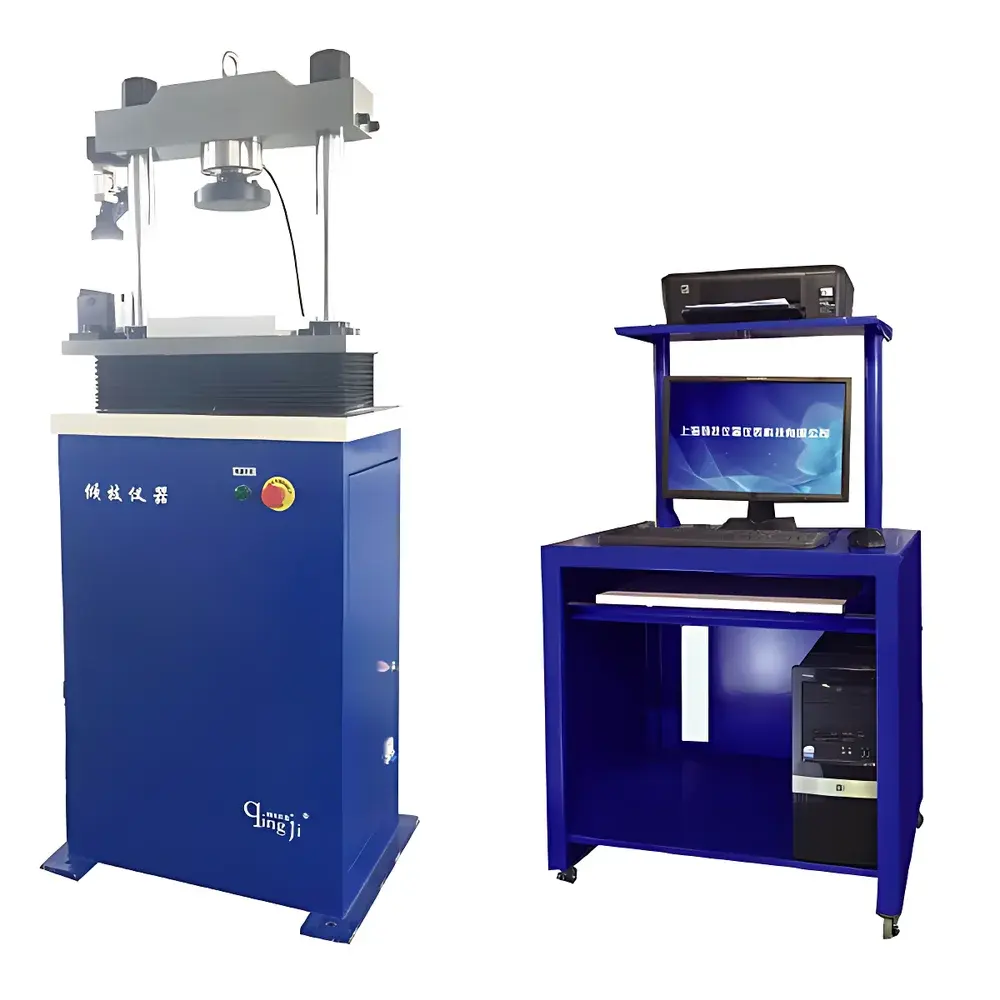
QJYL872 Flexural and Compressive Strength Testing Machine
| Origin | Shanghai, China |
|---|---|
| Manufacturer Type | Authorized Distributor |
| Country of Origin | China |
| Model | QJYL872 |
| Price | USD 6,300 (FOB Shanghai) |
| Max. Test Load | 300 kN |
| Flexural Test Capacity | 10 kN |
| Compressive Loading Rate Range | 0–10 kN/s |
| Flexural Loading Rate Range | 0–0.075 kN/s |
| Relative Indication Error | ±0.5% |
Overview
The QJYL872 Flexural and Compressive Strength Testing Machine is a dual-mode universal testing system engineered for high-precision mechanical characterization of brittle and quasi-brittle construction materials under standardized uniaxial loading conditions. It operates on the principle of controlled-force or controlled-rate hydraulic actuation, delivering repeatable load application in both three-point bending (flexural) and axial compression configurations. Designed in strict alignment with international material testing protocols—including ISO 679 (cement mortars), ASTM C109/C348 (compressive and flexural strength of hydraulic cement), and EN 196-1—the instrument serves as a core verification tool in quality control laboratories, precast concrete plants, building materials certification centers, and academic civil engineering departments. Its rigid four-column frame, integrated load cell feedback loop, and closed-loop digital controller ensure structural stability and measurement fidelity across the full 300 kN compressive and 10 kN flexural range.
Key Features
- Hydraulically actuated dual-range loading system with independent calibration for compressive (0–300 kN) and flexural (0–10 kN) modes
- Digital closed-loop control enabling programmable loading rates: 0–10 kN/s (compression) and 0–0.075 kN/s (flexure), compliant with GB/T 50081–2002 and ASTM C348 ramp profiles
- High-accuracy load measurement via strain-gauge-based load cell with ±0.5% relative indication error (per ISO 7500-1 Class 1)
- Modular fixture interface supporting standardized test geometries: 40 mm × 40 mm × 160 mm cement mortar beams (three-point bend), 150 mm cube concrete specimens (compression), and 240 mm × 115 mm × 53 mm clay bricks (GB 13544–2000)
- Integrated displacement transducer with sub-millimeter resolution for deformation monitoring during failure analysis
- Compact footprint (1200 mm × 800 mm × 2200 mm) and low-maintenance hydraulic power unit suitable for constrained lab environments
Sample Compatibility & Compliance
The QJYL872 accommodates standardized specimens per multiple national and international standards: cementitious mortars (GB/T 17671–1999, ISO 679), fired clay bricks (GB 13544–2000, ASTM C62), normal-strength concrete (GB/T 50081–2002, ASTM C39), autoclaved aerated concrete (GB/T 11969–2020), and ceramic tile substrates (GB/T 4100–2015). All test routines are structured to satisfy GLP documentation requirements, with traceable calibration certificates provided for load cell and displacement sensor (NIST-traceable reference standards). The system supports audit-ready operation under ISO/IEC 17025-accredited laboratories and meets mechanical safety provisions of GB/T 2611–2007 (General Requirements for Testing Machines).
Software & Data Management
The embedded control software enables real-time load–displacement curve acquisition, automatic peak detection, and pass/fail evaluation against user-defined limits. Raw data export is supported in CSV and XML formats for downstream statistical analysis (e.g., Weibull modulus calculation, coefficient of variation reporting). Audit trails record operator ID, test date/time, calibration status, and parameter modifications—fully compliant with FDA 21 CFR Part 11 requirements when deployed in regulated QC environments. Optional PC-based software extends functionality with batch reporting, multi-specimen comparative analysis, and integration into LIMS platforms via OPC UA protocol.
Applications
- Quality assurance of Portland cement and blended cements per ISO 679 and GB/T 17671
- Mechanical validation of masonry units including solid clay bricks, concrete blocks, and fly ash bricks
- Structural performance assessment of precast concrete elements during production qualification
- Research-grade flexural toughness evaluation of fiber-reinforced cement composites
- Educational demonstration of stress–strain behavior, modulus of rupture (MOR), and compressive strength development in civil engineering curricula
- Third-party conformity testing for CE marking (EN 771 series) and CCC certification (China Compulsory Certification)
FAQ
Does the QJYL872 support automated test sequence execution for multi-specimen batches?
Yes—programmable test templates allow sequential loading of up to 99 specimens with auto-reset, dwell time, and result logging.
Is third-party calibration certification included with delivery?
A factory-issued calibration certificate traceable to CNAS-accredited metrology institutes is supplied; on-site verification by local accredited labs is recommended annually.
Can the machine be configured for tensile testing with appropriate fixtures?
No—this model is mechanically optimized for compression and three-point bending only; tensile applications require a dedicated universal testing machine with dual-acting grips.
What maintenance intervals are specified for the hydraulic system?
Hydraulic oil replacement and filter inspection are required every 1,500 operating hours or biannually, whichever occurs first.
Is remote diagnostic support available post-warranty?
Yes—technical assistance via secure remote desktop connection is offered under annual service contracts, including firmware updates and troubleshooting logs.



