
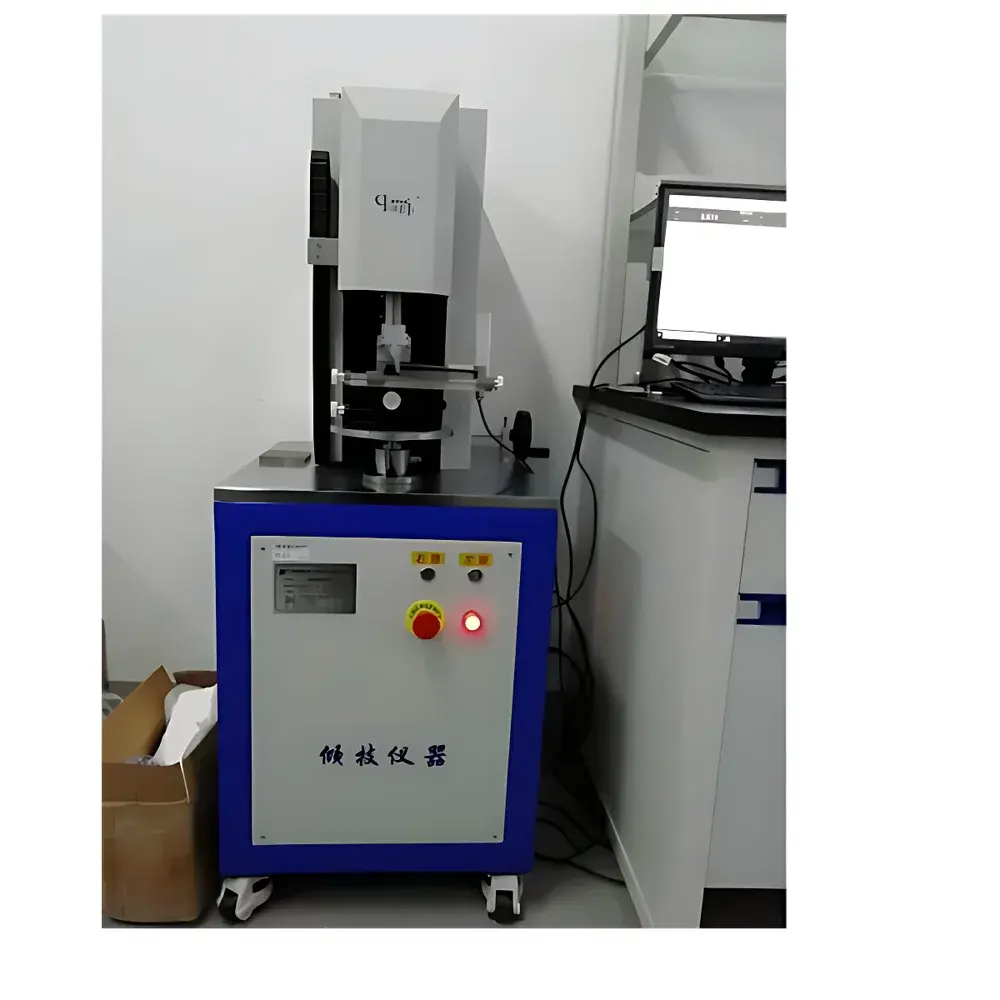
Qinji QJNZ-10N·m Computer-Controlled Vertical Torsion Testing Machine
| Brand | Qinji |
|---|---|
| Origin | Shanghai, China |
| Manufacturer Type | Authorized Distributor |
| Country of Origin | China |
| Model | QJNZ-10N·m |
| Max. Torque | 10 N·m |
| Torque Measurement Range | 0.2–10 N·m |
| Accuracy Class | 0.5 |
| Compliance Standards | YY 0315–2023, ISO/TS 13498:2011 |
| Control System | Windows-based Real-Time Data Acquisition & Closed-Loop Control |
Overview
The Qinji QJNZ-10N·m Computer-Controlled Vertical Torsion Testing Machine is a precision-engineered electromechanical system designed for static and quasi-static torsional mechanical characterization of biomedical implants, dental abutments, orthopedic fasteners, and small-diameter metallic or polymer components. It operates on the principle of controlled angular displacement under regulated torque input, enabling quantitative evaluation of torsional stiffness, yield torque, ultimate failure torque, and angular deformation hysteresis. The vertical configuration ensures gravitational alignment of test specimens—critical for replicating in vivo loading conditions in dental implant systems—and minimizes parasitic bending moments during high-fidelity torsion-only testing. Integrated with a Windows-based real-time control interface, the system supports programmable ramp-hold sequences, multi-step cyclic loading, and synchronized acquisition of torque (N·m), rotational angle (°), and time (s) at configurable sampling rates up to 100 Hz.
Key Features
- Vertical load frame architecture with rigid aluminum alloy column and precision-ground linear guide rails—engineered to eliminate lateral deflection and maintain coaxial alignment throughout the full 0–720° rotation range.
- High-resolution torque transducer calibrated to Class 0.5 accuracy per ISO 376:2011, delivering traceable measurement uncertainty ≤ ±0.5% of full scale (10 N·m) across the usable range (0.2–10 N·m).
- Stepper motor-driven actuation system with closed-loop position feedback, enabling repeatable angular positioning resolution of 0.01° and programmable angular velocity from 0.001°/s to 30°/s.
- Dedicated fixture kits compliant with YY 0315–2023 Annex C and ISO/TS 13498:2011 Clause 6—including implant-abutment interface holders, hex-drive adapters, and anti-rotation clamping jaws—ensuring standardized specimen mounting and load transfer.
- Real-time curve visualization and parameter annotation during testing: torque-angle loops, torque-time histories, and derivative-based inflection point detection (e.g., elastic limit identification) are rendered live and exportable as CSV or XML.
Sample Compatibility & Compliance
The QJNZ-10N·m accommodates cylindrical, hexagonal, and internal/external hex drive geometries typical of dental implants (e.g., 3.5–5.0 mm diameter fixtures), orthopedic screws (M2.5–M6), and modular prosthetic connectors. Specimen lengths up to 120 mm are supported within the standard vertical travel envelope. All test protocols align with regulatory validation requirements for Class II/III medical devices: data integrity meets FDA 21 CFR Part 11 principles via user-access logging, electronic signature support, and audit-trail-enabled software; mechanical verification follows ISO 17025-compliant calibration intervals traceable to CNAS-accredited laboratories. Test reports include metadata fields for operator ID, environmental temperature/humidity (via optional sensor integration), and instrument serial number—essential for GLP/GMP documentation workflows.
Software & Data Management
The proprietary TorsionControl v3.2 software suite runs natively on Windows 10/11 (64-bit) and provides ISO/IEC 17025-aligned test method templates preconfigured for YY 0315–2023 Section 6.3 (abutment-implant connection torque resistance) and ISO/TS 13498:2011 Clause 7.2 (cyclic torsional fatigue). Each test session generates a structured .tdf (Torsion Data File) containing raw sensor streams, processed metrics (e.g., max torque, plastic deformation angle, energy absorption), and digital signatures. Export options include PDF reports with embedded pass/fail criteria overlays, Excel-compatible .xlsx summaries, and ASCII .dat files for third-party statistical analysis (e.g., JMP, Minitab). Data backups are automatically timestamped and stored in encrypted local directories with optional network share mirroring.
Applications
- Validation of torque retention performance in dental implant–abutment interfaces per YY 0315–2023 and ISO/TS 13498:2011.
- Mechanical screening of bone screw–plate locking mechanisms under static torsion prior to biomechanical finite element modeling.
- Comparative assessment of surface-treated vs. untreated titanium alloys regarding torsional fatigue life and plastic hinge formation.
- Quality control testing of miniaturized surgical instruments (e.g., driver bits, torque-limiting handpieces) for consistency in clinical delivery torque.
- Research into viscoelastic torsional behavior of bioresorbable polymers (e.g., PLLA, PCL) under accelerated aging conditions.
FAQ
What calibration standards does the torque sensor conform to?
The transducer is factory-calibrated per ISO 376:2011 and supplied with a CNAS-traceable certificate of calibration valid for 12 months.
Can the system perform cyclic torsion tests?
Yes—software-defined waveforms (sinusoidal, trapezoidal, step-ramp) support up to 10⁵ cycles with user-specified amplitude, frequency, and mean torque offset.
Is remote operation or integration with LIMS possible?
The system supports TCP/IP communication via Ethernet; API documentation and LabVIEW drivers are available for custom LIMS or MES integration.
What maintenance is required during the first year of operation?
No scheduled maintenance is required; annual recalibration and firmware updates are included in the standard service package.
Are custom fixtures available beyond the standard dental kit?
Yes—Qinji’s engineering team provides non-standard fixture design and CNC fabrication services under NDA, with lead times typically 3–4 weeks.



