
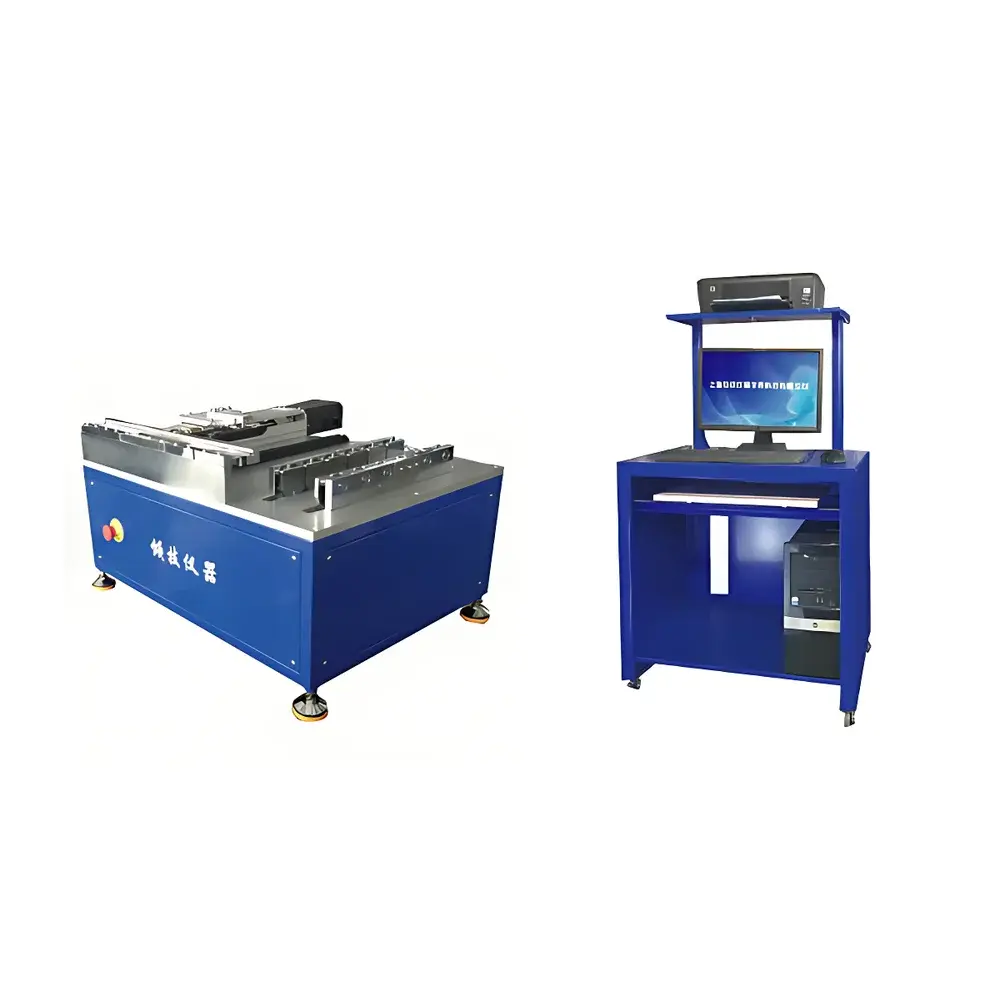
IC Card Bending and Torsion Testing Machine QJICWQ
| Origin | Shanghai, China |
|---|---|
| Manufacturer Type | Authorized Distributor |
| Origin Category | Domestic (China) |
| Model | QJICWQ |
| Price | USD 7,700 (FOB Shanghai) |
| Max. Torsion Angle | ±15° ±1° (Bidirectional) |
| Torque Measurement Range | Optional (Configurable per ISO/IEC 7816-1 & GB/T 16649.1) |
| Torque Resolution | 60 measurements/min |
| Angular Displacement Measurement Range | Optional (Programmable up to ±30°) |
| Motor Power | 35 W |
| Bending Speed | 29 rpm |
| Test Cycle Count Range | 1–9999 cycles |
| Dimensions (L×W×H) | 670 × 380 × 220 mm |
| Net Weight | 70 kg |
| Input Voltage | AC 220 V ±5%, 50 Hz |
Overview
The IC Card Bending and Torsion Testing Machine QJICWQ is a dedicated mechanical endurance tester engineered for standardized evaluation of polymeric smart cards—specifically compliant with ISO/IEC 7816-1, ISO/IEC 7810, and the Chinese national standard GB/T 16649.1. It applies controlled, repeatable cyclic bending and bidirectional torsional stress to simulate real-world handling conditions—including wallet flexing, insertion/removal forces in card readers, and mechanical fatigue induced during daily use. The system operates on a precision stepper motor-driven actuation architecture, delivering calibrated angular displacement (±15° ±1°) and programmable rotational speed (29 rpm for bending mode), enabling deterministic mechanical stress profiling across thousands of cycles. Its rigid aluminum alloy frame and vibration-damped base ensure high positional repeatability and minimal test-to-test deviation—critical for comparative quality assurance in production line validation and R&D benchmarking.
Key Features
- Compliance-focused test protocol execution aligned with ISO/IEC 7816-1 Annex A (bending) and Annex B (torsion), supporting full traceability for certification submissions.
- Bidirectional torsion capability with programmable angular limits (±15° ±1°), enabling asymmetric stress profiles to replicate non-uniform insertion torque scenarios.
- Modular sensor interface supporting optional torque transducers (0.01–5 N·m range) and high-resolution rotary encoders (0.01° resolution), configurable per client-specific test method requirements.
- Integrated microcontroller-based control unit with LCD interface, allowing standalone operation without external PC—ideal for cleanroom or factory-floor deployment.
- Robust mechanical architecture: 70 kg mass, low center of gravity, and anti-vibration rubber feet minimize resonance effects during high-cycle testing (up to 9999 cycles).
- Energy-efficient 35 W brushless DC motor ensures thermal stability over extended test durations and meets IEC 62368-1 safety compliance for lab-grade equipment.
Sample Compatibility & Compliance
The QJICWQ accommodates standard ID-1 format cards (85.6 × 53.98 × 0.76 mm) as defined in ISO/IEC 7810, including PVC, PET, polycarbonate, and composite laminates used in contact/contactless smart cards. Fixture geometry conforms to GB/T 16649.1 Clause 6.2.2 (bending fixture radius = 10 mm) and Clause 6.3.2 (torsion clamp alignment tolerance ≤ ±0.2 mm). All test parameters—including cycle count, angular amplitude, dwell time, and direction sequence—are fully configurable to satisfy internal QA protocols or third-party audit requirements (e.g., EMVCo, Common Criteria EAL4+ physical testing modules). The instrument supports GLP-aligned documentation: test logs include timestamped cycle counters, motor current signatures, and error flags for out-of-tolerance events.
Software & Data Management
While the QJICWQ operates autonomously via front-panel controls, optional RS-232/USB interface enables integration with laboratory information management systems (LIMS) or custom Python/Matlab scripts for automated data capture. Exported CSV files contain columnar data: cycle number, real-time angular position (°), motor encoder pulse count, elapsed time (ms), and pass/fail status per ISO-defined failure criteria (e.g., delamination, antenna discontinuity, or >5% resistance shift measured externally). Audit trails comply with FDA 21 CFR Part 11 when paired with validated software—supporting electronic signatures, user access levels, and immutable log archiving. Firmware updates are delivered via secure USB key to maintain version control across multi-site deployments.
Applications
- Smart card manufacturer QC labs verifying mechanical durability prior to EMV or FeliCa certification.
- University materials science departments studying polymer creep behavior under cyclic torsional loading.
- National metrology institutes performing inter-laboratory comparison studies for GB/T 16649.1 test method harmonization.
- Banknote and secure document printers validating substrate integrity after hot-stamping or laser personalization processes.
- Third-party testing laboratories accredited to CNAS (ISO/IEC 17025) offering accredited bending/torsion reports for smart card OEMs.
FAQ
What standards does the QJICWQ directly support?
It implements test sequences defined in ISO/IEC 7816-1:2017 Annex A (bending) and Annex B (torsion), GB/T 16649.1–2022, and ISO/IEC 7810:2019 dimensional verification protocols.
Can torque measurement be added post-purchase?
Yes—the machine features standardized mounting interfaces and analog signal conditioning circuitry compatible with NIST-traceable torque sensors (0.1–5 N·m range); calibration certificates are issued upon installation.
Is the 15° torsion angle adjustable?
The default mechanical stop is set at ±15° ±1°, but optional precision-machined limit brackets allow field adjustment between ±5° and ±30° in 1° increments, documented in the calibration record.
How is test failure determined?
The instrument detects mechanical end-stop contact or motor stall current thresholds; final pass/fail judgment requires external verification (e.g., continuity testing, visual inspection per ISO/IEC 10373-6), which is logged alongside raw motion data.
Does the system meet electromagnetic compatibility (EMC) requirements for EU labs?
Yes—it carries CE marking per EN 61326-1:2013 (measurement/control lab equipment) and EN 55011:2016 Class B emission limits, verified by an ILAC-accredited test house.



