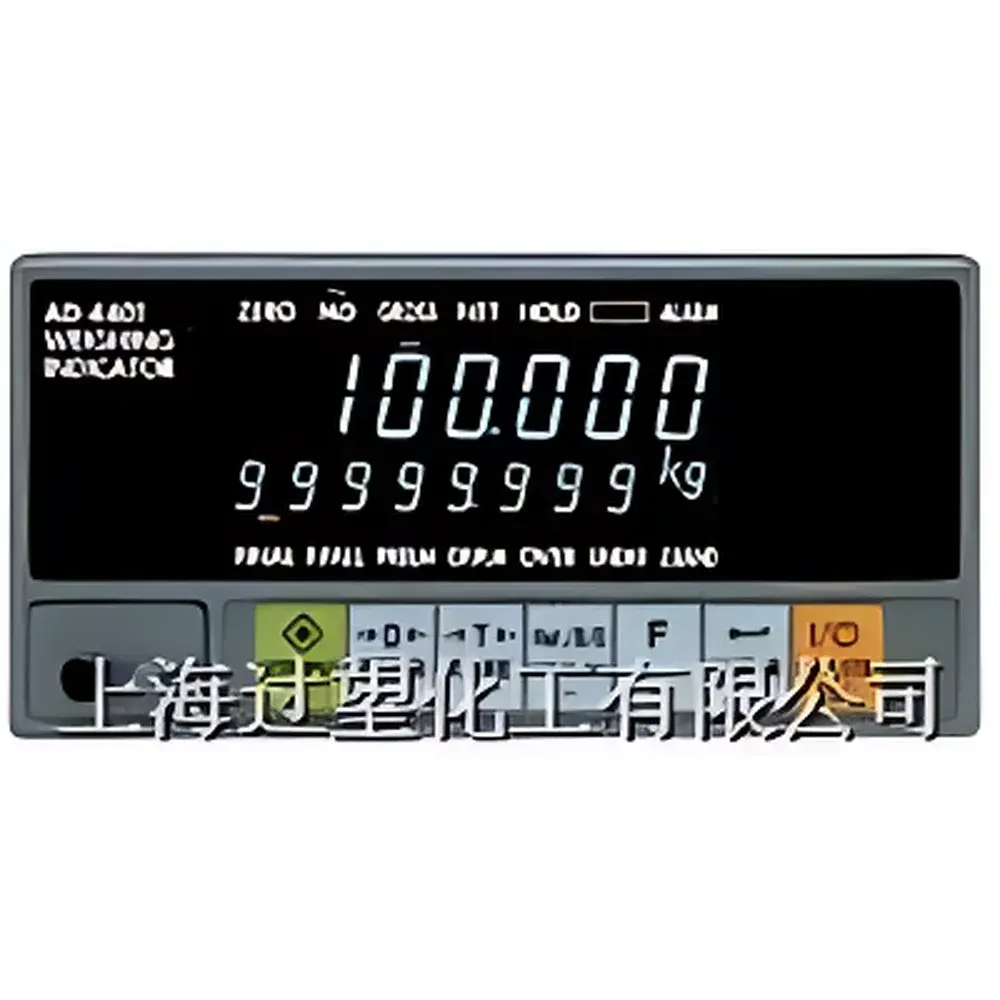
A&D AD-4401 Multi-Function Weighing Indicator
| Brand | A&D |
|---|---|
| Origin | Japan |
| Model | AD-4401 |
| Display Resolution | 1/16,000 |
| Internal A/D Resolution | 1/1,000,000 |
| Sampling Rate | 100 Hz |
| Input Sensitivity | 0.3 µV/d |
| IP Rating | IP65 (Front Panel) |
| Communication Interfaces | RS-232 (Current Loop & Optional TTL), RS-422/485 (Optional), BCD (Optional), 4–20 mA Analog Output (Optional) |
| Max Device Count on RS-422/485 Network | 10 units |
| Operating Modes | 8 Predefined Weighing & Control Modes |
| Built-in Diagnostics | I/O, A/D, Peripheral Detection |
| Auto-Compensation | Fuzzy Logic-Based Drop Compensation & Re-Feed Control |
| Data Logging | Batch Weight Summation & Cycle Count Accumulation |
Overview
The A&D AD-4401 Multi-Function Weighing Indicator is an industrial-grade, microprocessor-based weighing controller engineered for precision process integration in automated manufacturing and quality assurance environments. Designed and manufactured in Japan, the AD-4401 implements high-stability analog signal conditioning coupled with a 24-bit sigma-delta A/D converter to deliver robust measurement integrity under dynamic plant conditions. Its core architecture supports eight configurable operational modes—including checkweighing, loss-in-weight (LIW) feeding, gain-in-weight (GIW) batching, static weighing, and programmable recipe-based dispensing—enabling seamless deployment across pharmaceutical, food processing, chemical, and materials compounding applications. The indicator accepts standard load cell inputs (mV/V) and features real-time digital filtering, zero-tracking, and auto-zero stabilization to mitigate thermal drift and mechanical vibration effects. All firmware operations comply with fundamental metrological principles defined in OIML R76 and ISO/IEC 17025 traceability frameworks.
Key Features
- High-resolution weighing performance: 1/16,000 display resolution with internal 1/1,000,000 A/D conversion for enhanced repeatability and linearity.
- Dual-stage digital calibration: Full-scale and span calibration executed entirely via front-panel navigation—no external hardware or PC required.
- Real-time process supervision: Integrated fuzzy logic algorithm dynamically adjusts feed cutoff points based on material flow characteristics, minimizing overshoot and improving batch consistency.
- Comprehensive self-diagnostic suite: Continuously monitors analog input integrity, I/O status, peripheral module presence (e.g., OP-03 RS-422/485 board), and internal power rail stability.
- IP65-rated front panel: Sealed membrane keypad and high-luminance fluorescent display ensure reliable operation in humid, dusty, or washdown-prone production zones.
- Peak-hold functionality: Captures and retains maximum load values during transient events—critical for impact-sensitive material handling verification.
- Modular expansion support: Optional interface boards enable flexible system integration without hardware redesign.
Sample Compatibility & Compliance
The AD-4401 interfaces natively with standard 4-wire or 6-wire analog load cells (typically 2 mV/V or 3 mV/V output) and supports both tension and compression configurations. It accommodates load cell excitation voltages of 5 VDC or 10 VDC (selectable), with automatic bridge compensation for temperature-induced resistance shifts. While not certified as a legal-for-trade instrument per NTEP or MID directives, its measurement stability meets requirements for in-process control under FDA 21 CFR Part 11–aligned environments when deployed with appropriate audit-trail logging (via optional RS-485 networked SCADA systems). The unit conforms to IEC 61326-1 (EMC for industrial use) and IEC 61000-4 series immunity standards. For GMP-compliant installations, validation documentation—including IQ/OQ protocols and calibration traceability to NIST-traceable mass standards—is available upon request.
Software & Data Management
The AD-4401 operates autonomously without host software dependency; all configuration, calibration, and mode selection are performed locally using the intuitive front-panel interface. However, when equipped with the OP-03 RS-422/485 communication board, up to ten units can be daisy-chained to a central PLC or supervisory computer for centralized monitoring and parameter synchronization. ASCII-based command protocols allow bidirectional data exchange—including real-time weight, status flags, batch totals, and fault codes—enabling integration into MES or ERP platforms. Optional analog output (OP-07) supports continuous 4–20 mA transmission of net weight or deviation signals to legacy DCS systems. While the device does not store historical weight logs internally, cumulative batch weight and cycle count values persist through power cycles and are accessible via serial query.
Applications
- Pharmaceutical solid-dose manufacturing: Precise ingredient dispensing in granulation and tablet coating lines where ±0.1% accuracy and repeatable endpoint detection are critical.
- Food packaging lines: In-line checkweighing with reject actuation signal output for compliance with USDA-FSIS and EU Regulation (EC) No 852/2004 hygiene standards.
- Polymer compounding: Loss-in-weight gravimetric feeders controlling masterbatch addition rates in twin-screw extrusion processes.
- Chemical blending: Multi-component batching with sequential ingredient addition and interlock-based safety verification.
- Recycling and scrap sorting: Static weighing stations verifying container tare/net weights prior to material acceptance.
FAQ
Is the AD-4401 suitable for legal-for-trade applications?
No—the AD-4401 is designed for process control and internal quality monitoring, not direct commercial transactions. It lacks NTEP certification or MID approval required for trade use.
Can the AD-4401 operate in hazardous locations?
It is not intrinsically safe or explosion-proof rated. Installation in Class I, Division 1 areas requires additional barrier systems or enclosure solutions compliant with NEC Article 500.
What is the maximum cable length supported for RS-485 communication?
Up to 1,200 meters at 100 kbps, provided twisted-pair shielded cable with proper termination resistors is used.
Does the unit support password-protected parameter changes?
Yes—three-tier access levels (Operator, Technician, Administrator) restrict configuration edits via user-defined numeric passwords.
How is calibration traceability maintained?
Calibration procedures follow A&D’s documented SOPs; users may generate calibration certificates referencing NIST-traceable test weights, with date/time stamps and operator ID fields available in printed reports via RS-232.