
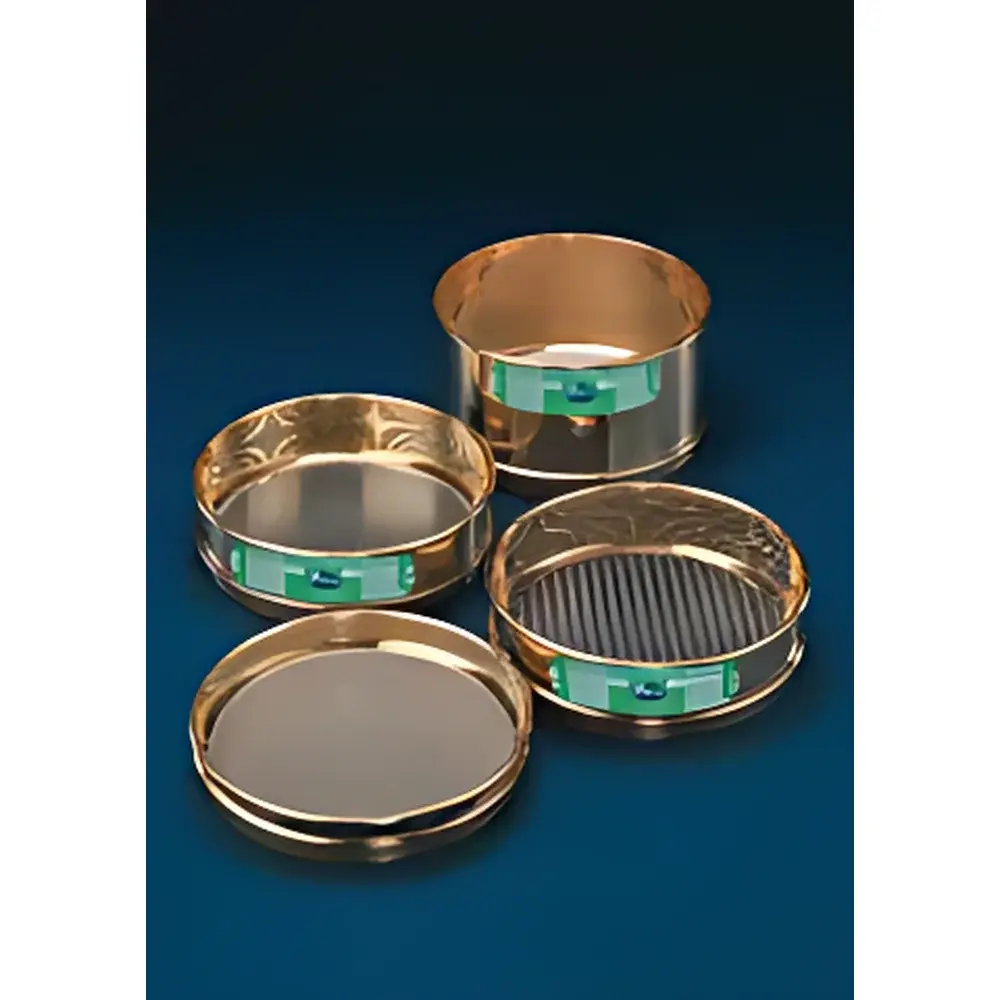
Endecotts Woven Wire Mesh and Perforated Plate Test Sieves
| Brand | Endecotts |
|---|---|
| Origin | United Kingdom |
| Model | Endecotts Series |
| Compliance | ISO 3310-1:2016, BS 410:2000, ASTM E11-22 |
| Nominal Aperture Range | 20 µm – 125 mm |
| Available Diameters | 75 mm (3″), 200 mm (8″), 300 mm (12″), 450 mm (18″) |
| Frame Materials | Stainless Steel, Brass, Electroplated Steel |
| Weave Type | Plain Weave, Twill Weave (per specification) |
| Certification | Individual Certificate of Compliance & Calibration Certificate (per ISO 3310-2:2016 Annex B) |
| Traceability | Unique Serial Number per Sieve |
Overview
Endecotts test sieves are precision-engineered physical separation tools designed for standardized particle size distribution analysis in laboratory, quality control, and R&D environments. Based on the fundamental principle of mechanical sieving—where particles are separated by differential passage through apertures of defined geometry and dimension—these sieves serve as primary reference standards in dry and wet sieving protocols. Manufactured in the United Kingdom with over 70 years of metrological expertise, each Endecotts sieve conforms strictly to ISO 3310-1:2016 (Test sieves — Technical requirements and testing — Part 1: Test sieves of metal wire cloth) and its harmonized national equivalents, including BS 410:2000 and ASTM E11-22. The sieves are not generic filtration media; they are metrologically traceable measurement instruments whose aperture dimensions, wire geometry, and frame integrity are validated under controlled conditions to ensure repeatability and inter-laboratory comparability.
Key Features
- Precision-woven wire mesh or laser-perforated plate construction, manufactured to tolerances specified in ISO 3310-1 Annex A (aperture deviation ±2.5% for apertures ≥125 µm; ±5% for apertures <125 µm)
- Individually serial-numbered frames with full traceability and dual certification: Certificate of Compliance (per ISO 3310-1 Clause 5.1) and optional Calibration Certificate (per ISO 3310-2:2016 Annex B, including mean aperture, standard deviation, wire diameter, and weave classification)
- Optically verified aperture dimensions using automated vision systems calibrated against NPL-traceable standards; measurement uncertainty documented per ISO/IEC 17025 requirements
- Frame integrity engineered for mechanical stability during vibratory or hand-sieving: seamless rim bonding, zero-gap junction between mesh and frame, and burr-free edges for operator safety and sample containment
- Material options selected for chemical compatibility and durability: 316 stainless steel (standard), brass (for non-magnetic or low-reactivity applications), and electroplated steel (for large-diameter industrial sieves ≥350 mm)
- Ergonomic frame design with reinforced beveled rims for secure manual handling and compatibility with standard sieve shakers (e.g., Endecotts AS200, Gilson RX-29, Fritsch Analysette 3)
Sample Compatibility & Compliance
Endecotts test sieves support a broad range of particulate materials—including mineral aggregates, pharmaceutical granules, catalysts, food powders, ceramics, and metal alloys—provided samples are free-flowing, non-fibrous, and non-agglomerating under dry conditions. For cohesive or moisture-sensitive materials, wet sieving protocols compliant with ISO 565:2022 may be applied using perforated plate sieves with appropriate liquid media. All sieves are certified to meet the dimensional and performance criteria of ISO 3310-1, BS 410, and ASTM E11. They are routinely employed in GLP-compliant laboratories and satisfy documentation requirements for FDA 21 CFR Part 11 audit trails when used in conjunction with validated sieve shaker systems and electronic data capture software. Each sieve’s Certificate of Compliance includes material lot number, manufacturing date, inspection technician ID, and reference to the accredited calibration laboratory (UKAS ISO/IEC 17025).
Software & Data Management
While Endecotts test sieves are passive metrological devices, their integration into digital QA/QC workflows is enabled via compatibility with industry-standard sieve analysis platforms. When used with certified sieve shakers equipped with integrated timers, amplitude sensors, and weight-based feed control (e.g., Endecotts AS200dc, Retsch AS 200), raw mass-on-sieve data can be exported in CSV or XML format for statistical evaluation in LIMS or validated spreadsheet templates. Calibration Certificates are issued in PDF/A-1b format with embedded digital signatures, supporting long-term archival and regulatory review. Full traceability—including serial number, aperture verification report, and frame material certification—is maintained across laboratory information management systems (LIMS) and electronic lab notebooks (ELN) in alignment with ISO/IEC 17025 clause 7.7 and EU GMP Annex 11.
Applications
- Quality assurance of bulk pharmaceutical excipients and active ingredients per USP <786> and Ph. Eur. 2.9.33
- Aggregate gradation testing in civil engineering per ASTM C136/C136M and EN 933-1
- Particle size specification verification for catalysts, battery electrode materials, and additive manufacturing powders
- Feedstock qualification in food processing (e.g., flour, sugar, spices) per Codex Alimentarius standards
- Research-grade fractionation in geotechnical, environmental, and materials science laboratories
- Validation of alternative particle sizing methods (e.g., laser diffraction, dynamic image analysis) via reference sieving
FAQ
What is the difference between a Certificate of Compliance and a Calibration Certificate?
A Certificate of Compliance confirms that the sieve was manufactured and inspected per ISO 3310-1 requirements, including visual inspection, aperture sampling, and dimensional verification. A Calibration Certificate (per ISO 3310-2) provides quantitative metrological data: mean aperture size (± standard deviation), wire diameter, and weave geometry—required for ISO/IEC 17025-accredited testing.
Can Endecotts sieves be used for wet sieving?
Yes—perforated plate sieves are explicitly designed for wet sieving per ISO 565:2022. Woven wire mesh sieves may be used in wet applications only if the wire material is chemically resistant to the suspension medium and the frame seal remains intact.
How often should test sieves be recalibrated?
Recalibration frequency depends on usage intensity and regulatory context. ISO/IEC 17025 recommends annual recalibration for accredited labs; high-use industrial settings may require biannual verification. Visual inspection before each use is mandatory per ISO 2591-1.
Are Endecotts sieves compatible with non-Endecotts sieve shakers?
Yes—all Endecotts sieves conform to standardized frame dimensions (e.g., 200 mm diameter with 25 mm height), ensuring mechanical compatibility with ISO-compliant shakers from Retsch, Fritsch, Gilson, and Hosokawa Alpine.
Do you supply custom aperture sizes or non-standard diameters?
Custom woven wire mesh sieves (including non-standard apertures down to 15 µm or up to 150 mm) and bespoke perforated plates are available upon request, subject to minimum order quantities and extended lead times. All custom units receive full certification per ISO 3310-2.



