
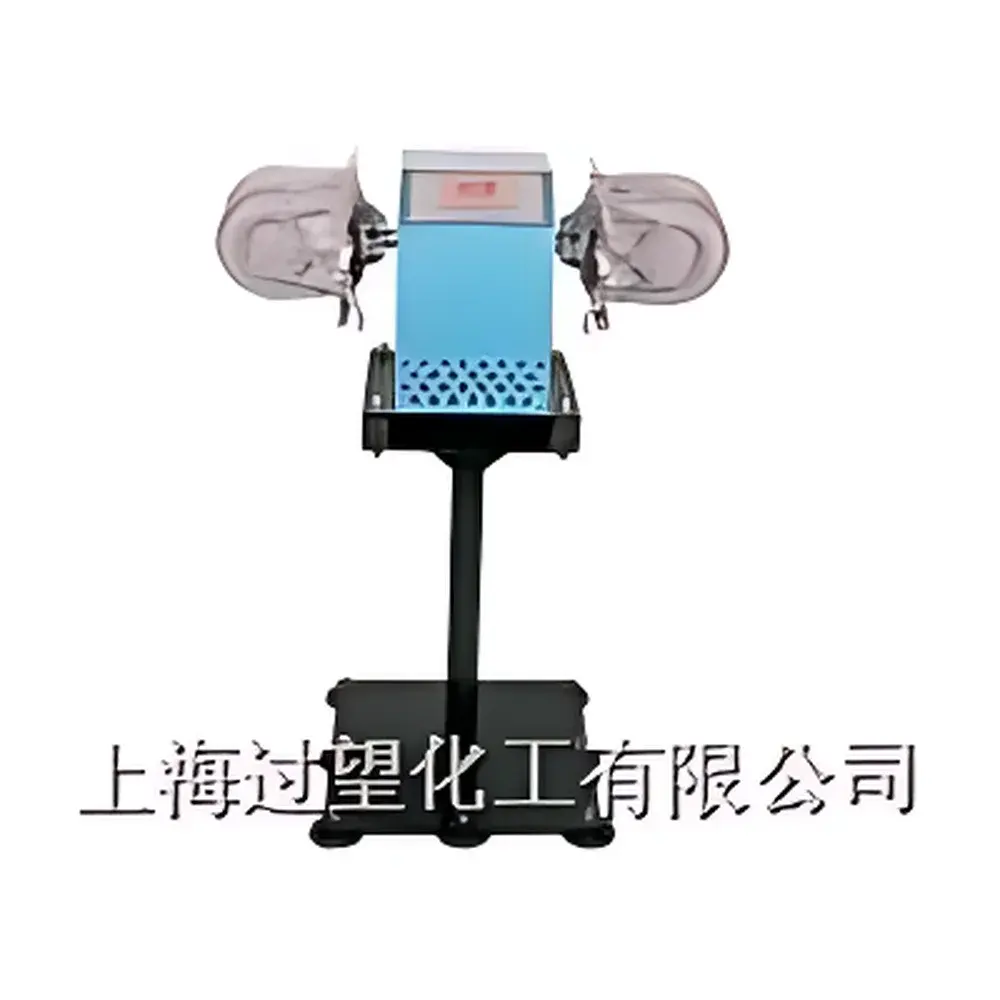
GW Series High-Efficiency Oscillatory Dispersion Tester for Paints and Pigments
| Key | Origin: Shanghai, China |
|---|---|
| Manufacturer Type | Authorized Distributor |
| Model | GW |
| Pricing | Available Upon Request |
| Motor Power | 370 W, 220 V, 50 Hz |
| Crankshaft Speed | 630 rpm |
| Reciprocating Stroke | 16 mm |
| Max. Amplitude (Top/Bottom) | 8 mm |
| Arm Oscillation Angle | 30° |
| Dimensions (L×W×H) | 790 × 520 × 1090 mm |
| Net Weight | 63 kg |
Overview
The GW Series High-Efficiency Oscillatory Dispersion Tester is an engineered laboratory instrument designed specifically for rapid pigment and filler dispersion evaluation in liquid-phase coating systems. It operates on the principle of controlled mechanical oscillation—utilizing a crank-driven eccentric mechanism to generate high-frequency, low-amplitude reciprocating motion of the dispersion head. This motion induces intense shear and impact forces within the sample cup, effectively breaking down agglomerates and promoting uniform particle distribution without requiring grinding media or extended processing times. Unlike rotor-stator homogenizers or high-shear mixers, the GW tester delivers reproducible dispersion energy through standardized mechanical displacement, making it particularly suitable for comparative studies where process consistency across multiple formulations is critical. Its design aligns with the fundamental requirements of ASTM D476 and ISO 8781-2 for pigment dispersion assessment, while also fulfilling the operational criteria specified in GB/T 9287—China’s national standard for evaluating pigment dispersibility via oscillatory methods.
Key Features
- Robust cast-iron frame with vibration-dampening base structure ensures stable operation at 630 rpm crankshaft speed and minimizes transmission of mechanical noise to adjacent workstations.
- Precision-machined oscillation arm with fixed 30° swing angle guarantees consistent energy input per cycle, enabling direct comparability between test runs and across laboratories.
- Adjustable vertical travel (16 mm total reciprocating stroke, ±8 mm amplitude) accommodates varied sample volumes (typically 10–100 mL) in standard DIN or ASTM-compatible dispersion cups.
- Thermally protected 370 W induction motor provides continuous-duty performance under load, compliant with IEC 60034-1 efficiency standards and rated for 220 V / 50 Hz mains supply common in Asian research facilities.
- Ergonomic height-adjustable platform and quick-clamp sample holder facilitate rapid setup and safe handling of solvent-based or high-viscosity dispersions without tooling.
Sample Compatibility & Compliance
The GW tester is validated for use with aqueous, solvent-borne, and UV-curable coating formulations containing organic pigments, inorganic extenders (e.g., TiO₂, CaCO₃), and polymeric dispersants. It supports preparation of tinted dilutions for color strength evaluation per ISO 787-24 and GB/T 1711—standards governing comparative colorimetric analysis of pigmentary systems. As a reference dispersion device under GB/T 9287, it satisfies audit requirements for GLP-compliant R&D labs conducting formulation screening, raw material qualification, and QC release testing. While not intrinsically certified for hazardous area use, its sealed motor housing and non-sparking mechanical drive meet IP54 environmental protection rating per IEC 60529.
Software & Data Management
The GW Series operates as a standalone mechanical instrument with no embedded digital controller or data logging capability. However, its deterministic kinematic profile—fixed crank speed, stroke length, and oscillation angle—enables full traceability when integrated into LIMS or ELN workflows. Users may record run parameters (e.g., time, cycles, cup type, batch ID) manually or via external timers synchronized to start/stop signals. For regulatory environments governed by FDA 21 CFR Part 11 or EU Annex 11, laboratories commonly pair the GW tester with validated electronic notebooks that capture operator identity, timestamped test entries, and version-controlled SOP references—ensuring full audit trail integrity during inspections.
Applications
- Rapid screening of dispersant efficacy across pigment classes (phthalocyanines, quinacridones, iron oxides) under identical mechanical stress conditions.
- Preparation of standardized tint bases for spectrophotometric evaluation of color strength, undertone, and flocculation stability per ISO 12041 and ASTM D2805.
- Comparative assessment of milling efficiency between alternative pigment surface treatments or resin architectures prior to full-scale wet-grind development.
- Quality control of incoming pigment batches using dispersion time-to-target fineness (e.g., Hegman gauge reading ≥6.5) as a release criterion.
- Supporting DOE (Design of Experiments) protocols in formulation optimization, where multiple variables (disperant dosage, pH, ionic strength) are evaluated concurrently using parallel dispersion units.
FAQ
Is the GW tester compatible with non-standard sample containers?
Yes—provided the container has a flat, rigid bottom and fits securely within the clamping range (max Ø 120 mm × H 150 mm), users may employ custom cups made from stainless steel, borosilicate glass, or chemically resistant polymers.
Does the instrument require calibration or periodic verification?
While no formal calibration certificate is issued, laboratories should verify crankshaft speed annually using a contact tachometer traceable to NIST or CNAS standards; amplitude and stroke may be confirmed via dial indicator measurement against factory specifications.
Can the GW tester be used for nanoparticle dispersion studies?
It is not recommended for primary deagglomeration of nanoparticles (<100 nm) due to insufficient energy density; however, it remains effective for secondary dispersion stabilization and compatibility screening in pre-dispersed nanosuspensions.
What maintenance is required for long-term reliability?
Biannual lubrication of the crankshaft bearing and oscillation pivot points with NLGI #2 lithium grease, plus visual inspection of belt tension and clamp jaw wear, ensures >10,000 operating hours under typical lab usage conditions.



