
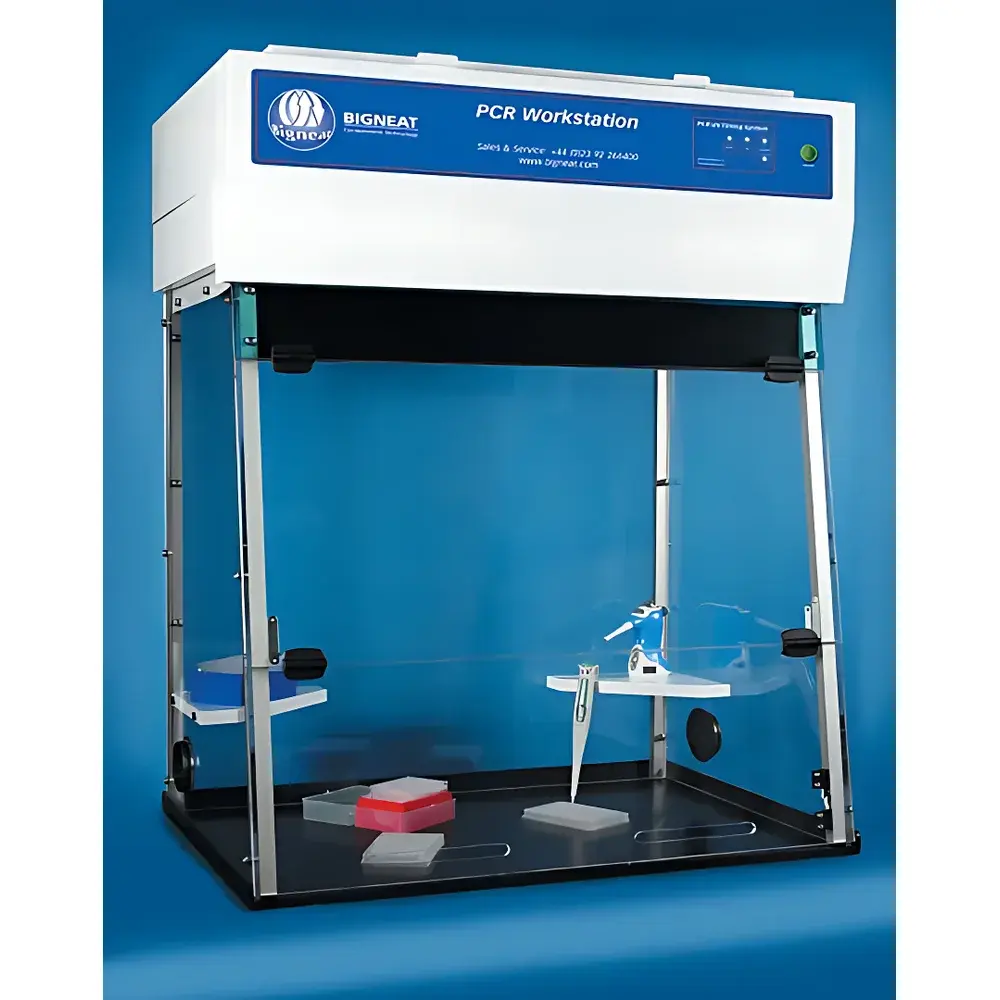
Bigneat BW UV PCR Vertical Laminar Flow Clean Bench
| Brand | Bigneat |
|---|---|
| Origin | United Kingdom |
| Model | BW UV PCR |
| Instrument Type | Vertical Laminar Flow Clean Bench |
| Cleanliness Class | ISO Class 5 (100-level) |
| Noise Level | <50 dB(A) |
| Airflow Direction | Vertical Downflow |
| User Configuration | Single-Operator, Front-Access |
| UV Lamp Power | 254 nm Germicidal UV-C |
| UV Exposure Timer | Adjustable 5–30 min |
| Work Surface Material | PVC-coated Black Tray |
| Viewing Window | 8 mm Acrylic, UV-blocking |
| Safety Interlock | Automatic UV shutoff upon sash movement |
| Air Velocity | 0.45 m/s (sash-open mode), 0.3 m/s (standard operation) |
| Illumination | 15 W White LED Lamp (externally controlled) |
| Structural Frame | Powder-coated Low-Carbon Steel |
| Compliance | EN 12464-1, EN 1822, IEC 61000-6-3, CE Marked |
Overview
The Bigneat BW UV PCR Vertical Laminar Flow Clean Bench is an engineered solution for molecular biology laboratories requiring stringent contamination control during polymerase chain reaction (PCR) setup, nucleic acid handling, and low-bioburden aseptic procedures. Unlike horizontal flow hoods—where airflow may direct contaminants toward the operator—the BW UV PCR employs a certified vertical laminar downflow architecture. Air is drawn through a pre-filter, conditioned, and passed through an H14-grade HEPA filter (per EN 1822:2022) before being delivered uniformly downward at a controlled velocity of 0.3 m/s (standard) or 0.45 m/s (sash-open mode). This unidirectional airflow creates a sterile work envelope that isolates samples from ambient particulates and microorganisms. Integrated 254 nm UV-C germicidal irradiation enables validated surface decontamination of the interior chamber prior to use, with programmable exposure durations (5–30 minutes) and optical reflector geometry ensuring uniform intensity distribution across the work surface. The system complies with ISO 14644-1 Class 5 (formerly “100-level”) air cleanliness requirements under dynamic operating conditions.
Key Features
- Vertical laminar airflow with real-time velocity regulation: maintains 0.3 m/s at rest and automatically increases to 0.45 m/s when the acrylic sash is raised—preventing inward particle incursion.
- H14 HEPA filtration (EN 1822-compliant): achieves ≥99.995% retention efficiency for particles ≥0.1–0.2 µm, delivering ISO Class 5 air quality within the working area.
- UV-C safety interlock system: door position sensor instantly deactivates the 254 nm UV lamp upon sash movement, eliminating operator exposure risk.
- UV-attenuating 8 mm acrylic viewing window: provides full visual access while blocking >99.9% of germicidal UV radiation; additionally rated for attenuation of β-particles (e.g., 32P emissions) common in radiolabeled nucleic acid workflows.
- Black PVC-coated work tray: enhances visibility of liquid spills or aerosol residues, supporting rapid visual inspection and procedural adherence to GLP principles.
- Low-noise operation (<50 dB[A] at 1 m): engineered fan and acoustic dampening ensure compatibility with quiet laboratory environments and adjacent sensitive instrumentation.
- Dual-port glove access points with removable caps: facilitate manipulation of sealed vessels or secondary containment without compromising laminar integrity.
Sample Compatibility & Compliance
The BW UV PCR clean bench is designed for non-hazardous biological samples—including DNA/RNA templates, primers, enzymes, and master mixes—under ISO Class 5 environmental control. It is not suitable for handling volatile chemicals, cytotoxic agents, or infectious materials requiring biosafety level 2 (BSL-2) containment. Regulatory alignment includes EN 12464-1 (lighting and indoor air quality for workplaces), EN 1822-1:2022 (HEPA/ULPA filter classification), and IEC 61000-6-3 (EMC emission limits). The unit carries CE marking per EU Machinery Directive 2006/42/EC and Low Voltage Directive 2014/35/EU. While not classified as medical device software, its timer-based UV control supports audit-ready documentation for internal SOPs aligned with ISO/IEC 17025 and CLIA-mandated environmental monitoring protocols.
Software & Data Management
The BW UV PCR operates via a dedicated electromechanical control panel with tactile push-button interface—no embedded firmware or network connectivity. UV exposure duration is set manually (5–30 min increments); elapsed time is indicated by LED countdown. All operational parameters—including airflow status, UV activation, and low-flow alarm—are displayed via discrete status LEDs. The absence of digital data logging aligns with ISO 13485 Annex C and FDA 21 CFR Part 11 guidance for equipment where electronic records are not required for critical process steps. For laboratories implementing electronic lab notebooks (ELN), manual entry of UV cycle logs and daily airflow verification results satisfies traceability requirements under GLP and GMP Annex 11.
Applications
- Pre-PCR reaction assembly: pipetting of template DNA, Taq polymerase, dNTPs, and primers under particle-free conditions.
- Cloning workflow stages: ligation, transformation plate streaking, and plasmid miniprep setup.
- Cell culture passaging support: non-infectious reagent preparation and media aliquoting.
- Quality control sample preparation: reference standard dilution and calibration curve generation for qPCR assays.
- Radiolabeling workflows involving 32P or 35S: acrylic shielding reduces operator beta radiation dose per ICRP Publication 103 recommendations.
FAQ
Is the BW UV PCR certified for ISO Class 5 (100-level) performance?
Yes—verified under dynamic operating conditions per ISO 14644-1:2015 using discrete particle counter measurements at 0.5 µm and 5.0 µm thresholds.
Can this unit be used for handling live pathogens or viral vectors?
No. It provides only personnel and product protection—not environmental protection—and is not a biosafety cabinet (BSC). BSL-2+ work requires NSF/ANSI 49-compliant Class II BSCs.
What maintenance is required for the H14 HEPA filter?
Annual filter integrity testing (DOP/PAO scan) and pressure differential monitoring are recommended. Filter replacement intervals depend on usage frequency and ambient air quality—typically every 2–5 years.
Does the unit meet electromagnetic compatibility (EMC) standards for integration into automated lab environments?
Yes—it conforms to IEC 61000-6-3 (radiated/emission) and IEC 61000-6-2 (immunity), enabling co-location with PCR cyclers, centrifuges, and robotic liquid handlers without signal interference.
Is the black work surface chemically resistant to common PCR decontaminants such as 10% bleach or DNA-away™?
The PVC-coated tray resists short-term exposure to sodium hypochlorite (≤10%), ethanol (70–100%), and quaternary ammonium compounds. Prolonged immersion or undiluted acids/bases are not recommended.



