
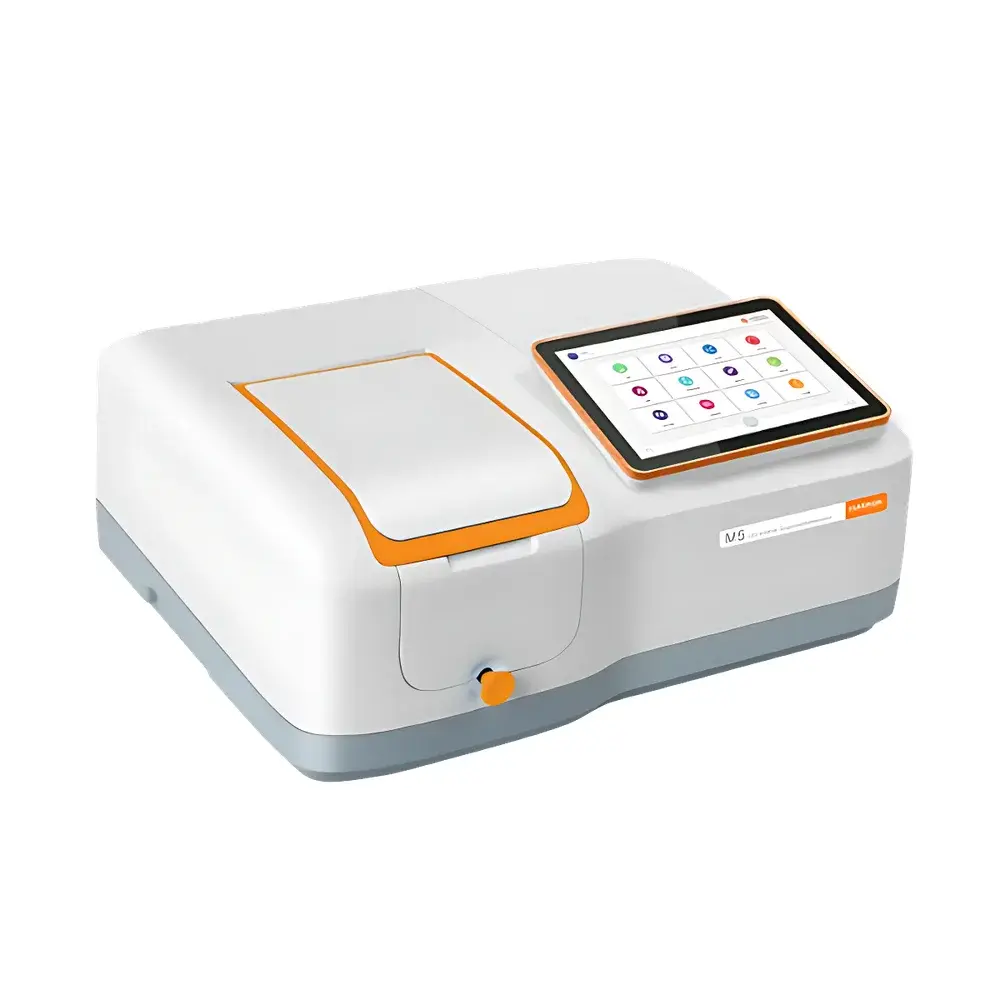
Mapada M5 Dual-Beam Pulsed Xenon Lamp UV-Vis Spectrophotometer
| Brand | Mapada |
|---|---|
| Origin | Shanghai, China |
| Manufacturer Type | OEM Manufacturer |
| Instrument Architecture | Dual-Beam |
| Detector Type | Photocell |
| Wavelength Range | 190–1100 nm |
| Wavelength Scanning Mode | Automatic |
| Spectral Bandwidth | 2 nm |
| Wavelength Accuracy | ±0.5 nm |
| Wavelength Repeatability | ≤0.3 nm |
Overview
The Mapada M5 Dual-Beam Pulsed Xenon Lamp UV-Vis Spectrophotometer is an engineered solution for routine and research-grade quantitative and qualitative analysis in the ultraviolet, visible, and near-infrared spectral regions. Utilizing a stable pulsed xenon lamp as its broadband light source, the M5 eliminates the need for lamp replacement during typical laboratory service life and ensures consistent spectral output across 190–1100 nm without thermal drift or intensity decay associated with deuterium/tungsten halogen lamp combinations. Its dual-beam optical design continuously compares sample and reference beam intensities in real time, compensating for source fluctuation, solvent absorption, and cuvette imperfections—thereby delivering high photometric stability and measurement reproducibility. Designed for compliance-driven environments, the M5 supports traceable calibration protocols and meets fundamental performance criteria aligned with ISO 9001 quality management systems and ASTM E275–22 (Standard Practices for Describing and Measuring Performance of UV-Visible Spectrophotometers).
Key Features
- Dual-beam optical architecture with real-time reference compensation for enhanced baseline stability and reduced measurement variability
- Pulsed xenon lamp source offering >10⁹ shot lifetime, no warm-up delay, and uniform spectral irradiance from 190 nm to 1100 nm
- Fixed 2 nm spectral bandwidth optimized for resolution/sensitivity balance in pharmaceutical assay, water quality testing, and material characterization
- Automated wavelength scanning with step resolution down to 0.1 nm and programmable scan speed (60–1200 nm/min)
- Wavelength accuracy of ±0.5 nm and repeatability ≤0.3 nm—verified per NIST-traceable holmium oxide and didymium glass filters
- Integrated self-diagnostic routines including lamp energy monitoring, optical alignment verification, and detector linearity validation
- Robust mechanical design with temperature-stabilized monochromator housing and anti-vibration optical baseplate
Sample Compatibility & Compliance
The M5 accommodates standard 10 mm pathlength quartz, glass, or plastic cuvettes (including matched pairs for ratio-based quantitation), as well as microvolume adapters (down to 50 µL) and optional fiber-optic probes for remote or in-situ measurements. It supports both transmission and absorbance modes, with transmittance linearity validated from 0–100% T and absorbance linearity verified up to 3.0 AU at 260 nm (using neutral density filters). The instrument conforms to essential electromagnetic compatibility (EMC) requirements per IEC 61326-1 and safety standards per IEC 61010-1. While not inherently 21 CFR Part 11 compliant, its firmware architecture allows integration into validated laboratory information management systems (LIMS) via RS-232 or USB virtual COM port, enabling audit trail generation, electronic signature support, and user-access-level configuration when deployed under GLP or GMP frameworks.
Software & Data Management
The M5 operates with Mapada’s SpectraPro v3.2 software (Windows 10/11 compatible), providing intuitive control of acquisition parameters, kinetic and multi-wavelength scanning, spectral subtraction, and concentration calculation using single- or multi-point calibration curves. Raw spectral data are exported in CSV and JCAMP-DX formats for third-party analysis (e.g., MATLAB, OriginLab, Unscrambler). Software features include automatic peak identification, baseline correction algorithms (asymmetric least squares), and customizable report templates compliant with internal SOPs. All measurement sessions log timestamp, operator ID, instrument serial number, and calibration status metadata—enabling full traceability for internal QA audits or regulatory inspections.
Applications
- Pharmaceutical QC: Assay of active pharmaceutical ingredients (APIs) per USP and EP 2.2.25; excipient purity screening
- Environmental analysis: Nitrate, phosphate, and COD determination in wastewater per APHA Standard Methods 4500-NO₃⁻, 4500-P, and 5210 B
- Academic research: Ligand-binding studies, enzyme kinetics (e.g., NADH oxidation at 340 nm), and nanoparticle size estimation via plasmon resonance
- Food & beverage: Colorimetric quantification of anthocyanins, carotenoids, and preservatives such as sulfites and benzoates
- Materials science: Optical bandgap estimation of thin films and semiconductor nanomaterials using Tauc plot methodology
FAQ
Does the M5 support GLP-compliant data integrity practices?
Yes—when operated with SpectraPro v3.2 on a domain-authenticated Windows system and integrated with a validated LIMS or ELN, the M5 supports ALCOA+ principles (Attributable, Legible, Contemporaneous, Original, Accurate) through session logging, electronic signatures, and immutable raw data export.
Can the xenon lamp be replaced by the user?
No—the pulsed xenon lamp is factory-aligned and sealed within the optical module. Replacement requires certified service technician intervention and post-replacement wavelength calibration verification.
Is the 2 nm spectral bandwidth adjustable?
No—the M5 employs a fixed-slit monochromator optimized for robustness and long-term wavelength fidelity; variable bandwidth models (e.g., M6 series) are available for advanced method development needs.
What cuvette materials are recommended below 220 nm?
Only high-quality synthetic fused silica cuvettes with certified UV transmission down to 190 nm should be used; standard quartz may exhibit significant absorption below 200 nm due to metallic impurities.
How often must wavelength calibration be performed?
Initial calibration is performed at factory; users should verify wavelength accuracy quarterly using holmium oxide reference filter (NIST SRM 2034) or equivalent, especially after transport or mechanical shock.




