
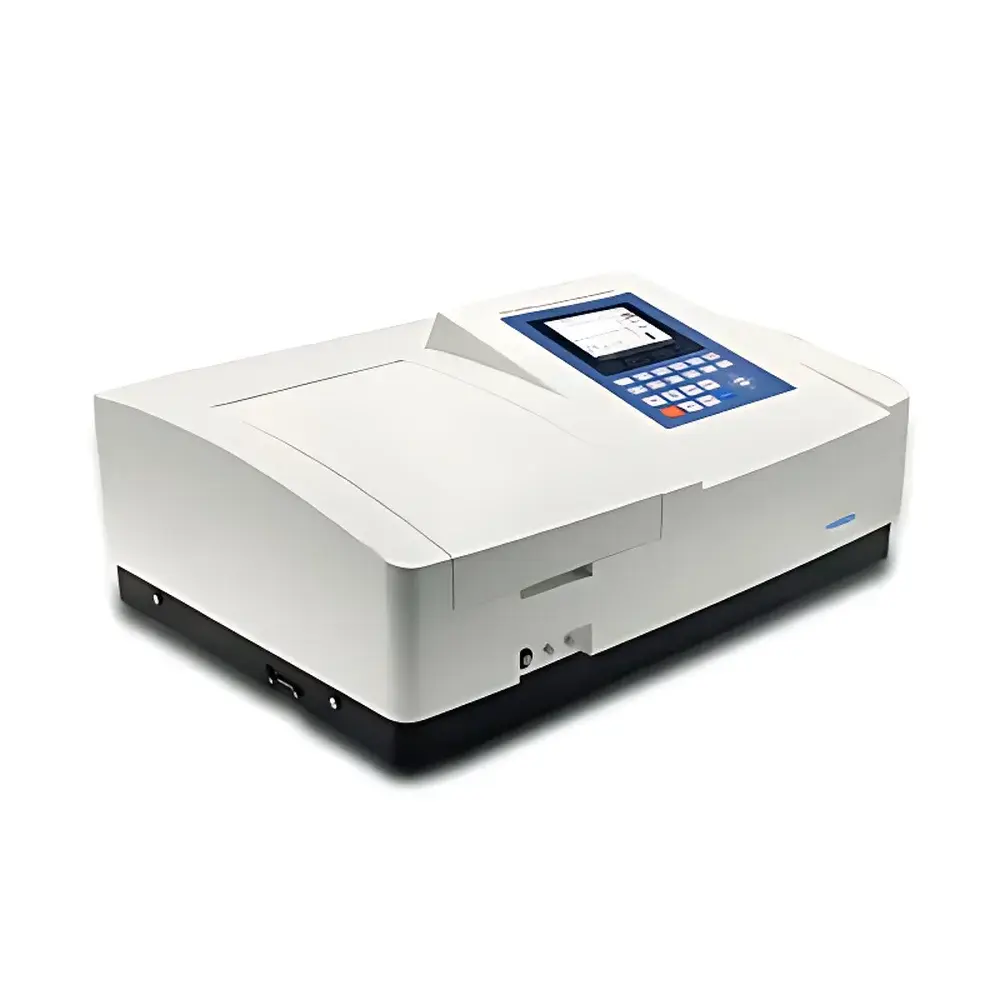
Mapada UV-3000PC Scanning Ultraviolet-Visible Spectrophotometer
| Brand | Mapada |
|---|---|
| Origin | Shanghai, China |
| Manufacturer Type | Direct Manufacturer |
| Product Origin | Domestic (China) |
| Model | UV-3000PC |
| Price Range | USD 4,200–7,000 |
| Optical Design | Pseudo-Double-Beam |
| Detector | Silicon Photodiode |
| Wavelength Range | 190–1100 nm |
| Wavelength Accuracy | ±0.5 nm |
| Spectral Bandwidth | 4 nm |
| Wavelength Setting | Motorized Auto-Scanning |
| Display | 320 × 240 LCD (5-inch), Graphical Interface |
| Measurement Modes | Transmittance (%T), Absorbance (A), Concentration (C), Energy (E) |
| Scan Speed Options | High / Medium / Low (up to 3800 nm/min) |
| Photometric Range | 0–200% T, –4.0 to +4.0 A |
| Light Sources | Imported long-life deuterium lamp (D₂) and tungsten-halogen lamp (W) |
| Lamp Monitoring | Real-time operational hour logging for both lamps |
| Sample Compartment | Accommodates cuvettes from 5 mm to 100 mm pathlength |
| Data Interface | USB 2.0 |
| Printer Interface | Parallel port (Centronics) |
| Power Supply | AC 220 V / 50 Hz or AC 110 V / 60 Hz |
| Dimensions (W × D × H) | 490 × 360 × 240 mm |
| Net Weight | 14 kg |
Overview
The Mapada UV-3000PC is a pseudo-double-beam scanning ultraviolet-visible (UV-Vis) spectrophotometer engineered for precision quantitative and qualitative analysis across academic research laboratories, quality control environments, and routine pharmaceutical testing workflows. Operating on the principle of Beer-Lambert law-based absorbance measurement, the instrument employs a high-stability optical architecture with a 1200 lines/mm holographic grating and motorized wavelength drive to deliver consistent spectral acquisition from 190 nm to 1100 nm. Its pseudo-double-beam design compensates for source intensity drift and detector sensitivity variation during scanning—enhancing baseline stability and photometric reproducibility without requiring a dedicated reference beam path. The system integrates dual light sources: an imported ozone-reduced deuterium lamp for deep-UV performance (190–350 nm) and a stabilized tungsten-halogen lamp for visible-NIR coverage (350–1100 nm), ensuring broad spectral continuity and long-term radiometric reliability.
Key Features
- 5-inch graphical LCD (320 × 240 pixels) with native support for real-time display of absorption spectra, kinetic time-course plots, multi-wavelength quantitation, and standard calibration curves—all in intuitive English-language interface.
- Optimized optical train featuring a high-efficiency 1200 lines/mm holographic grating and precision-aligned silicon photodiode detector, delivering ±0.5 nm wavelength accuracy and 4 nm spectral bandwidth as specified per ISO 9001-verified manufacturing protocols.
- Modular lamp housing with plug-in deuterium and tungsten-halogen lamps—enabling field replacement without optical recalibration or mechanical realignment.
- Integrated lamp-hour monitoring system that logs cumulative operational time for both sources, supporting predictive maintenance scheduling and regulatory traceability under GLP/GMP frameworks.
- Spacious sample compartment accommodating rectangular cuvettes with pathlengths from 5 mm to 100 mm—including standard 10 mm quartz, glass, or plastic cells—and compatible with optional accessories such as Peltier temperature controllers or fiber-optic probes.
- GLP self-validation function allowing users to perform on-demand wavelength accuracy verification (using holmium oxide or didymium filters) and photometric linearity checks (via neutral density filters), with automated report generation compliant with internal audit requirements.
- Dual data output: USB 2.0 interface for direct connection to Windows-based PCs; parallel (Centronics) port for legacy dot-matrix or thermal printers used in regulated QC labs.
Sample Compatibility & Compliance
The UV-3000PC supports a wide range of liquid-phase samples in transmission mode, including aqueous and organic solutions, buffer-diluted biomolecules (e.g., nucleic acids, proteins), colored dyes, catalyst precursors, and pharmaceutical formulations. Its 190–1100 nm range enables detection of π→π* transitions (e.g., aromatic compounds), n→π* transitions (e.g., carbonyls), and charge-transfer bands critical in method development per USP General Chapter <851> and EP 2.2.25. The instrument meets core performance criteria outlined in ISO/IEC 17025 for analytical instrument qualification and is routinely deployed in laboratories adhering to FDA 21 CFR Part 11 when paired with Mapada’s validated PC software (version 3.2+), which includes electronic signature capability, audit trail logging, and user-access-level configuration.
Software & Data Management
Bundled Mapada SpectraPro™ PC software (v3.2 or later) provides full remote control, spectral acquisition, derivative analysis, peak search, multi-curve overlay, and custom report export (PDF, CSV, TXT). All raw scan data are stored with metadata tags—including date/time stamp, operator ID, lamp status, and calibration history—ensuring full traceability. The software supports IQ/OQ documentation templates aligned with ASTM E2500 and facilitates integration into LIMS environments via standardized ASCII output formats. Data encryption and role-based access control comply with institutional cybersecurity policies for sensitive analytical records.
Applications
- Quantitative determination of active pharmaceutical ingredients (APIs) per ICH Q2(R2) guidelines using single- or multi-point calibration.
- Enzyme kinetics monitoring (e.g., NADH/NADPH oxidation at 340 nm) with configurable time-scan intervals down to 0.1 s.
- Water quality analysis: nitrate (220 nm), phosphate (880 nm), and COD estimation via dichromate reduction.
- Material science: bandgap estimation of semiconductor nanoparticles via Tauc plot construction from diffuse reflectance-derived Kubelka-Munk functions.
- Educational use: spectral identification of conjugated systems, solvent effects on λmax, and validation of Lambert-Beer linearity across concentration gradients.
FAQ
What is the difference between “pseudo-double-beam” and true double-beam optics?
Pseudo-double-beam instruments alternate rapidly between sample and reference beams using a single detector and chopper wheel—reducing cost and complexity while maintaining adequate baseline correction for most routine applications. True double-beam systems employ two synchronized detectors, offering superior stability for ultra-low-drift applications like long-duration kinetics.
Is the UV-3000PC compliant with FDA 21 CFR Part 11?
Yes—when operated with Mapada SpectraPro™ v3.2+ and configured with password-protected user roles, electronic signatures, and immutable audit trails, the system satisfies electronic record and signature requirements for regulated pharmaceutical and clinical labs.
Can the instrument be calibrated using NIST-traceable standards?
Absolutely. The built-in GLP validation module accepts NIST SRM 2034 (peak wavelength), SRM 930e (photometric accuracy), and SRM 2035 (stray light) for full performance verification per ISO/IEC 17025 Section 6.5.
What maintenance is required for the deuterium lamp?
Lamp lifetime exceeds 1,000 hours under typical usage. The instrument logs operational hours automatically; replacement is recommended after 1,200 hours or if spectral noise increases beyond 0.002 AU RMS in the 200–220 nm region.
Does the software support method transfer to other Mapada models?
Yes—SpectraPro™ uses a unified method file format (.mpm) compatible across UV-2000, UV-3000, and UV-6000 series instruments, enabling seamless cross-platform method migration and comparative analysis.




