
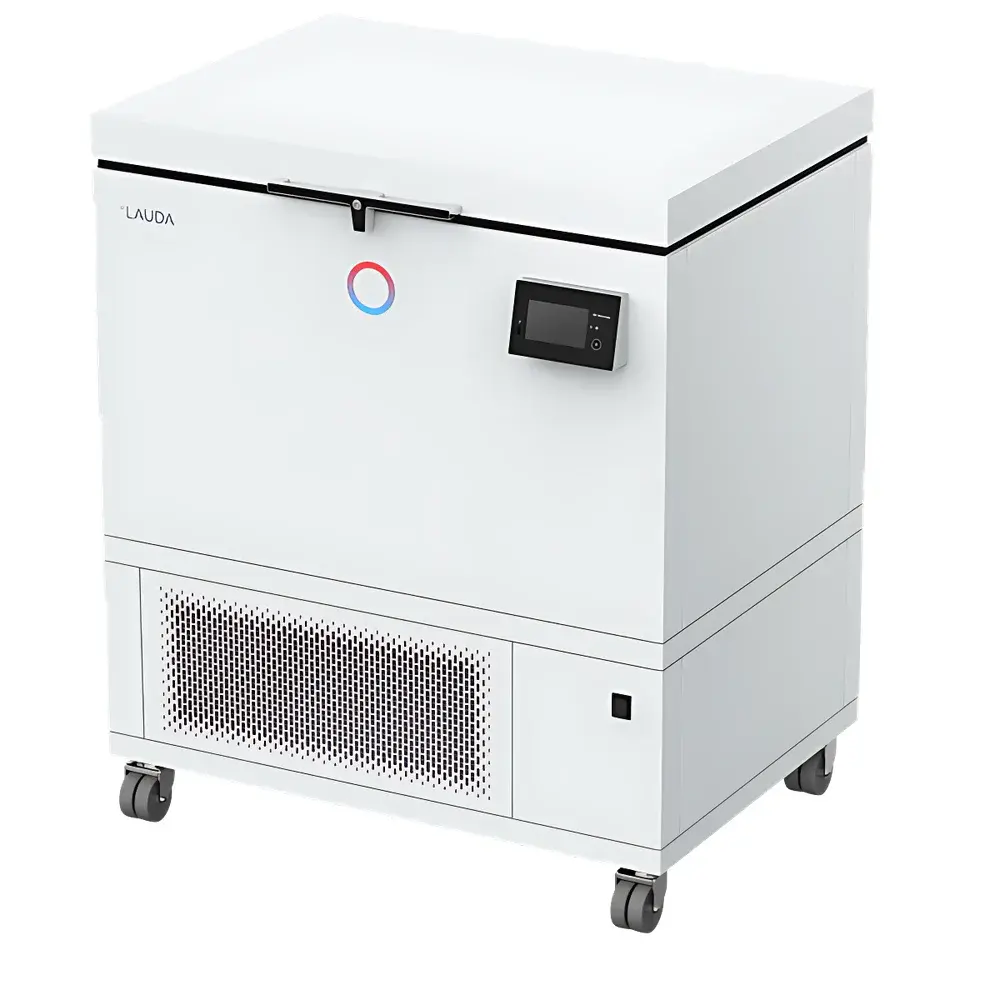
LAUDA Versafreeze VF 20040 C -40 °C Upright Laboratory Low-Temperature Freezer
| Brand | LAUDA |
|---|---|
| Origin | Germany |
| Model | VF 20040 C |
| Type | Upright Ultra-Low Temperature Freezer (≥ –60 °C) |
| Effective Volume | 205 L |
| Internal Dimensions (W×D×H) | 790 × 520 × 500 mm |
| External Dimensions (W×D×H) | 960 × 790 × 1130 mm |
| Power Supply | 230 V / 50 Hz |
| Energy Consumption | 7 kWh/d at –40 °C |
| Cooling Time (20 °C → –40 °C, empty) | ≤ 3 h |
| Hold Time (–40 °C → 0 °C, power off) | ≥ 6 h |
| Refrigerant | R-1270 (GWP = 3), 0.145 kg |
| Net Weight | 188 kg |
| Ambient Operating Range | 15–28 °C |
| Temperature Range | –40 to 0 °C |
| Port Diameter | 2 × Ø13 mm (for Pt100 probes) |
| Compressor | Hermetic, maintenance-free |
| Insulation | High-vacuum multilayer panel system |
| Door Seal | Magnetic gasket, frost-resistant |
| Data Logging | Built-in, non-volatile memory |
| Connectivity | Ethernet (IIoT-ready), RS-485 |
Overview
The LAUDA Versafreeze VF 20040 C is a high-efficiency upright laboratory low-temperature freezer engineered for stable, energy-conscious storage of biological samples, reagents, and temperature-sensitive materials at –40 °C. Unlike conventional cascade or single-stage ultra-low temperature freezers operating below –60 °C, the VF 20040 C is purpose-built for applications requiring precise thermal control within the –40 to 0 °C range—ideal for preserving cell lines, primary tissues, enzymatic preparations, RNA/DNA stocks, and pharmaceutical intermediates where deep cryogenic conditions are unnecessary but long-term thermal stability remains critical. Its refrigeration architecture employs a single-stage, hermetically sealed compressor system paired with natural hydrocarbon refrigerant R-1270 (propylene), classified as A3 safety grade with a global warming potential (GWP) of just 3—fully aligned with EU F-Gas Regulation (EU) No 517/2014 and future-proofed against phase-out timelines affecting high-GWP alternatives. The unit achieves rapid cooldown (≤3 hours from ambient to –40 °C, empty load) and extended hold time (≥6 hours without power) through an integrated eight-layer vacuum-insulated panel (VIP) construction, minimizing thermal bridging and maximizing usable internal volume relative to footprint.
Key Features
- High-vacuum multilayer insulation system delivering superior thermal resistance per unit thickness—enabling 205 L effective storage volume within a compact 0.85 m² floor footprint.
- Water-cooled condenser option available, reducing heat rejection into laboratory ambient air by >90% compared to air-cooled equivalents—critical for temperature-sensitive core facilities and shared lab environments.
- Stainless steel interior (AISI 304) with seamless welds and rounded corners for easy decontamination and compliance with GLP/GMP cleaning validation protocols.
- Intelligent touchscreen interface with password-protected user management (three-tier access: operator, supervisor, administrator) and configurable alarm thresholds for high/low temperature, door open, power failure, and sensor fault.
- Integrated data logger storing ≥30 days of minute-interval temperature history and alarm events in non-volatile memory; supports CSV export via USB or network transfer.
- Dual Ø13 mm pass-through ports fitted with vacuum-tight caps, enabling real-time monitoring with external Pt100 sensors without compromising cabinet integrity.
- Self-diagnostic system with continuous compressor performance monitoring, refrigerant pressure logging, and predictive maintenance alerts via Ethernet interface.
Sample Compatibility & Compliance
The VF 20040 C accommodates standard laboratory consumables including 2 mL cryovials (up to 1,200 units), 50 mL conical tubes, microcentrifuge tube racks, 96-well PCR plates, and deep-well plates—supported by optional drawer kits and adjustable stainless steel shelving systems. Its uniform temperature distribution (±1.2 °C across all zones at –40 °C, per IEC 61000-4-2 validation protocol) ensures reproducible storage conditions essential for ISO 17025-accredited testing labs and clinical trial sample repositories. The unit meets EN 61000-6-3 (EMC emission), EN 61000-6-2 (immunity), and IEC 61010-1 (safety for laboratory equipment) standards. Optional 21 CFR Part 11-compliant software modules provide electronic signature capability, audit trail generation, and role-based access control for regulated biobanking and pharmaceutical QC workflows.
Software & Data Management
Equipped with embedded Linux-based firmware, the VF 20040 C supports native IIoT integration via standard Ethernet (TCP/IP) and Modbus RTU over RS-485. Remote monitoring, configuration, and firmware updates are achievable through LAUDA’s web-enabled LabControl Suite—deployable on-premise or via secure cloud gateway. Logged temperature data complies with ALCOA+ principles (Attributable, Legible, Contemporaneous, Original, Accurate, Complete, Consistent, Enduring, Available) and can be exported in timestamped, digitally signed CSV format. Optional PDF report generation includes calibration certificate traceability to national metrology institutes (e.g., PTB, NIST) and deviation trend analysis for preventive maintenance scheduling.
Applications
- Long-term stabilization of monoclonal antibodies and recombinant proteins prior to lyophilization.
- Storage of clinical biospecimens under ISO 20387:2018 biobanking requirements.
- Pre-analytical holding of blood plasma, serum, and PBMCs prior to flow cytometry or ELISA processing.
- Intermediate storage of thermolabile reference standards in pharmaceutical QC laboratories.
- Backup cold chain buffer for vaccine formulation development pipelines.
- Environmental simulation support—maintaining controlled cold staging for material stress testing per ASTM D792 or ISO 1183.
FAQ
What is the minimum ambient temperature required for stable operation?
The unit is rated for continuous operation between 15 °C and 28 °C ambient. Operation below 15 °C may impair oil return dynamics and reduce compressor service life.
Can the freezer be integrated into a centralized building management system (BMS)?
Yes—via Modbus RTU over RS-485 or HTTP API over Ethernet, supporting real-time status polling, alarm forwarding, and setpoint adjustment.
Is external backup cooling (e.g., liquid nitrogen or CO₂) supported?
The cabinet includes provisions for retrofitting external cryogen interfaces; however, LAUDA does not supply or validate third-party emergency cooling modules. Integration requires site-specific risk assessment per IEC 62304.
How often does the built-in data logger require calibration verification?
Per ISO/IEC 17025:2017, annual traceable calibration of the internal Pt100 sensor array is recommended using a certified dry-block calibrator (±0.1 °C uncertainty).
Does the unit comply with FDA 21 CFR Part 11 for electronic records?
Hardware-level compliance is achieved; full Part 11 implementation requires deployment of LAUDA’s validated LabControl Suite with configured audit trail, electronic signatures, and system access controls.





