
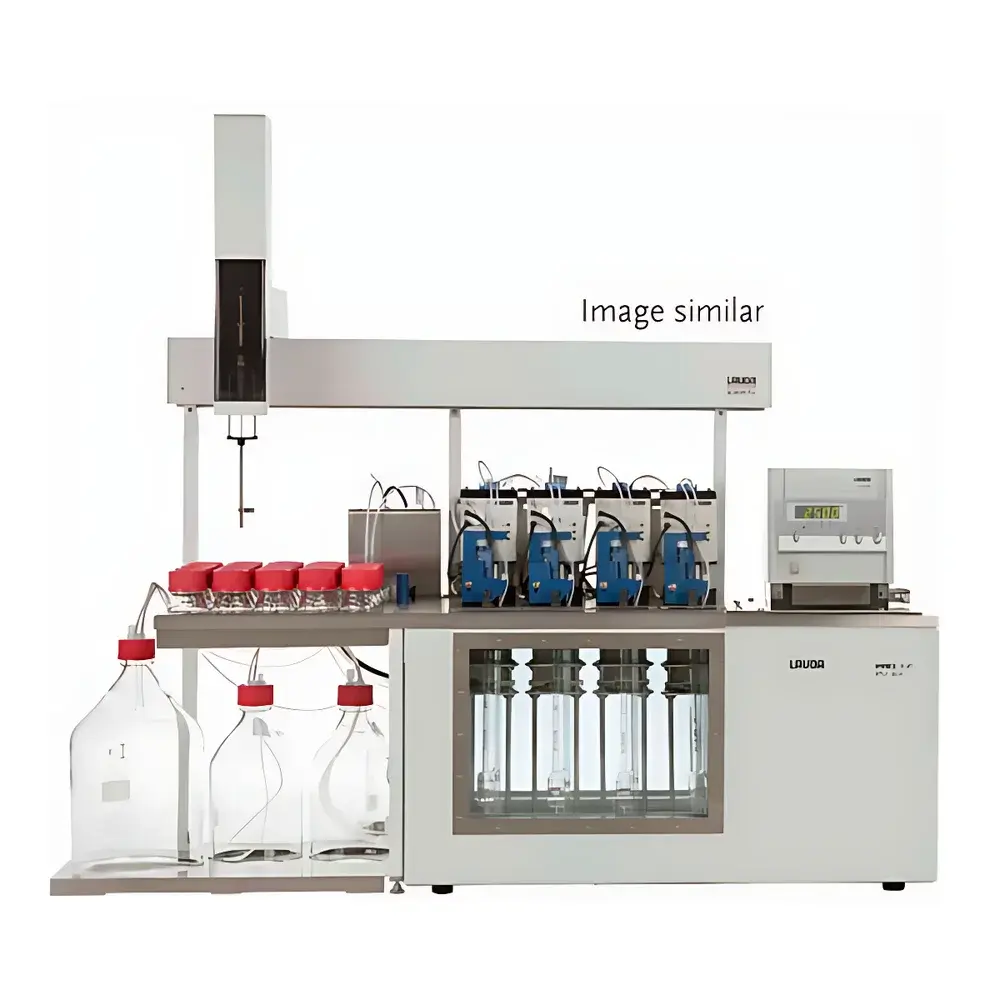
LAUDA PVS Automatic Capillary Viscometer System
| Brand | LAUDA |
|---|---|
| Origin | Germany |
| Instrument Type | Fixed-Position Capillary Viscometer |
| Measurement Principle | Kinematic Viscosity via Capillary Flow Time (ASTM D445, ISO 3104, DIN 51562) |
| Temperature Range (Measurement) | –65 °C to +180 °C |
| Time Resolution | 0.01 s |
| Time Range | 0–9999.99 s |
| Kinematic Viscosity Range | 0.3–50,000 mm²/s |
| Sample Capacity | Up to 160 samples/10 h |
| Compliance | ASTM D445/D446/D2270, ISO 3104/3105/2909, IP 71, DIN 51562-1–3 |
| Automation Modules | VAS Auto-Sampler (2-/4-position), VRM Auto-Clean & Dry (1-/2-channel, HT option up to 180 °C), BE Titration Module (665-type burette), S5 Infrared Timing Measurement Station |
| Software | Windows-based PVS Control Suite with GLP-compliant audit trail, user management, and report generation per 21 CFR Part 11 requirements |
Overview
The LAUDA PVS Automatic Capillary Viscometer System is a modular, standards-compliant platform engineered for high-precision kinematic viscosity measurement across research, quality control, and regulatory environments. Based on the fundamental principle of capillary flow timing—where kinematic viscosity (ν, mm²/s) is calculated as ν = C × t (C = viscometer constant, t = efflux time in seconds)—the PVS system delivers traceable, reproducible results under strictly controlled thermal conditions. Its architecture integrates thermally stable bath systems, infrared-sensing timing stations, and programmable automation modules to eliminate manual handling errors and ensure compliance with globally recognized test methods including ASTM D445 (Standard Test Method for Kinematic Viscosity of Transparent and Opaque Liquids), ISO 3104, DIN 51562, and IP 71. The system’s extended temperature capability—from –65 °C to +180 °C—enables characterization of low-temperature aviation fuels, high-temperature polymer melts, and thermally sensitive biopolymer solutions without compromising timing accuracy or thermal equilibrium stability.
Key Features
- Modular scalability: Configurable from single-position manual operation to fully automated 8-position systems with integrated sample loading, measurement, solvent cleaning, and drying.
- S5 Measurement Station: Equipped with microprocessor-controlled infrared sensors for non-contact, drift-free efflux time detection across Ubbelohde, micro-Ubbelohde, Ostwald, and Cannon–Fenske capillaries.
- VAS Auto-Sampler: Supports 2-position (VAS 1/2) or 4-position (VAS 1/4) configurations; accommodates 23–53 vials (25/50/100 mL) with programmable aspiration volume and rinse cycles.
- VRM Cleaning Module: Provides solvent-selectable, pressure-regulated cleaning and nitrogen-assisted drying for one (VRM 1) or two (VRM 2) capillaries; high-temperature variant (VRM 2/HT) handles residual samples up to 180 °C using chemically resistant PTFE and sapphire components.
- BE Titration Module: Integrates with dilution viscometers and magnetic stirrers to perform multi-step concentration series for intrinsic viscosity determination (e.g., Huggins, Kraemer plots) using calibrated 665-type burettes.
- PVS Control Unit: Central interface bridging PC software, timing hardware, temperature controllers, and peripheral modules; supports real-time monitoring, error logging, and hardware diagnostics.
Sample Compatibility & Compliance
The LAUDA PVS system is validated for use with a broad spectrum of Newtonian and quasi-Newtonian fluids, including hydrocarbon-based lubricants, synthetic ester oils, polymer solutions (e.g., PET, PA, PVC in phenol/o-chlorophenol), cellulose derivatives (viscose, methylcellulose), enzyme-containing buffers, and aviation turbine fuels (Jet A-1, JP-8). Its design conforms to Good Laboratory Practice (GLP) and Good Manufacturing Practice (GMP) requirements through configurable user access levels, electronic signatures, and full 21 CFR Part 11–compliant audit trails. All measurement sequences—including temperature equilibration, flow timing, cleaning cycles, and data export—are timestamped, version-controlled, and exportable in CSV, PDF, or XML formats for regulatory submission. Calibration verification is supported via NIST-traceable standard oils and certified capillary constants issued per ISO 4787.
Software & Data Management
The Windows-native PVS Control Software provides a unified interface for instrument configuration, method development, batch scheduling, and result evaluation. Predefined templates align with ASTM D445 Annexes (e.g., multi-run averaging, outlier rejection per Dixon’s Q-test), while custom protocols support multi-solvent cleaning sequences, variable temperature ramps, and automatic dilution factor application. Data integrity safeguards include mandatory electronic signatures for critical actions (e.g., calibration update, method modification), encrypted local database storage, and optional integration with LIMS via OPC UA or SQL Server connectivity. Reports comply with ISO/IEC 17025 documentation requirements and include metadata such as ambient humidity, bath stability deviation (< ±0.01 °C over 30 min), and raw timing traces with signal-to-noise ratio annotations.
Applications
- Polymers & Plastics: Determination of relative viscosity, limiting viscosity number (LVN), and intrinsic viscosity for molecular weight estimation (Mark–Houwink–Sakurada relationships); monitoring degradation during extrusion or recycling.
- Lubricants & Fuels: Kinematic viscosity at 40 °C and 100 °C per ASTM D445; calculation of viscosity index (VI) per ASTM D2270 and ISO 2909; cold-flow properties of jet fuels per ASTM D341.
- Biotechnology: Enzyme activity assessment via time-resolved viscosity changes in substrate polymer solutions (e.g., cellulase on carboxymethyl cellulose).
- Pulp & Paper: Degree of polymerization (DP) of cellulose via cuprammonium or cadoxen solution viscosity; tracking chain scission during bleaching or aging.
- Pharmaceutical Excipients: Viscosity profiling of hydroxypropyl methylcellulose (HPMC) and polyvinylpyrrolidone (PVP) solutions for controlled-release formulation development.
FAQ
What capillary types are supported by the S5 station?
Ubbelohde, micro-Ubbelohde, Ostwald, and Cannon–Fenske viscometers—each mounted on standardized aluminum blocks with individual thermal mass optimization.
Can the PVS system validate viscosity measurements per ISO/IEC 17025?
Yes—when operated with documented calibration procedures, certified reference materials, and enabled audit-trail functionality, the system meets technical requirements for accredited testing laboratories.
Is remote monitoring or unattended overnight operation possible?
Yes—the PVS Control Unit supports scheduled batch runs with automatic shutdown, solvent level alerts, and email/SNMP notifications for fault conditions.
How is temperature uniformity verified across the bath?
Lauda’s transparent-window baths incorporate dual platinum resistance thermometers (PRTs) with independent PID loops; stability is verified per ASTM E1137 using calibrated probe thermometers at three spatial points.
Does the VRM module support aqueous and chlorinated solvent cleaning?
Yes—VRM channels are constructed from chemically inert materials (PTFE, sapphire, Hastelloy C-276) and support solvent switching via solenoid-valve manifolds with pressure regulation and vapor recovery options.



