
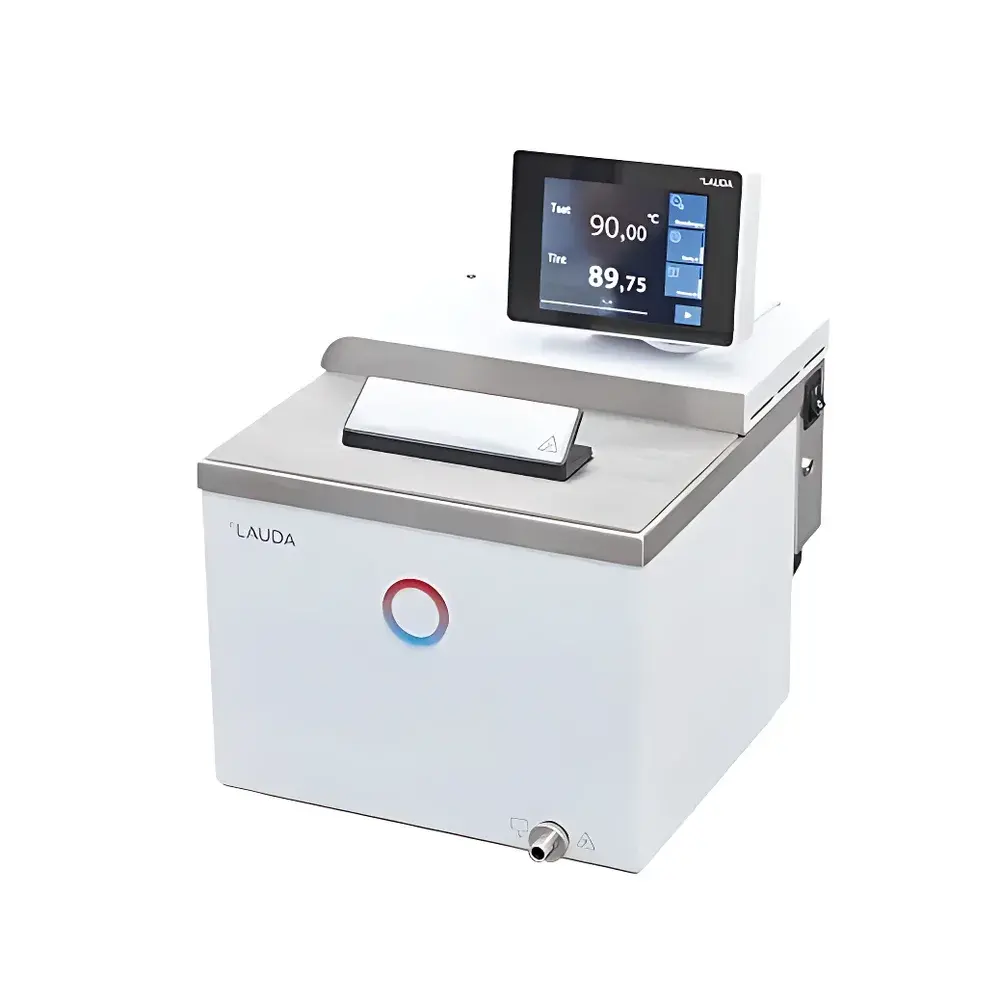
LAUDA PRO P 10 C Heated Circulating Bath (40–250 °C, ±0.01 °C Stability)
| Brand | LAUDA |
|---|---|
| Origin | Germany |
| Model | P 10 C |
| Bath Volume | 10.0 L |
| Temperature Range | 40–250 °C |
| Temperature Stability | ±0.01 °C |
| Power Supply | 100–120 V, 50/60 Hz |
| Max. Heating Power | 1.85 kW |
| Bath Dimensions (W×D×H) | 240 × 150 × 200 mm |
| Overall Dimensions (W×D×H) | 310 × 335 × 415 mm |
| Controller | 5.7″ Multi-Touch Color Display with Detachable Remote Unit |
| Interface Standard | Ethernet, USB, Pt100 Input |
| Pump | LAUDA Varioflex, 8-Stage Adjustable Flow |
Overview
The LAUDA PRO P 10 C is a high-precision, microprocessor-controlled heated circulating bath engineered for demanding laboratory applications requiring stable thermal environments from 40 °C up to 250 °C. Unlike conventional water baths limited by boiling point or silicone oil degradation, the P 10 C is specifically designed for use with high-boiling-point heat transfer fluids (e.g., Therm 250), enabling reliable operation at elevated temperatures without evaporation loss or oxidative breakdown. Its core thermoregulation architecture employs a fully electronic, PID-based continuous controller with dual-loop capability—supporting both internal bath temperature regulation and external process control via integrated Pt100 sensor inputs. The system incorporates an internally mounted cooling coil, permitting active temperature reduction when paired with an external chiller—extending effective operational range down to 20 °C under auxiliary cooling. Constructed with a stainless-steel insulated bath (240 × 150 × 200 mm), ergonomic handles, drain valve, and optional lid, the unit meets stringent mechanical durability and operator safety requirements for continuous-duty lab environments.
Key Features
- 5.7-inch multi-touch color display with intuitive graphical interface; detachable remote control unit enables 360° access and reduced bench footprint
- LAUDA Varioflex circulation pump with 8-stage adjustable flow rate—optimized for low-noise, pulse-free delivery in both internal and external loop configurations
- Integrated cooling coil compatible with external chillers (e.g., LAUDA RE series), enabling dynamic temperature ramping and overshoot suppression
- PowerAdapt energy management system dynamically adjusts heating output to match available supply capacity—ensuring stable performance even under fluctuating line voltage conditions
- Programmable controller supporting up to 100 multi-segment protocols (50 segments per program), with timer, countdown, and hold functions
- Comprehensive safety suite: adjustable low-temperature overheat protection with audible alarm, self-diagnostic assistant, and fail-safe shutdown logic
- Standard interfaces include Ethernet (for LabVIEW, SCADA, and remote monitoring), USB (data export/import, firmware updates), and Pt100 input for external sensor feedback
- Expandable I/O architecture supports optional RS232/485, Profibus, EtherCAT, analog 0–10 V, or dry-contact modules for integration into automated test systems
- User management for up to 20 distinct operator profiles with role-based access control—essential for GLP/GMP-compliant laboratories
- Stainless-steel bath structure with thermal insulation, G3/8″ threaded ports (2×), and drain valve—designed for long-term chemical compatibility with oils and synthetic heat transfer media
Sample Compatibility & Compliance
The P 10 C is validated for use with non-aqueous heat transfer media including silicone oils (e.g., Dow Corning 200 Fluid), aromatic hydrocarbons, and specialized thermostatic liquids such as Therm 250. It is not rated for aqueous operation above 100 °C due to vapor pressure and corrosion constraints. The unit complies with IEC 61010-1:2010 for electrical safety in laboratory equipment and meets CE marking requirements for EMC (EN 61326-1) and low-voltage directives. Its programmable logic, audit-trail-capable data logging (via USB/Ethernet), and user authentication framework support alignment with FDA 21 CFR Part 11 (when deployed with compliant software infrastructure) and ISO/IEC 17025 documentation workflows. All temperature stability specifications (±0.01 °C) are verified per ASTM E1137/E1137M using calibrated Pt100 reference sensors traceable to NIST standards.
Software & Data Management
The embedded controller firmware supports real-time temperature logging at configurable intervals (1 s to 60 min), with time-stamped datasets exportable in CSV format via USB mass storage or Ethernet FTP/SFTP. Optional LAUDA WinSoft Pro software provides full remote supervision—including live graphing, multi-unit synchronization, alarm notification (email/SNMP), and electronic signature-enabled protocol archiving. All logged events—including setpoint changes, pump speed adjustments, alarm triggers, and user logins—are retained with immutable timestamps, satisfying GLP audit requirements. Firmware updates are delivered via signed binary packages; version history and checksum validation ensure integrity during deployment.
Applications
- Calibration of high-temperature sensors (RTDs, thermocouples, infrared pyrometers) across extended ranges
- Thermal aging studies of polymers, composites, and electronic encapsulants per ASTM D3045 and ISO 2578
- Viscometer and rheometer temperature control for ASTM D445/D446 compliance testing
- Reaction calorimetry and synthesis temperature staging in pharmaceutical process development
- Material testing under controlled thermal stress (e.g., coefficient of thermal expansion measurements)
- Environmental simulation for automotive component qualification (SAE J2412, ISO 16750-4)
- Reference bath for metrology labs performing accredited temperature calibration services
FAQ
Can the P 10 C operate with water as the heat transfer medium?
No. Water is unsuitable above 100 °C due to vapor pressure, corrosion risk, and insufficient thermal stability. Only certified high-boiling-point fluids (e.g., Therm 250, silicone oils) are permitted.
Is external cooling mandatory to achieve the full 20–250 °C range?
Yes. The 20 °C lower limit requires connection to an external chiller via the integrated cooling coil. Without auxiliary cooling, the minimum operating temperature is 40 °C.
Does the unit support 230 V power input?
The standard P 10 C model is configured for 100–120 V, 50/60 Hz. A 230 V variant (P 10 C-EU) is available upon request—consult technical sales for regional configuration options.
How is temperature uniformity validated across the bath volume?
LAUDA specifies axial/radial uniformity as ≤ ±0.03 °C at 100 mm immersion depth (per DIN 12876-1). Verification requires three-point mapping using traceable Pt100 probes; methodology is documented in the included calibration manual.
Can the detachable controller be used with multiple PRO-series units?
Each controller is uniquely paired to its host unit during factory commissioning. Cross-unit operation is not supported without reconfiguration by authorized LAUDA service personnel.



