
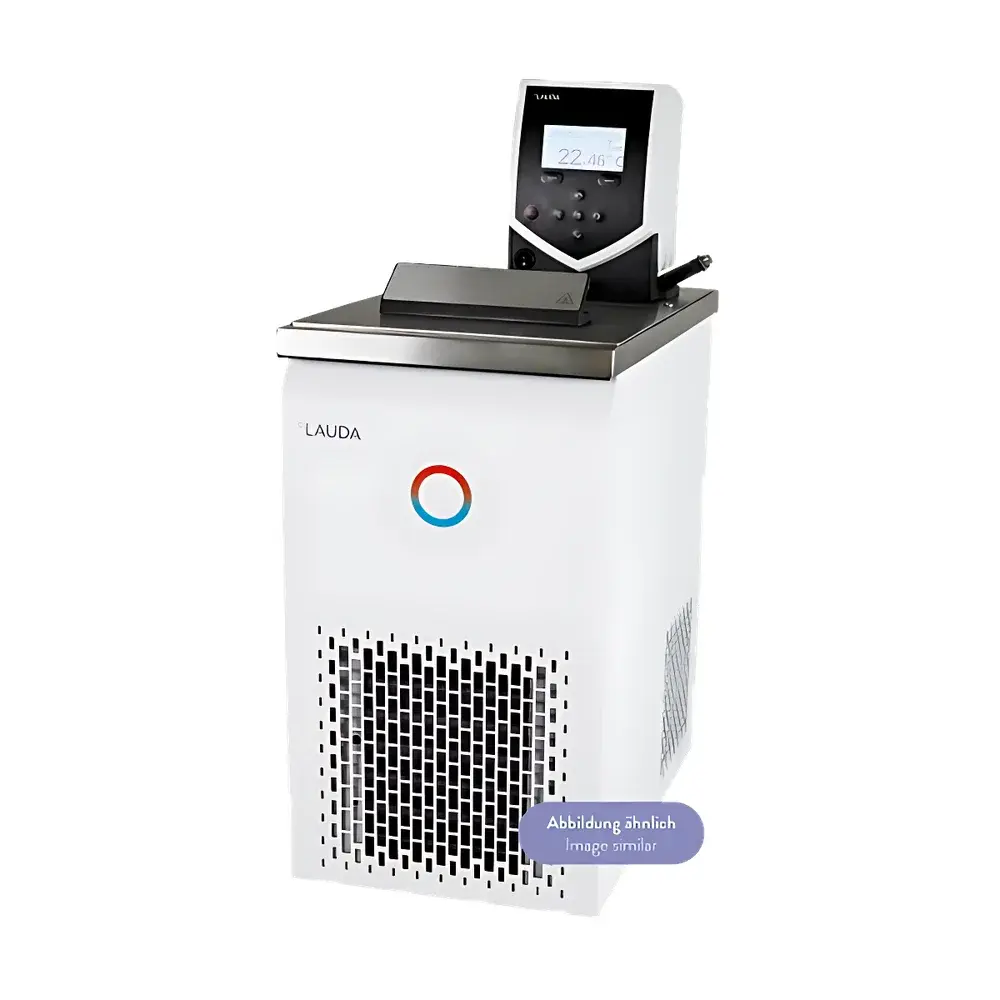
LAUDA ECO RE1050 S Refrigerated Circulating Bath with External Loop
| Brand | LAUDA |
|---|---|
| Origin | Germany |
| Model | RE1050 S |
| Temperature Range | −50 °C to 200 °C |
| Temperature Stability | ±0.02 °C |
| Bath Volume | 10.0 L |
| Internal/External Circulation | Yes |
| Cooling Capacity | up to 700 W |
| Heating Power | 2.0 kW |
| Pump Flow Rate | up to 22 L/min at 0.6 bar |
| Bath Dimensions (W×D×H) | 200 × 200 × 160 mm |
| Unit Weight | 35 kg |
| Power Supply | 230 V, 50 Hz |
| Refrigerant | R-452A (GWP = 2140), 0.270 kg |
Overview
The LAUDA ECO RE1050 S is a high-precision, refrigerated circulating bath engineered for demanding laboratory and industrial applications requiring stable thermal control across an exceptionally wide temperature range—from −50 °C to +200 °C. Unlike conventional water or oil baths limited by passive heating or narrow cooling envelopes, the RE1050 S integrates a fully active dual-mode thermal management system combining high-efficiency resistive heating with a compressor-based refrigeration circuit. Its operation is governed by a microprocessor-controlled PID algorithm with adaptive tuning, ensuring continuous thermal equilibrium even under dynamic load conditions—such as when external equipment draws variable heat loads via the integrated circulation loop. The unit employs a stainless-steel bath vessel (200 × 200 × 160 mm) with a nominal fill volume of 10.0 L and a minimum operational fill of 8.0 L, designed for compatibility with both aqueous and organic heat transfer fluids—including silicone oils and glycol–water mixtures—under Class III safety certification per DIN EN 61010-1, permitting safe use with flammable media.
Key Features
- LAUDA SmartCool intelligent cooling system dynamically modulates compressor output and fan speed based on real-time thermal demand, reducing energy consumption and extending component service life.
- LAUDA Silver immersion thermostat with monochrome graphical LCD display—simultaneously showing setpoint, actual bath temperature, and pump status—with intuitive soft-key navigation and cursor-driven parameter entry.
- Vario adjustable circulation pump with six discrete flow stages (0–22 L/min at up to 0.6 bar), enabling precise hydraulic matching to external reactors, viscometers, or spectrophotometer jackets without manual valve intervention.
- Integrated programmable controller supporting single-sequence operation with up to 20 ramp-hold segments; ideal for automated thermal cycling protocols in material testing or reaction calorimetry.
- Comprehensive safety architecture: electronic overtemperature protection (Tmax function), ground-fault monitoring, dry-run detection, and automatic shutdown upon coolant level or pressure anomaly.
- Modular interface expansion capability—including optional RS-485, Profibus DP, Ethernet/USB, analog 0–10 V / 4–20 mA, and Pt100/LiBus modules—for seamless integration into centralized lab automation systems compliant with GLP/GMP data integrity requirements.
- Front-access drain valve and rear-mounted fluid discharge port simplify maintenance and fluid replacement while minimizing operator exposure to hot or hazardous media.
Sample Compatibility & Compliance
The RE1050 S is certified to DIN EN 61010-1:2019 for use with both non-flammable and flammable liquids (Safety Class III), making it suitable for applications involving ethanol, acetone, ethylene glycol, and low-viscosity silicone oils. Its stainless-steel bath construction resists corrosion from aggressive solvents and alkaline solutions when operated within specified pH and temperature limits. The unit complies with EU Directive 2014/68/EU (PED) for pressure equipment and meets electromagnetic compatibility standards per EN 61326-1:2013. Refrigerant R-452A is selected for its balanced performance and reduced global warming potential (GWP = 2140) relative to legacy alternatives such as R-404A, aligning with F-Gas Regulation (EU) No 517/2014 phase-down schedules. For regulated environments, optional audit-trail-enabled firmware supports 21 CFR Part 11-compliant electronic records when paired with LAUDA’s LabSoft software suite.
Software & Data Management
While the RE1050 S operates autonomously via its embedded controller, full remote supervision and data logging are enabled through LAUDA’s LabSoft PC software (sold separately). LabSoft provides real-time graphing of temperature, pump speed, and power draw; event-triggered alarms with timestamped log export (CSV/Excel); and secure user-level access control (administrator/operator/guest). When equipped with the Ethernet/USB interface module, the device supports Modbus TCP communication for integration into SCADA platforms or LIMS environments. All configuration changes, program executions, and fault events are recorded with immutable timestamps—supporting traceability requirements under ISO/IEC 17025 and FDA 21 CFR Part 11 when deployed with appropriate validation documentation.
Applications
- Calibration of temperature-sensitive instrumentation (e.g., thermocouples, RTDs, infrared sensors) across extended ranges per ASTM E74 and ISO 17025 procedures.
- Thermal conditioning of samples prior to rheological, DSC, or TGA analysis—ensuring reproducible pre-equilibration at defined ramp rates and dwell times.
- Circulating temperature control for jacketed glass reactors, photoreactors, and electrochemical cells in synthetic chemistry and battery R&D.
- Stabilization of optical components (e.g., laser diodes, interferometers) where sub-0.05 °C drift is critical to measurement fidelity.
- Accelerated aging studies of polymers and adhesives under controlled thermal stress profiles per ISO 11359 and ASTM D3045.
FAQ
What types of heat transfer fluids are compatible with the RE1050 S?
Water, 50/50 glycol–water mixtures, and silicone oils (e.g., DC200 series) are routinely used. Fluid selection must consider viscosity at minimum operating temperature, flash point, and chemical compatibility with stainless steel and Viton seals.
Can the unit maintain stability at −50 °C with an external load?
Yes—when paired with an appropriately sized external heat exchanger and insulated tubing, the RE1050 S sustains ±0.02 °C stability at −50 °C under static conditions and ±0.05 °C under moderate dynamic loads (≤300 W).
Is the USB interface capable of real-time data streaming?
The standard USB port supports configuration upload/download and firmware updates. Real-time streaming requires the optional RS-485 or Ethernet interface module and LabSoft software.
Does the device support external temperature feedback control?
Yes—via the optional Pt100/LiBus module, users can configure cascade control using an external probe placed directly in the sample or reactor, overriding bath-sensor-based regulation.
What maintenance intervals are recommended for long-term reliability?
Compressor oil and refrigerant charge require verification every 24 months; condenser coil cleaning every 6 months in dusty environments; and annual calibration of the internal Pt100 sensor traceable to NIST standards.
Related Products



