
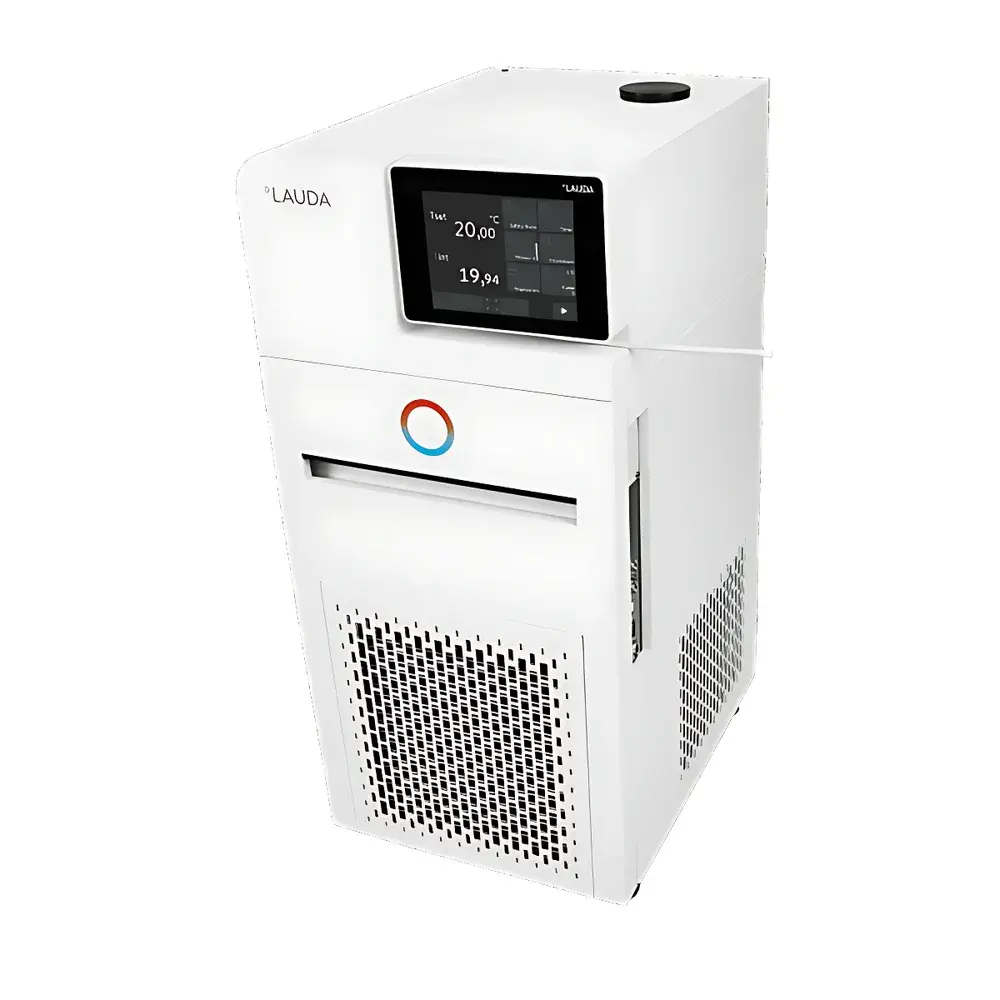
LAUDA PRO RP 245 EC External Circulation Thermostat for Reactor Temperature Control (-45 to 200 °C)
| Brand | LAUDA |
|---|---|
| Origin | Germany |
| Model | RP 245 EC |
| Instrument Type | Integrated Circulating Chiller |
| Cooling Method | Hybrid (Air- and Water-Cooled) |
| Temperature Range | -45 to 200 °C |
| Cooling Capacity | 800 W at 20 °C |
| Temperature Stability | ±0.05 K |
| Circulating Pump Pressure | 0.68 bar |
| Circulating Pump Flow Rate | 22 L/min |
| Reservoir Volume | 2.4–4.4 L |
| Internal Fill Volume | Minimal (Optimized for Rapid Thermal Response) |
Overview
The LAUDA PRO RP 245 EC is an integrated external circulation thermostat engineered for precise, dynamic temperature control of laboratory reactors, jacketed vessels, and other externally connected process equipment. It operates on a dual-mode thermal management principle—combining resistive heating with a hybrid refrigeration system that seamlessly switches between air-cooled and water-cooled condensation based on ambient conditions and thermal load. This architecture enables stable operation across an exceptionally wide working range of –45 °C to +200 °C, making it suitable for exothermic reaction quenching, cryogenic synthesis, high-temperature polymerization, and accelerated stability testing. The unit employs R-449A refrigerant (GWP = 1397), compliant with EU Regulation (EU) No 517/2014 on fluorinated greenhouse gases, and conforms to DIN 12876 Class III safety standards for laboratory thermostats handling flammable and non-flammable media.
Key Features
- Hybrid cooling system with automatic mode selection between air and water cooling—ensures consistent performance under variable ambient temperatures (5–40 °C) and load conditions
- Minimal internal fluid volume (<2.4 L minimum fill) and high-flow Varioflex pump (22 L/min @ 0.68 bar) enable rapid thermal ramping and tight dynamic control
- 5.7-inch multi-touch color display with detachable remote operation capability; supports up to 100 user-defined programs (50 segments each)
- Full electronic PID controller with independent internal/external sensor inputs and adaptive PowerAdapt energy optimization
- SmartCool digital compressor management reduces cycling frequency and extends service life while improving energy efficiency
- Stainless steel insulated reservoir with overflow protection, drain valve, and M16 × 1 threaded ports (13 mm ID)
- Comprehensive I/O interface suite: USB 2.0, Ethernet (TCP/IP), RS-232/485, Profibus DP, EtherCAT, analog 0–10 V / 4–20 mA, and dry-contact modules
- User management for up to 20 authenticated operators with role-based access control and audit-ready event logging
- Integrated self-diagnostic assistant, real-time system health monitoring, timer/countdown functions, and configurable overtemperature protection with audible alarm
Sample Compatibility & Compliance
The RP 245 EC is designed for closed-loop circulation of heat-transfer fluids—including silicone oils, glycol/water mixtures, and low-viscosity synthetic heat transfer media—compatible with reactor jackets, coil systems, and calorimetric cells. Its pressure-suction pump configuration supports both pressurized delivery and vacuum-assisted suction, accommodating complex external plumbing layouts. All electrical and mechanical components meet CE marking requirements and comply with EN 61010-1 (Safety of Electrical Equipment for Laboratory Use) and EN 61326-1 (EMC for Measurement and Control Equipment). The unit satisfies key regulatory expectations for GLP/GMP environments through traceable calibration support, password-protected parameter locking, and optional 21 CFR Part 11-compliant data archiving when paired with LAUDA’s Thermostat Control Software (TCS).
Software & Data Management
Equipped with native USB and Ethernet interfaces, the RP 245 EC supports direct data export in CSV format and real-time remote supervision via LAUDA’s TCS software platform. TCS provides full protocol scripting, time-stamped temperature/flow/power logging, alarm history with timestamps, and automated report generation aligned with ISO/IEC 17025 documentation requirements. Firmware updates are delivered via secure HTTPS, and configuration backups can be scheduled or triggered manually. Optional integration with LabArchives, DeltaV, or Siemens Desigo CCMS enables centralized asset monitoring within enterprise-wide laboratory information management systems (LIMS) or building management systems (BMS).
Applications
- Temperature-controlled chemical synthesis in glass or stainless-steel reactors (e.g., Grignard, lithiation, hydrogenation)
- Calorimetric studies requiring sub-0.1 K stability during reaction enthalpy measurement
- Material testing under thermal stress (e.g., polymer curing kinetics, battery cell thermal cycling)
- Electronics thermal validation—junction temperature simulation for PCBs and power modules
- Pharmaceutical stability chambers and dissolution apparatus auxiliary cooling
- Preparative chromatography column temperature regulation (HPLC, SFC)
- Environmental simulation for aerospace component qualification
FAQ
What is the minimum and maximum fluid volume the RP 245 EC can operate with?
The unit requires a minimum fill volume of 2.4 L and accommodates up to 4.4 L in its stainless steel reservoir.
Does the RP 245 EC support external temperature feedback control?
Yes—it accepts input from external Pt100 or thermocouple sensors via dedicated terminals and implements cascade PID control for improved process stability.
Can the unit be operated in a fume hood or confined space?
Due to its hybrid cooling design, the RP 245 EC may be installed in ventilated enclosures only when using water-cooling mode; air-cooling mode requires ≥500 mm clearance on all sides for adequate airflow.
Is R-449A refrigerant compatible with standard service tools and recovery equipment?
Yes—R-449A is a zeotropic blend classified as A1 (non-toxic, non-flammable) and uses standard R-404A/R-507 service fittings and recovery protocols.
How does SmartCool contribute to energy efficiency?
SmartCool dynamically modulates compressor speed and staging based on real-time thermal demand and ambient conditions, reducing unnecessary on/off cycling by up to 40% compared to fixed-speed systems.



