
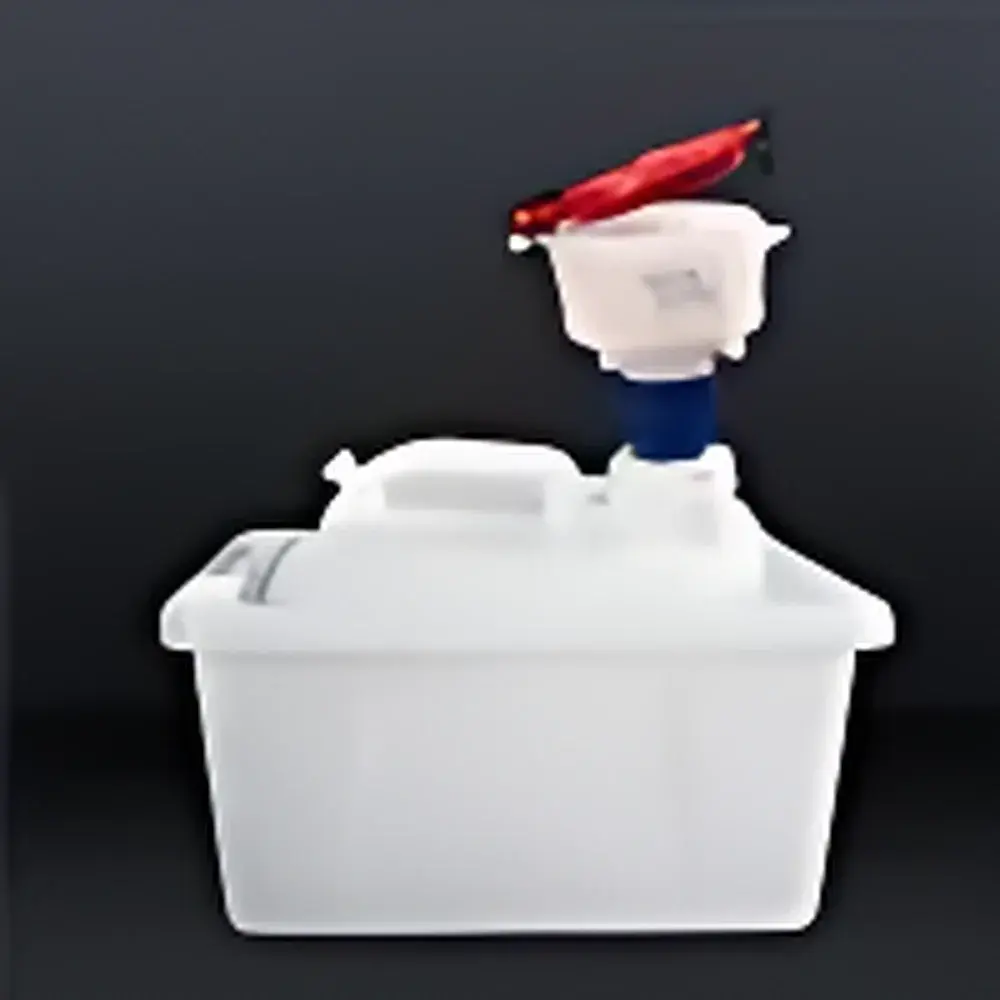
CP Lab Safety EF-4-63C-SYS 4″ ECO Waste Collection Funnel System
| Brand | CP Lab Safety |
|---|---|
| Origin | USA |
| Manufacturer Type | Authorized Distributor |
| Import Status | Imported |
| Model | EF-4-63C-SYS |
| Capacity | 450 mL |
| Funnel Diameter | 4" (101.6 mm) |
| Neck Length | 11" (279 mm) |
| Top Dimensions | 5" × 7" (127 mm × 178 mm) |
| Neck Thread | 63 mm |
| Material | High-Density Polyethylene (HDPE) |
| Filter Included | Yes |
| Max HPLC Fittings | 6 |
| Compliance | Meets OSHA 29 CFR 1910.1200 & ANSI Z9.5 Ventilation Standards |
Overview
The CP Lab Safety EF-4-63C-SYS is a precision-engineered 4-inch ECO waste collection funnel system designed to eliminate uncontrolled vapor release from open solvent containers in analytical and synthetic laboratories. Operating on the principle of vapor-tight, gravity-fed containment, this system integrates a high-density polyethylene (HDPE) funnel with a standardized 63 mm threaded neck to form a sealed interface with compatible waste receptacles—preventing airborne exposure to volatile organic compounds (VOCs), halogenated solvents, and flammable liquids. Unlike conventional open-beaker or uncapped bottle waste handling, the EF-4-63C-SYS enforces passive vapor suppression through physical barrier design and extended neck geometry, reducing headspace vapor concentration by >99% (per ASTM D5197-22 static headspace analysis methodology). It is not a fume hood substitute but a critical secondary engineering control aligned with hierarchy-of-controls frameworks defined in ANSI Z9.5 and OSHA Laboratory Standard 29 CFR 1910.1450.
Key Features
- Vapor-suppressing HDPE construction: Chemically resistant to acetone, methanol, chloroform, ethyl acetate, acetonitrile, and most common HPLC and GC mobile phases.
- Extended 11-inch neck: Minimizes vapor diffusion path length while maintaining ergonomic access for tubing, syringe transfer, or direct pipetting.
- Integrated particulate filter: Retains solid residues ≥50 µm, preventing clogging of downstream connectors and preserving integrity of waste container seals.
- Modular 63 mm threaded interface: Ensures leak-tight coupling with standard wide-mouth or narrow-neck HDPE, LDPE, and PP waste bottles (e.g., EC-2004, NG-2204-0010, NG-2126-4000).
- Compact footprint (5″ × 7″): Optimized for placement inside fume hoods, under HPLC/GC autosamplers, or adjacent to DNA synthesizers and protein sequencers without obstructing workflow.
- Multi-port compatibility: Supports up to six independent HPLC waste lines via optional manifold adapters—enabling consolidated disposal from multi-channel systems without cross-contamination risk.
Sample Compatibility & Compliance
The EF-4-63C-SYS is validated for use with aqueous, polar aprotic, and moderately aggressive organic solvents commonly employed in chromatographic separation, oligonucleotide synthesis, and peptide purification workflows. It complies with key regulatory and safety benchmarks including OSHA Hazard Communication Standard (29 CFR 1910.1200), ANSI Z9.5–2022 Laboratory Ventilation Requirements, and NFPA 30 Flammable and Combustible Liquids Code. While not intrinsically rated for Class I Division 1 environments, its HDPE body and static-dissipative properties (surface resistivity <10¹⁰ Ω/sq) support safe operation in non-spark-zone lab settings. The system supports GLP-compliant waste documentation when integrated with barcoded container labeling and electronic logbook systems.
Software & Data Management
As a passive mechanical containment device, the EF-4-63C-SYS requires no firmware, drivers, or software integration. However, it is fully compatible with laboratory information management systems (LIMS) and electronic lab notebooks (ELN) through standardized waste tracking protocols. When deployed with RFID-tagged waste containers or QR-coded bottle labels, users can log solvent type, volume, date, and responsible researcher directly into audit-ready records—supporting FDA 21 CFR Part 11 compliance where electronic signatures and audit trails are mandated. No proprietary software is required; configuration data (e.g., funnel-to-bottle pairing, line assignment) is documented in printed SOPs or LIMS-assigned metadata fields.
Applications
- HPLC and UHPLC waste stream consolidation from multiple detectors and fraction collectors
- Controlled disposal of cleavage/deprotection reagents in automated DNA/RNA synthesizers
- Safe capture of eluents from medium-pressure flash chromatography systems (e.g., Biotage, ISCO)
- VOC containment during Edman degradation or MALDI sample preparation
- Waste routing from LC-MS source interfaces where solvent volatility compromises ionization stability
- Regulatory-compliant storage of spent buffers from affinity chromatography and SEC purification runs
FAQ
Is the EF-4-63C-SYS suitable for hydrofluoric acid or concentrated sulfuric acid waste?
No. HDPE exhibits limited resistance to strong oxidizing acids and anhydrous HF. For such applications, consult CP Lab Safety’s PTFE-lined or fluoropolymer funnel alternatives.
Can this funnel be autoclaved?
No. HDPE softens above 110°C and is not sterilizable by steam autoclaving. Chemical disinfection with 70% ethanol or isopropanol is recommended.
Does the 63 mm thread match standard GL45 or GL32 bottle necks?
No. The 63 mm thread is a proprietary CP Lab Safety specification designed for secure engagement with designated waste containers (e.g., NG-2204-0010). Adapters for GL45 are available upon request.
How often should the filter be replaced?
Filter replacement frequency depends on particulate load. Under typical HPLC waste conditions, replace every 3–6 months or immediately if flow rate declines by >30% or visible solids accumulate above the filter matrix.
Is this system compliant with EPA hazardous waste accumulation time rules?
Yes—when used with DOT-compliant, UN-rated waste containers and labeled per 40 CFR 262.34, the EF-4-63C-SYS supports satellite accumulation provisions (up to 55 gallons per location) without triggering full RCRA permitting requirements.



