
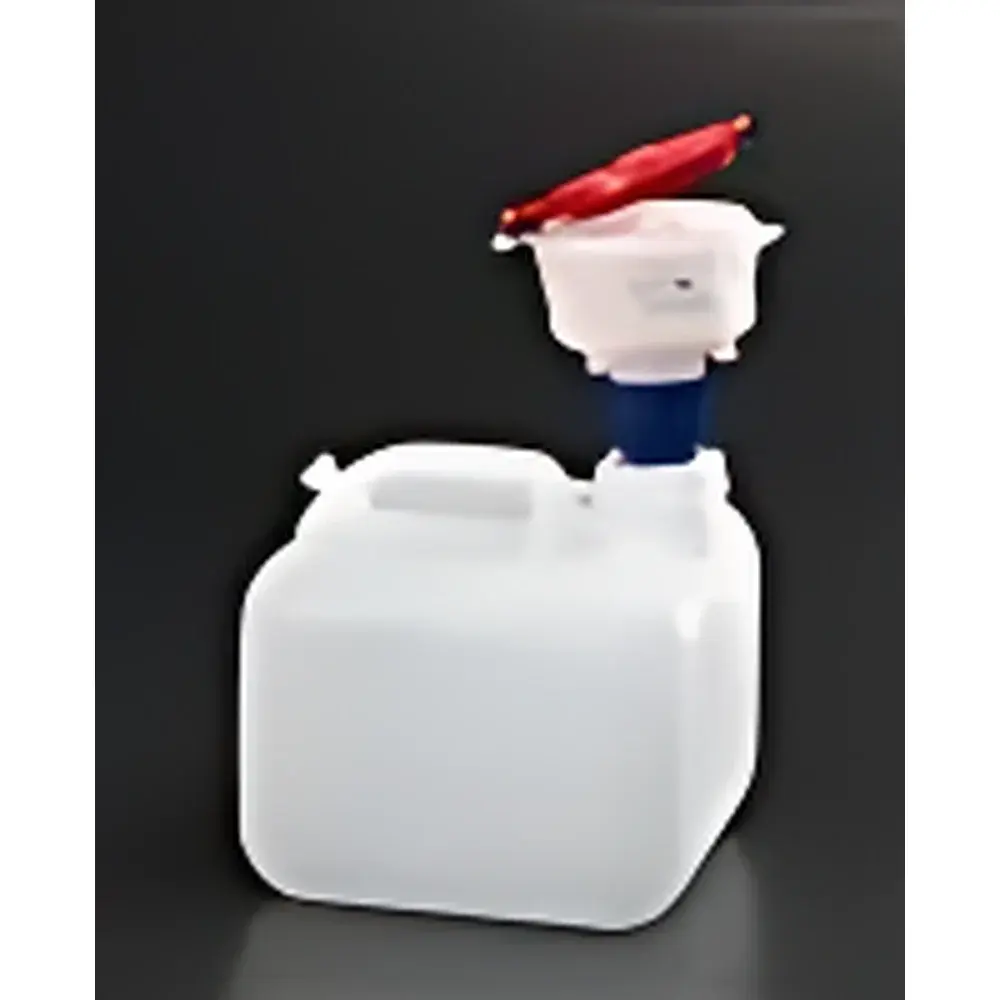
CP Lab Safety EF-4-63BY-SYS 4-Inch ECO Waste Collection Funnel System
| Brand | CP Lab Safety |
|---|---|
| Origin | USA |
| Manufacturer Type | Authorized Distributor |
| Product Category | Imported Laboratory Safety Equipment |
| Model | EF-4-63BY-SYS |
| Capacity | 450 mL |
| Funnel Diameter | 4 in (101.6 mm) |
| Neck Length | 11 in (279 mm) |
| Top Dimensions | 5 in × 7 in (127 mm × 178 mm) |
| Neck Thread | 63 mm |
| Material | High-Density Polyethylene (HDPE) |
| Filter Included | Yes |
| Max HPLC Fittings | 6 |
| Compliance | Meets OSHA, ANSI Z9.5, and NFPA 30 laboratory ventilation & flammable liquid handling guidelines |
Overview
The CP Lab Safety EF-4-63BY-SYS is a purpose-engineered 4-inch ECO waste collection funnel system designed to eliminate uncontrolled vapor release from open solvent waste containers in analytical and synthetic laboratories. Built upon the principle of passive vapor containment—leveraging extended-neck geometry, threaded sealing interfaces, and chemically inert HDPE construction—it provides a physical barrier that reduces volatile organic compound (VOC) emissions by up to 99% compared to conventional open-top carboys or beakers. This engineering approach directly addresses occupational exposure risks associated with chronic inhalation of solvents such as acetonitrile, chloroform, methanol, and ethyl acetate—compounds routinely used in HPLC, GC, peptide synthesis, and nucleic acid purification workflows. The system integrates seamlessly into standard lab infrastructure without requiring electrical power, vacuum sources, or retrofitting, making it suitable for Class I, II, and III biosafety cabinets, fume hoods, and sink-mounted waste stations.
Key Features
- Extended 11-inch neck design minimizes headspace vapor diffusion and prevents back-splash during liquid transfer
- Chemically resistant high-density polyethylene (HDPE) body withstands prolonged contact with aliphatic, aromatic, and halogenated solvents
- Integrated particulate filter retains solid residues, preventing clogging of downstream containers and maintaining flow integrity
- 63 mm threaded neck ensures secure, leak-tight coupling with 10 L horizontal-format solvent bottles (e.g., Justrite, Kimble, VWR series)
- Yellow color-coded cap enables rapid visual identification in multi-solvent waste segregation protocols
- Compact footprint (5″ × 7″) allows placement within tight fume hood sashes or under benchtop instrumentation without obstructing workflow
- No moving parts or consumables beyond the replaceable filter—designed for long-term reliability and minimal maintenance
Sample Compatibility & Compliance
The EF-4-63BY-SYS is validated for use with common laboratory waste streams including HPLC mobile phases, GC rinse solvents, oligonucleotide deprotection cocktails, and protein precipitation supernatants. It conforms to OSHA 29 CFR 1910.1200 (Hazard Communication), ANSI Z9.5–2022 (Laboratory Ventilation), and NFPA 30–2024 (Flammable and Combustible Liquids Code) requirements for safe handling of Class I liquids. When used with compatible HDPE or PP waste containers rated for chemical resistance (e.g., UN-certified 10 L horizontal drums), the assembly supports full-chain traceability under GLP-compliant waste documentation systems. The absence of metal components eliminates galvanic corrosion risk and ensures compatibility with electrostatic-sensitive environments.
Software & Data Management
As a passive mechanical containment device, the EF-4-63BY-SYS does not incorporate embedded electronics or digital interfaces. However, its standardized dimensions and thread specifications enable integration into digitally managed waste tracking ecosystems. Laboratories utilizing LIMS platforms (e.g., LabWare, STARLIMS) or electronic waste manifests can assign unique identifiers to each funnel-container assembly, logging solvent type, volume thresholds, and disposal dates via barcode scanning. The consistent 63 mm interface also supports automated fill-level monitoring when paired with external ultrasonic or capacitive sensors mounted on the receiving vessel—enabling real-time alerts prior to overfill conditions per EPA 40 CFR Part 264.173 compliance thresholds.
Applications
This funnel system is routinely deployed across regulated and research-intensive settings: HPLC method development labs requiring repeated fraction collection; oligonucleotide synthesis suites managing phosphoramidite cleavage waste; proteomics facilities handling TFA-containing eluents; environmental testing labs processing EPA Method 525.3 extracts; and pharmaceutical QC labs performing residual solvent analysis per ICH Q3C guidelines. Its low-profile geometry makes it especially valuable beneath autosamplers, column ovens, and fraction collectors where vertical clearance is constrained. In academic core facilities, the yellow cap variant aids in enforcing solvent-specific waste segregation policies mandated by institutional EH&S offices.
FAQ
Can this funnel be sterilized using autoclaving?
No. HDPE softens above 120 °C and is incompatible with steam sterilization. Chemical disinfection using 70% ethanol or isopropanol is recommended.
Is the filter replaceable, and what is its pore size?
Yes—the integrated filter is user-replaceable and features a nominal 100 µm mesh rating, sufficient to retain precipitated salts and resin fragments without impeding flow rates typical of gravity-fed waste streams.
Does the system meet FDA 21 CFR Part 11 requirements?
While the funnel itself is a non-electronic device and therefore outside the scope of Part 11, its use supports audit-ready waste handling practices when documented within validated SOPs and linked to electronic batch records.
Can it be used with acidic or basic aqueous waste?
Yes—HDPE exhibits excellent resistance to 1–6 M HCl, HNO₃, NaOH, and KOH solutions at ambient temperatures, though prolonged exposure to >50% H₂SO₄ is not advised.
What is the maximum recommended fill rate to avoid overflow during active instrument drainage?
For continuous flow applications (e.g., HPLC fraction collectors), maintain inflow ≤ 120 mL/min to ensure vapor lock mitigation and prevent bypass through the filter housing.



