
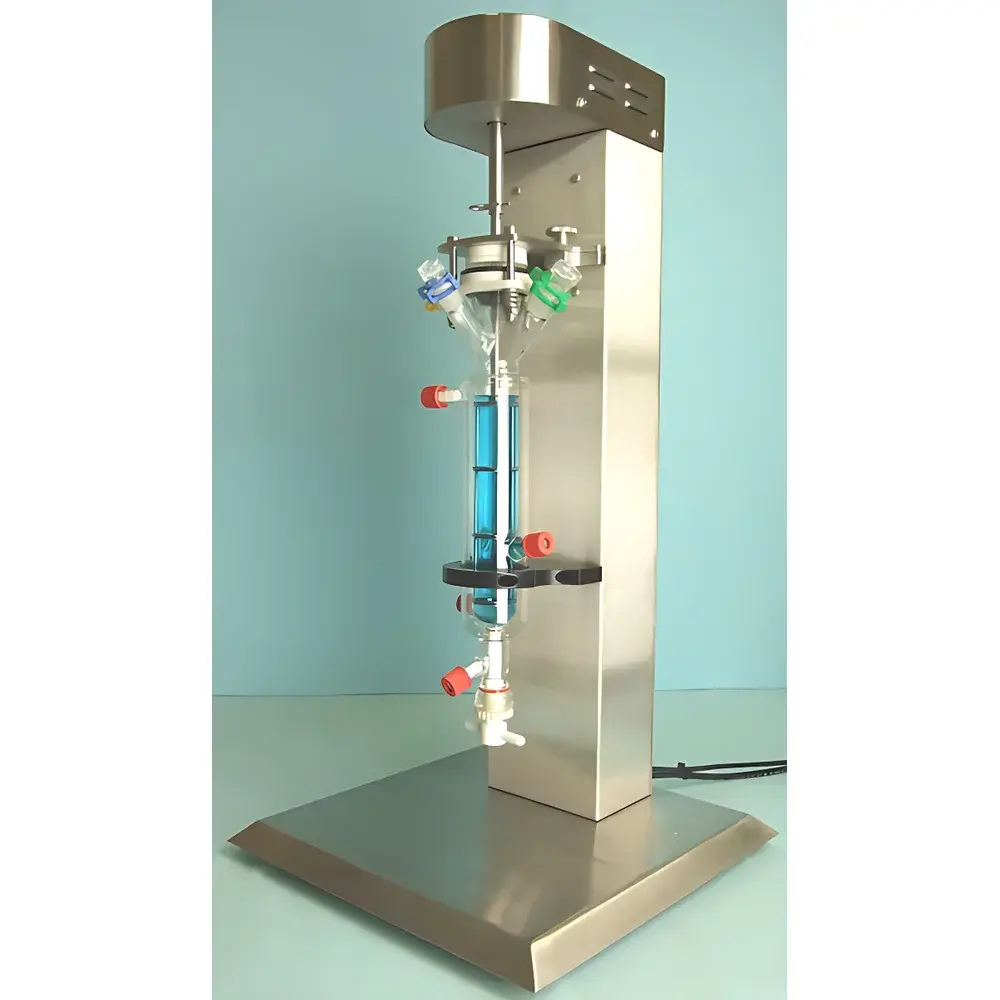
NiTech Solutions Batch Evaluator Series Continuous Crystallization Reactor for Process Development
| Origin | UK |
|---|---|
| Manufacturer Type | Authorized Distributor |
| Origin Category | Imported |
| Model | Batch Evaluator |
| Price Range | USD 27,000 – 68,000 |
| Vessel Volume | 150–3200 mL |
| Construction Material | Borosilicate Glass or 316L Stainless Steel |
| Temperature Range | −20 °C to 100 °C |
| Operating Pressure | Ambient to 10 bar (g) |
| Mixing Mechanism | Static Baffle or Dynamic Baffle Configuration |
| Compliance | Designed for ASTM E2500, ICH Q5, Q7, and FDA 21 CFR Part 11–ready data integrity architecture |
Overview
The NiTech Solutions Batch Evaluator Series is a purpose-engineered bench-scale continuous crystallization reactor platform designed explicitly for early-stage process development in pharmaceutical, fine chemical, and advanced materials manufacturing. Unlike conventional batch crystallizers, the Batch Evaluator implements a tubular flow-through architecture grounded in controlled residence time distribution (RTD), enabling precise decoupling of nucleation, growth, and agglomeration kinetics under dynamically adjustable thermal and hydrodynamic conditions. Its core design leverages segmented baffle-based mixing—either static (for low-shear, diffusion-dominated regimes) or dynamic (for enhanced radial dispersion and interphase mass transfer)—to emulate the hydrodynamics of full-scale continuous tubular crystallizers. This ensures direct scalability from lab-scale kinetic studies to pilot- and production-scale continuous manufacturing lines without empirical re-optimization. The system operates within a rigorously defined temperature-pressure envelope (−20 °C to 100 °C, up to 10 bar), supporting both solvent-mediated and anti-solvent crystallization pathways, as well as reactive crystallization where supersaturation is generated in situ via chemical reaction.
Key Features
- Modular vessel configurations (DN15 to DN60) with scalable volumes (150 mL to 3200 mL), constructed from borosilicate glass (for visual process monitoring and corrosion-sensitive chemistries) or electropolished 316L stainless steel (for high-pressure, high-temperature, or abrasive slurry applications)
- Interchangeable mixing elements: static baffles for laminar flow control and reproducible shear profiles; dynamic baffles for tunable turbulence intensity and improved solid suspension uniformity
- Integrated jacketed temperature control with dual-zone capability—enabling independent upstream cooling and downstream annealing zones to model multi-stage crystallization profiles
- Pressure-rated design compliant with PED 2014/68/EU and ASME B31.3 process piping standards, validated for safe operation with volatile solvents, hydrogenation intermediates, and exothermic reaction mixtures
- Pre-engineered interfaces for seamless integration with upstream continuous reactors (e.g., Corning AFR, Vapourtec R-Series) and downstream continuous centrifugal separators or membrane filters
Sample Compatibility & Compliance
The Batch Evaluator accommodates heterogeneous multiphase systems including slurries, viscous solutions (>500 cP), gas-liquid-solid suspensions (e.g., hydrogenation + crystallization), and thermally labile biocatalytic streams. It supports crystallization of APIs (e.g., paracetamol, ibuprofen), inorganic salts (e.g., NaCl, KNO₃), and specialty pigments under GLP-compliant experimental protocols. All wetted components meet USP Class VI and EP 3.1.9 extractables/leachables requirements. System validation documentation—including IQ/OQ protocols, calibration certificates for Pt100 temperature sensors (±0.1 °C accuracy), and pressure transducer traceability to NPL standards—is provided. The platform is engineered for alignment with ICH Q5 (biotechnology-derived products), Q7 (GMP for APIs), and ASTM E2500-13 (user requirement specification for process equipment).
Software & Data Management
Operation is managed via NiTech’s proprietary Process Insight Suite—a deterministic real-time control environment supporting synchronized acquisition of temperature, pressure, flow rate, and inline PAT signals (e.g., FBRM, PVM, or Raman spectroscopy inputs). All parameter logs are timestamped, digitally signed, and stored in an audit-trail-enabled SQLite database compliant with FDA 21 CFR Part 11 requirements. Export formats include CSV, HDF5, and ISA-88–structured XML for integration into LIMS (e.g., LabWare, Thermo SampleManager) and MES platforms. Custom scripting (Python API) enables automated DoE execution, kinetic model fitting (e.g., MSMPR-based population balance modeling), and real-time deviation detection using statistical process control (SPC) limits.
Applications
- Screening of crystallization kinetics under variable supersaturation generation rates (cooling, anti-solvent addition, reaction-driven)
- Optimization of seed loading protocols, polymorph selectivity, and crystal habit control in chiral resolution processes
- Development of continuous reactive crystallization workflows for metal-organic frameworks (MOFs) and co-crystals
- Scale-down modeling of industrial tubular crystallizers for regulatory filing (e.g., ANDA, MAA submissions)
- Process validation support for Quality-by-Design (QbD) initiatives per ICH Q8(R2) and Q9
FAQ
Can the Batch Evaluator replicate the residence time distribution (RTD) of a full-scale NiTech continuous crystallizer?
Yes—the system’s baffle geometry and flow regime mapping are calibrated to match the dimensionless RTD curves (E(t), I(t)) of corresponding production-scale units, ensuring kinetic fidelity across scales.
Is the system compatible with hazardous chemistry such as nitration or chlorination?
When configured with 316L SS and appropriate pressure relief, it supports Class 1.1–1.4 energetic reactions under HAZOP-reviewed operating envelopes; full safety case documentation is available upon request.
Does NiTech provide support for PAT sensor integration?
Standard interfaces exist for FBRM (Mettler Toledo), PVM (Malvern Panalytical), and Raman probes (Kaiser Optical); custom OEM sensor mounting kits are supplied with mechanical and electrical interface specifications.
What level of automation is included out-of-the-box?
The base system includes programmable logic controller (PLC)-based sequencing for temperature ramping, flow modulation, and pressure hold steps; higher-level recipe management requires optional Process Insight Suite licensing.
How is cleaning validation addressed for multi-product use?
Vessels feature CIP-compatible internal surface finish (Ra ≤ 0.4 µm), full drainability, and documented swab recovery studies for common solvents and API residues per PDA TR29 guidelines.



