
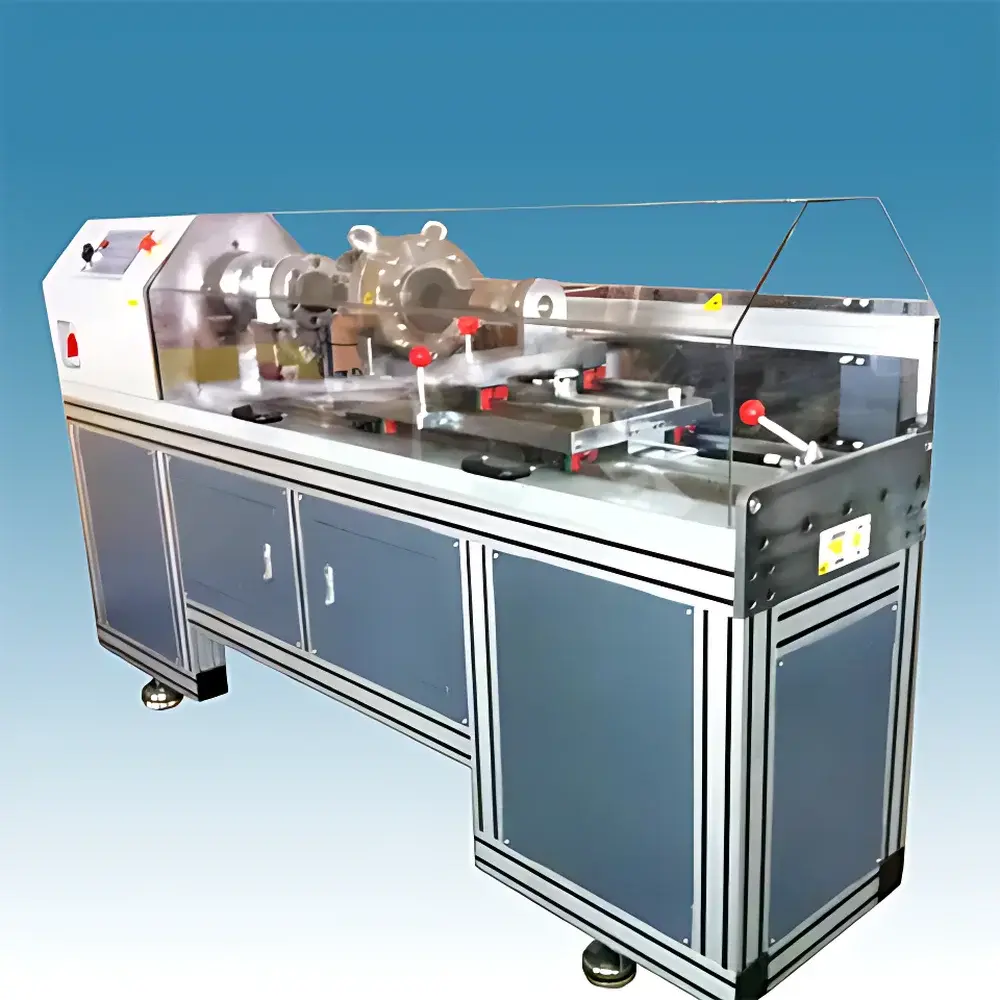
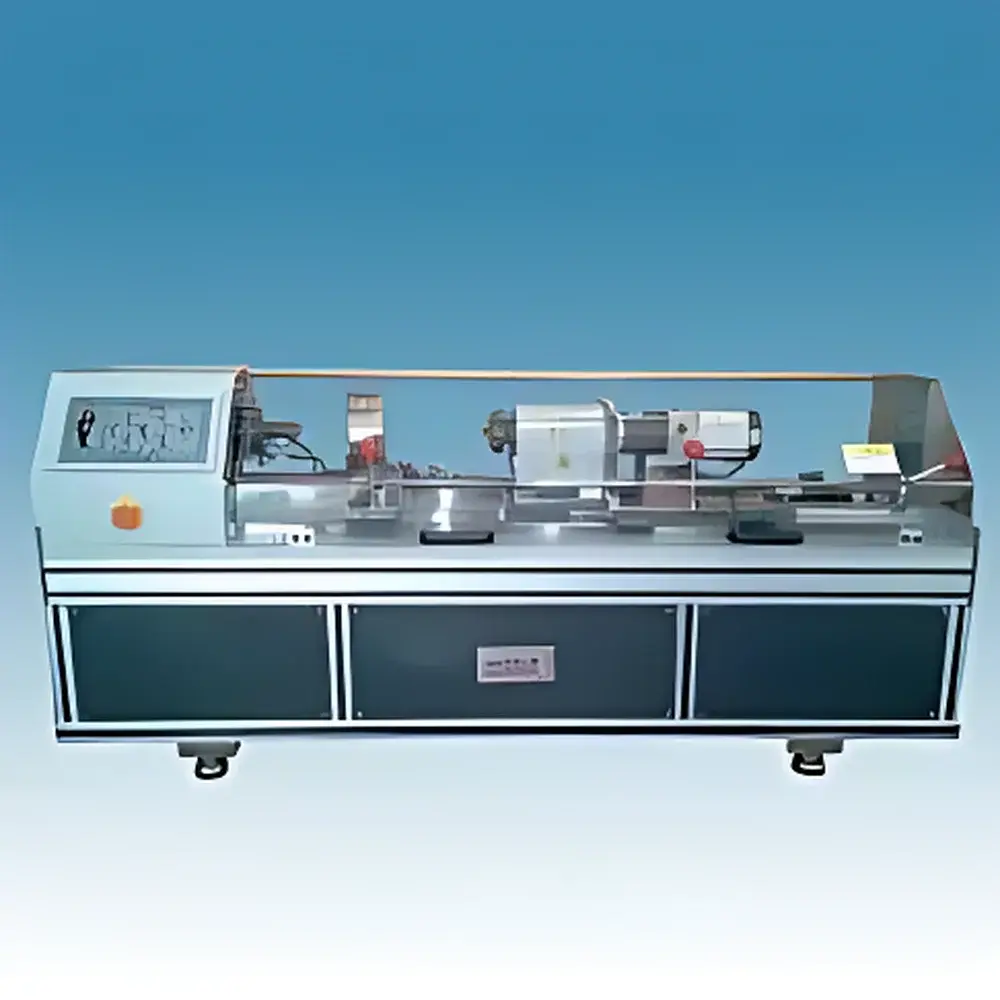
Hengyi HY(NJ)-2000N·m Bolt Axial Force and Torque Testing Machine
| Brand | Hengyi |
|---|---|
| Origin | Shanghai, China |
| Manufacturer | Hengyi Test Equipment Co., Ltd. |
| Model | HY(NJ)-2000N·mHYJU |
| Max Torque | 2000 N·m |
| Torque Measurement Range | 2–2000 N·m |
| Torque Resolution | 1/500,000 |
| Torsion Angle Range | 0–100,000° (or continuous) |
| Motor Power | 3 kW |
| Axial Force Range | 5–500 kN |
| Torque & Angle Accuracy | ±0.5% (typical) |
| Rotational Speed Range | 0–1000°/min |
| Gauge Length | 1000 mm |
| Specimen Clamping Range | M10–M27 (customizable) |
| Dimensions (L×W×H) | ≈2800×540×1250 mm |
| Weight | 2200 kg |
Overview
The Hengyi HY(NJ)-2000N·m Bolt Axial Force and Torque Testing Machine is a high-precision, horizontally configured torsion testing system engineered for the simultaneous measurement of axial preload force and applied torque during fastener tightening and failure characterization. It operates on the principle of coupled axial-torsional loading, enabling real-time synchronization of force (kN), torque (N·m), angular displacement (°), and rotational speed (°/min) under controlled closed-loop servo control. Designed specifically for high-strength bolt qualification in structural engineering applications, this machine meets the mechanical test requirements defined in ISO 898-1, ASTM F606, EN 14399, and GB/T 1231–2006 for high-strength bolts used in steel structures. Its rigid floor-standing frame—constructed from high-rigidity welded steel—minimizes deflection during high-torque loading up to 2000 N·m, ensuring measurement stability and long-term repeatability across thousands of test cycles.
Key Features
- Integrated dual-sensor architecture: High-accuracy load cell (5–500 kN range) and torque transducer (2–2000 N·m range) with independent signal conditioning and 24-bit ADC resolution
- High-fidelity angular measurement via optical encoder with 0.01° resolution and ≤±0.5% linearity error over 0–100,000° full-scale rotation
- AC servo motor drive (3 kW) delivering smooth, programmable torsion rates from 0.01°/min to 1000°/min with ≤±0.5% speed regulation accuracy
- Modular clamping system accommodating threaded fasteners from M10 to M27; custom jaw inserts available for non-standard geometries or oversized specimens
- Robust mechanical design featuring hardened guide rails, preloaded ball screws, and vibration-damped base structure for consistent test alignment and minimal parasitic bending
- Embedded HYtest digital control platform supporting real-time PID tuning, multi-step test profiles, and automatic yield detection based on torque–angle slope analysis
Sample Compatibility & Compliance
This system is validated for testing structural high-strength bolts including but not limited to: ASTM A325/A490, EN 14399-4/-6, GB/T 1231–2006 hex bolts, torqued shear bolts, and friction-grip assemblies. It supports both static and dynamic torque–tension correlation studies, including K-factor (torque coefficient) determination per GB/T 16823.3–2010 and ISO 16047. All hardware and firmware comply with electromagnetic compatibility (EMC) standards IEC 61326-1 and safety requirements IEC 61000-6-2. The mechanical architecture conforms to GB/T 2611–2007 general technical specifications for testing machines, including frame stiffness verification, load path alignment tolerance (<0.1 mm/m), and thermal drift compensation within ±0.5°C operating range.
Software & Data Management
The HYtest Control & Analysis Suite provides ISO/IEC 17025-compliant data acquisition with timestamped audit trails, user-level access control (admin/operator/guest), and electronic signature support aligned with FDA 21 CFR Part 11 principles. Test sequences—including ramp-hold, step-cycle, and break-point capture—are programmable via intuitive graphical interface. Raw data export is supported in CSV, XML, and universal .tdms formats. Real-time plotting includes synchronized torque vs. angle, axial force vs. angle, torque vs. time, and derived metrics such as coefficient of friction (µ), thread efficiency, and elastic-to-plastic transition points. Calibration records are digitally archived with traceability to CNAS-accredited reference standards.
Applications
- Verification of torque–tension relationships for wind turbine tower bolting systems (IEC 61400-1 compliance)
- Quality assurance testing of anchor bolts in bridge cable anchorage and dam construction
- R&D validation of lubricant performance and surface coating effects on bolted joint behavior
- Production-line inspection of high-strength fasteners for rail infrastructure and power transmission towers
- Failure mode analysis including thread stripping, shank yielding, and head fracture under combined axial-torsional loading
- Support for GLP/GMP-regulated laboratories requiring full traceability, calibration history, and report generation per ISO 17025 clause 7.8
FAQ
What standards does this machine directly support for bolt certification?
It is fully compatible with GB/T 1231–2006, GB/T 16823.3–2010, ISO 16047, ASTM F606, and EN 14399 series for mechanical property evaluation and torque coefficient determination.
Can the system perform automated K-factor calculation per ISO 16047?
Yes—the software implements ISO-defined methodology for calculating torque coefficient (K) using measured torque, axial force, and nominal diameter, with configurable averaging windows and outlier rejection filters.
Is remote operation and data monitoring supported?
The system supports Ethernet-based remote access via secure HTTP/HTTPS interface; live data streaming and alarm notifications are configurable through optional OPC UA integration.
What maintenance intervals are recommended for long-term accuracy?
Annual verification of torque and force sensors against certified reference standards is advised; optical encoder calibration is recommended every 24 months or after 5000 operational hours.
Does the machine meet requirements for accredited laboratory reporting?
Yes—it generates compliant test reports containing equipment ID, operator ID, environmental conditions, raw data plots, statistical summaries, and digital signatures meeting ILAC-MRA and CNAS documentation requirements.



