
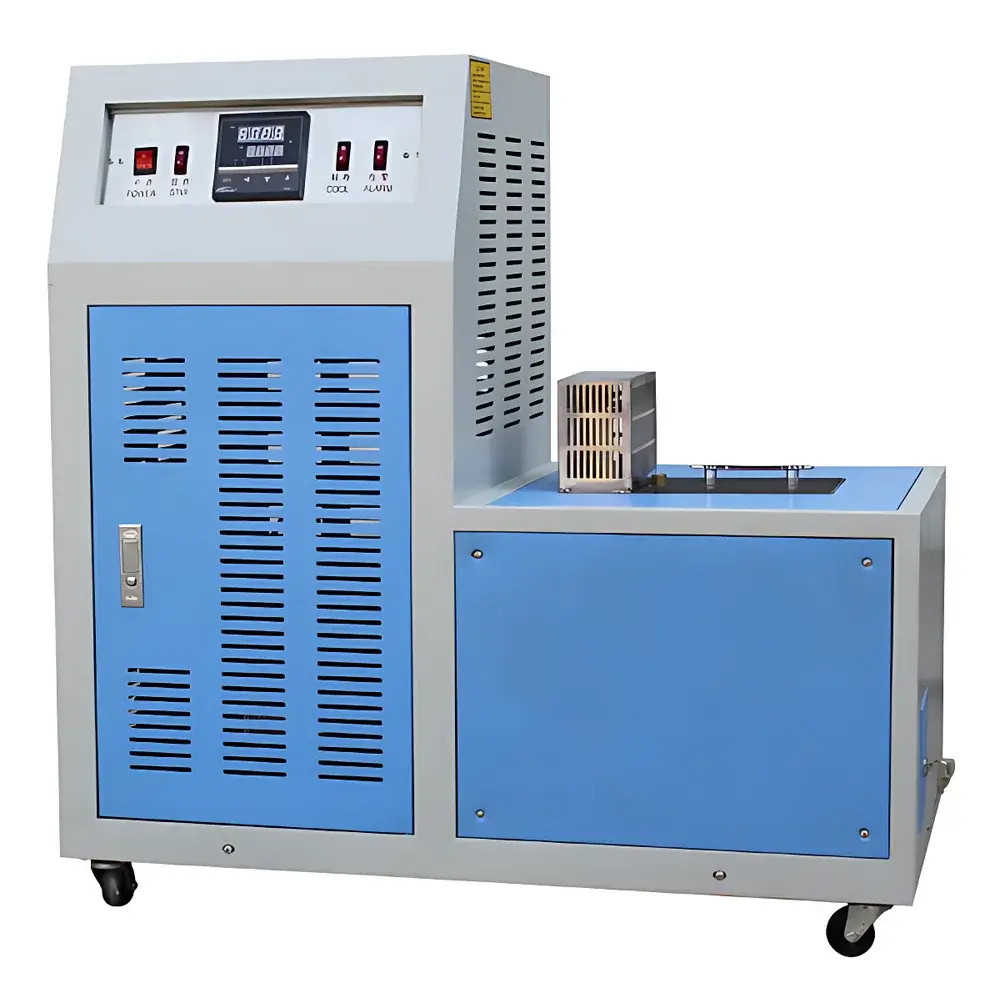
Hengyi HY(DWC)-40 Impact Test Low-Temperature Bath
| Brand | Hengyi |
|---|---|
| Origin | Shanghai, China |
| Manufacturer Type | Direct Manufacturer |
| Country of Origin | China |
| Model | HY(DWC)-40 |
| Price | Upon Request |
| Temperature Range | Room Temp (≤25°C) to –40°C |
| Temperature Stability | ±0.5°C |
| Cooling Rate | ~1.2°C/min (RT to 0°C), ~1.0°C/min (0°C to –20°C), ~0.5°C/min (–20°C to –40°C) |
| Internal Chamber Dimensions | 275 × 160 × 120 mm (L×W×H) |
| Max Sample Capacity | >60 specimens (10 × 10 × 55 mm Charpy V-notch) |
| Timer Range | 1–9999 min (1-min resolution) |
| Coolant | Anhydrous Ethanol or Other Non-Freezing Fluid |
| Circulation Motor Power | 23 W |
| Power Supply | 220–240 V, 50 Hz, 1.8 kW |
| Ambient Operating Temperature | 5–25°C |
Overview
The Hengyi HY(DWC)-40 Impact Test Low-Temperature Bath is a precision-engineered cryogenic conditioning system designed specifically for standardized Charpy and Izod impact testing of metallic materials under controlled sub-zero thermal conditions. It operates on the principle of cascade compression refrigeration—employing two independent refrigeration circuits (high- and low-stage compressors) to achieve stable, uniform cooling down to –40°C with high thermal reproducibility. The system integrates forced convection via a submerged circulation motor and thermally balanced bath geometry to ensure homogeneous temperature distribution across the entire sample immersion volume. This architecture directly supports compliance with ISO 148-1:2016, ISO 83:1977, ASTM E23-22, EN 10045-1:1990, and GB/T 229–2020 (revised version of GB/T 229–2007), all of which mandate strict temperature uniformity, stability, and dwell-time control during pre-test specimen conditioning.
Key Features
- Cascade refrigeration system featuring an Aspera (Italy) dual-stage compressor for reliable, oil-lubricated operation and extended service life at sustained low temperatures
- Digital PID temperature controller with real-time feedback from a calibrated Pt100 sensor, delivering ±0.5°C thermal stability over the full operating range (RT to –40°C)
- Stainless-steel insulated bath chamber with optimized internal geometry (275 × 160 × 120 mm usable volume) and integrated impeller-driven fluid circulation to eliminate thermal stratification
- Programmable digital timer (1–9999 minutes, 1-minute resolution) synchronized with temperature acquisition for precise soak-time validation in GLP/GMP-aligned workflows
- Three stainless-steel sample baskets included, each accommodating ≥20 standard 10 × 10 × 55 mm Charpy specimens—enabling batch processing of >60 samples per cycle without re-cooling delays
- Low-power circulation motor (23 W) minimizes heat input while maintaining turbulent flow for rapid thermal equilibration of immersed specimens
- Front-access design with transparent acrylic lid and ergonomic handle for safe, repeatable specimen loading and retrieval under cryogenic conditions
Sample Compatibility & Compliance
The HY(DWC)-40 accommodates standard Charpy V-notch, U-notch, and subsize metallic specimens conforming to ISO 148-1, ASTM E23, and GB/T 229 geometries. Its bath volume and thermal mass are validated to maintain uniform temperature within ±0.5°C across the entire working zone—even during continuous specimen insertion/removal cycles. The system meets the thermal performance requirements outlined in Annex A of ASTM E23-22 (“Requirements for Cooling Baths Used in Notched-Bar Impact Testing”) and Clause 6.3 of ISO 148-1:2016 (“Temperature Control and Uniformity”). When operated with anhydrous ethanol (or equivalent non-freezing coolant), it satisfies the chemical compatibility and viscosity criteria specified in EN 10045-1 for low-temperature impact baths. Documentation packages include factory calibration certificates traceable to NIM (National Institute of Metrology, China) and optional IQ/OQ protocols for regulated laboratory environments.
Software & Data Management
While the HY(DWC)-40 operates via embedded microcontroller-based hardware control (no PC dependency), its digital interface supports RS-232 or optional RS-485 output for integration into centralized lab data management systems. Temperature readings and timer status can be logged externally using third-party SCADA or LIMS platforms compliant with ASTM E1338 and ISO/IEC 17025 data integrity guidelines. All operational parameters—including actual bath temperature, setpoint, elapsed soak time, and compressor runtime—are stored in non-volatile memory for audit trail generation. For laboratories subject to FDA 21 CFR Part 11 or EU Annex 11 requirements, optional firmware upgrades provide electronic signature support, user-level access control, and immutable event logging.
Applications
- Pre-conditioning of ferrous and non-ferrous metal specimens prior to Charpy V-notch impact testing per ISO 148, ASTM E23, and GB/T 229
- Supporting fracture toughness evaluation (e.g., KIC, JR) where precise low-temperature stabilization is required prior to loading
- Calibration verification of impact testing machines’ temperature-dependent energy absorption response
- Material qualification for cryogenic service applications—e.g., LNG pipeline steels, aerospace alloys, and pressure vessel components
- Research-grade thermal transition studies (ductile-to-brittle transition temperature, DBTT) requiring multi-point isothermal holds between –10°C and –40°C
- Supplementary use in tensile testing, hardness measurement, or dimensional stability assessments requiring stabilized sub-zero environments
FAQ
What refrigerant is used in the HY(DWC)-40 system?
The unit employs environmentally compliant R404A/R23 mixed refrigerant in the cascade circuit—fully sealed and non-user-serviceable per ASHRAE Standard 34 classification.
Can the bath accommodate non-standard specimen geometries?
Yes—the open-chamber design allows custom fixtures or larger test pieces up to 270 mm in length; however, thermal uniformity validation must be performed per ISO/IEC 17025 if deviating from standard Charpy dimensions.
Is remote monitoring supported out of the box?
Basic serial communication (RS-232) is standard; Ethernet or Modbus TCP interfaces are available as factory-installed options upon request.
What maintenance intervals are recommended for the Aspera compressor?
Compressor oil and filter replacement is advised every 12 months or 3,000 operating hours—whichever occurs first—using original Aspera service kits to preserve warranty and thermal performance.
Does the system comply with CE or UKCA marking requirements?
The HY(DWC)-40 meets EMC Directive 2014/30/EU and Low Voltage Directive 2014/35/EU; CE documentation is supplied with each unit. UKCA marking requires additional conformity assessment by a UK-approved body and is available upon special order.



