
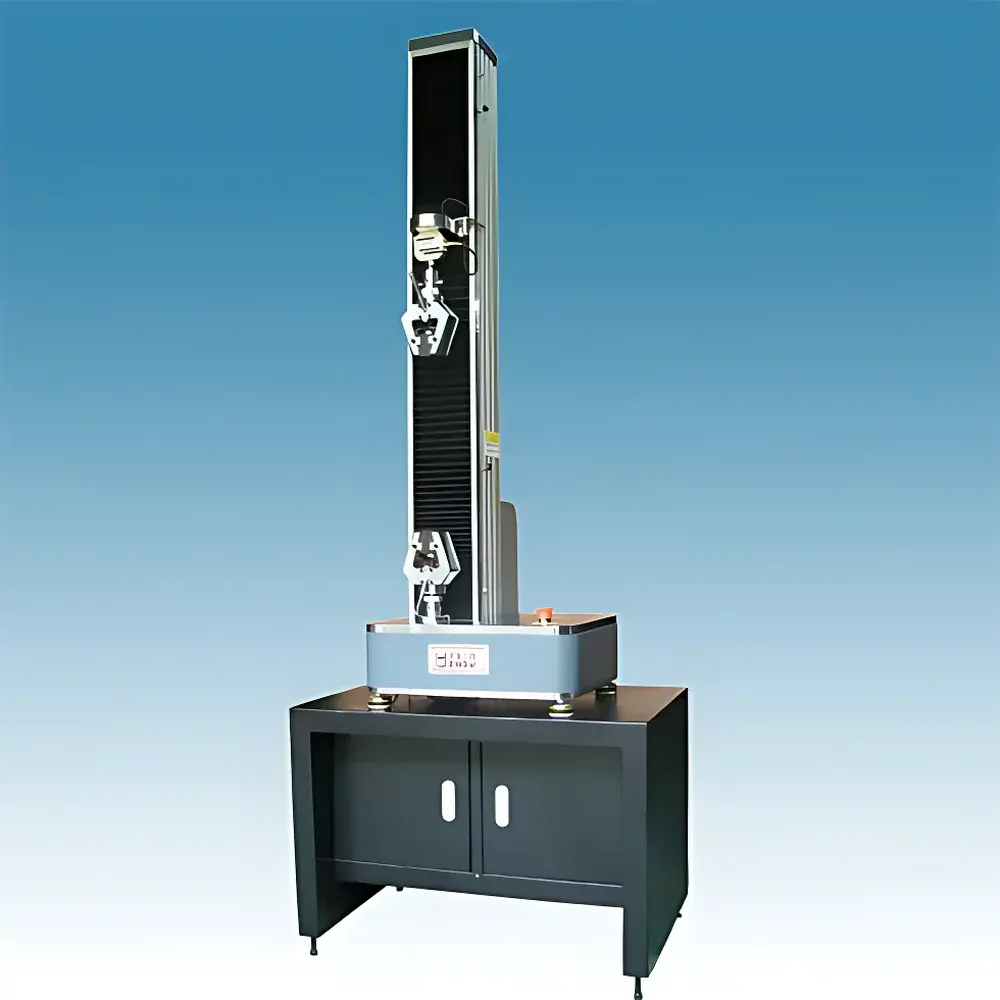
Hengyi HY-0580FGHJ Universal Testing Machine for Polyester Fiber Composites
| Brand | Hengyi |
|---|---|
| Origin | Shanghai, China |
| Manufacturer Type | Direct Manufacturer |
| Country of Origin | China |
| Model | HY-0580FGHJ |
| Instrument Type | Electromechanical Universal Testing Machine |
| Load Capacity Options | 1 N to 5000 N (interchangeable load cells) |
| Force Accuracy | ≤ ±0.5% of reading |
| Effective Test Width | 120 mm |
| Effective Vertical Travel | 800 mm |
| Speed Range | 0.001–500 mm/min (adjustable) |
| Speed Accuracy | ±0.5% of set value |
| Displacement Accuracy | ±0.5% of reading |
| Strain Measurement Accuracy | ±0.5% of reading |
| Control Modes | Stress control, strain control, displacement control, constant-force/constant-displacement/constant-strain hold |
| Safety Features | Electronic limit protection, overload protection (110% FS), automatic emergency stop, self-diagnostic system |
| Power Supply | 220 V AC, 750 W |
| Dimensions (W×D×H) | 470 × 400 × 1510 mm |
| Weight | 120 kg |
Overview
The Hengyi HY-0580FGHJ Universal Testing Machine is an electromechanical force-testing platform engineered for high-reproducibility tensile, compressive, flexural, shear, peel, and tear evaluations of polymer composites—including polyester fiber-reinforced systems—as well as metals, plastics, elastomers, textiles, and advanced functional materials. Its modular single-column architecture integrates a precision ball-screw actuation system, digital closed-loop servo control, and high-resolution load cell technology to deliver traceable mechanical property data in compliance with static uniaxial testing principles defined in ISO 7500-1, ASTM E4, and GB/T 16825.1. Designed for laboratory and quality control environments, the system supports standardized mechanical characterization under controlled ambient conditions, enabling consistent determination of ultimate tensile strength (UTS), yield strength, modulus of elasticity, elongation at break, and stress–strain hysteresis behavior.
Key Features
- Modular load cell configuration: Interchangeable transducers ranging from 1 N to 5000 N, all calibrated to Class 0.5 accuracy per ISO 376 and GB/T 16825.1.
- High-fidelity motion control: Servo-driven crosshead with adjustable speed range (0.001–500 mm/min), maintaining ±0.5% speed accuracy across full range.
- Full-range force resolution: 500,000 internal counts, no auto-ranging or switching—ensuring uniform resolution from 0.1% to 100% of selected capacity.
- Dual-mode actuation interface: Manual jog control for rapid positioning + programmable automated return to home position post-test.
- Integrated safety architecture: Dual electronic limit switches, real-time overload detection (triggered at 110% FS), and automatic shutdown upon abnormal voltage/current/pressure conditions.
- Multi-parameter feedback loop: Simultaneous acquisition of force, displacement, and strain (via optional extensometer), each with ≤±0.5% measurement uncertainty.
- Configurable control profiles: Stress-rate (0.005–6 %FS/s), strain-rate (0.002–6 %FS/s), and displacement-rate modes—all with adaptive accuracy thresholds per rate magnitude.
Sample Compatibility & Compliance
The HY-0580FGHJ accommodates specimens up to 120 mm wide and 800 mm tall, supporting standardized test geometries per ISO 527 (plastics), ISO 5083 (fiber-reinforced composites), GB/T 3923 (woven fabrics), GB/T 1040 (tensile properties of plastics), and ASTM D3039 (polymer matrix composites). Its mechanical design conforms to GB/T 2611-2007 (General Technical Requirements for Testing Machines) and GB/T 16491-2008 (Electronic Universal Testing Machines). Calibration traceability aligns with national metrological standards in China (JJG 139), while software validation supports audit-ready documentation for GLP and ISO/IEC 17025-accredited laboratories. Optional extensometers meet ISO 9513 Class 1 requirements for strain measurement.
Software & Data Management
The embedded Windows-based control software provides ISO/IEC 17025-compliant test sequence definition, real-time curve overlay, multi-channel synchronized data logging (≥1 kHz sampling), and automated report generation in PDF/Excel formats. All test parameters—including operator ID, environmental notes, calibration certificates, and raw waveform data—are stored with timestamped metadata. Audit trail functionality records user actions, parameter changes, and system events, satisfying FDA 21 CFR Part 11 requirements for electronic records and signatures when deployed in regulated manufacturing or pharmaceutical R&D settings. Customizable test templates allow rapid deployment of method-specific protocols aligned with ASTM D882 (thin plastic films) or ISO 13934-1 (tensile properties of textiles).
Applications
This system is routinely deployed in material development labs evaluating interfacial adhesion in polyester/carbon hybrid laminates, quality assurance departments verifying batch-to-batch consistency of conductive fiber yarns, and academic research groups studying viscoelastic relaxation in thermoplastic composites. Typical use cases include: tensile strength and modulus mapping of melt-spun PET fibers; creep and stress-relaxation profiling under elevated temperature; peel resistance assessment of coated textile substrates; and cyclic loading analysis of flexible composite electrodes. Its adaptability to custom fixtures enables non-standard tests such as button pull-out, seam strength, and micro-tensile evaluation of fiber bundles.
FAQ
What standards does the HY-0580FGHJ comply with for composite material testing?
It meets GB/T 1040, ISO 527, ASTM D3039, and ISO 13934-1 for tensile characterization, and supports method development for emerging standards in smart textile and multifunctional composite evaluation.
Can the system be integrated into a LIMS or MES environment?
Yes—via TCP/IP or RS232 communication protocols, raw data export (CSV, XML), and OPC UA-compatible interfaces for enterprise-level system integration.
Is third-party calibration certification available?
Certified calibration reports traceable to NIM (National Institute of Metrology, China) are provided with initial delivery and can be renewed annually per ISO/IEC 17025 requirements.
Does the machine support high-temperature or environmental chamber integration?
The base frame is compatible with external environmental chambers (−70°C to +300°C); mounting brackets and cable feedthroughs are configurable upon order specification.
How is software validation handled for regulated industries?
IQ/OQ documentation packages—including installation qualification, operational qualification, and performance verification protocols—are available as optional deliverables for GMP and ISO 13485 environments.
Related Products



