
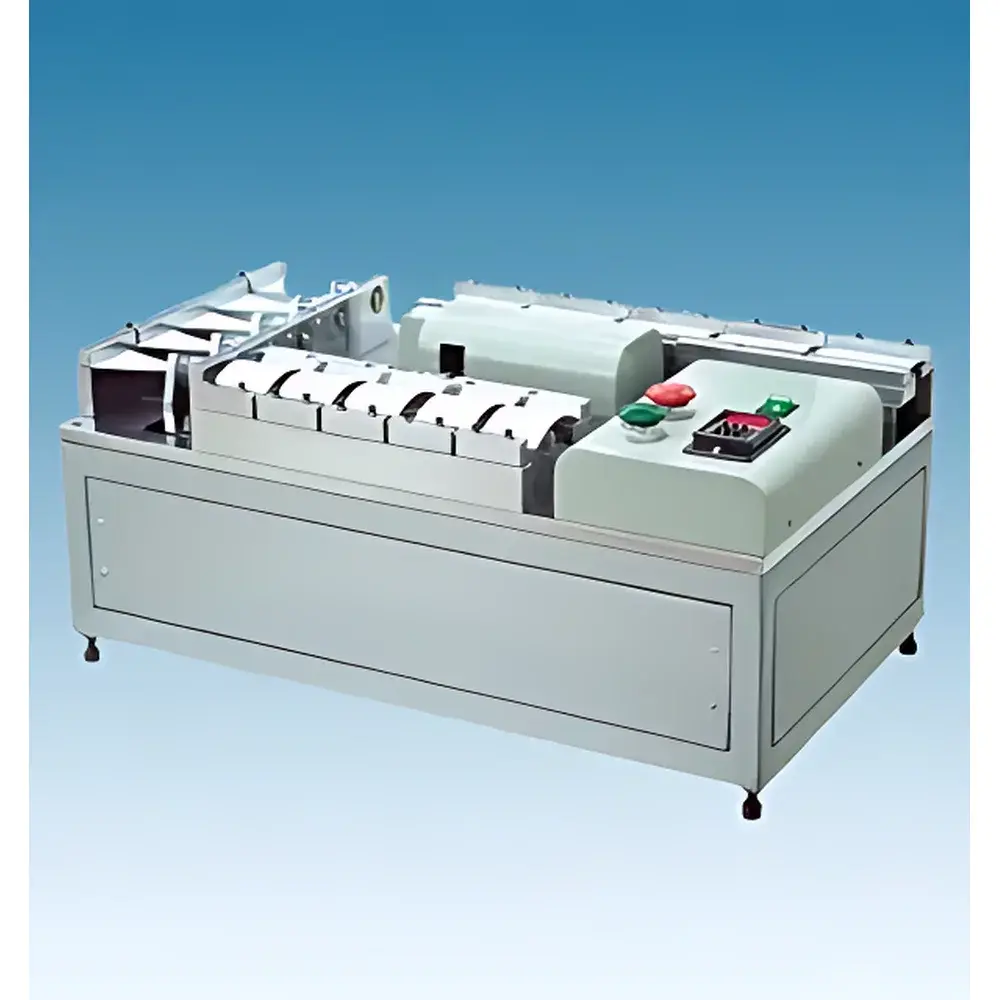
Hengyi HY(IC)WWE Dynamic Bending and Bidirectional Torsion Tester for Smart Cards
| Brand | Hengyi / Hengyitest |
|---|---|
| Origin | Shanghai, China |
| Manufacturer Type | Direct Manufacturer |
| Region of Origin | Domestic (China) |
| Model | HY(IC)WWE |
| Price | Upon Request |
| Test Stations | 15 (5 long-edge bending, 5 short-edge bending, 5 torsion) |
| Cycle Count Range | 1–9999 cycles |
| Counting Method | Non-contact photoelectric sensor (replacing mechanical switch-based counting) |
| Max. Bending Displacement (long edge) | 20 mm (–1.0 mm tolerance, +0.00 mm) |
| Min. Bending Displacement (long edge) | 2 mm ± 0.50 mm |
| Max. Bending Displacement (short edge) | 10 mm (–1.0 mm tolerance, +0.00 mm) |
| Min. Bending Displacement (short edge) | 1 mm ± 0.50 mm |
| Torsion Angle | ±15° ±1° (bidirectional, d = 86 mm |
| total angular range | 30°) |
| Test Speed | 30 rpm or 0.5 Hz (bending & torsion) |
| Dimensions (L×W×H) | 670 × 380 × 220 mm |
| Weight | 70 kg |
| Power Supply | AC 220 V ±5% |
| Power Consumption | 35 W |
| Fixture Mounting | Compliant with ISO/IEC 7816-1:2018 and ISO/IEC 10373-6:2021 dimensional specifications |
Overview
The Hengyi HY(IC)WWE Dynamic Bending and Bidirectional Torsion Tester is a precision-engineered electromechanical test system designed specifically for evaluating the mechanical durability of contact and contactless smart cards under standardized cyclic flexural and torsional stress. It operates on the principle of controlled, repeatable displacement-driven actuation—applying defined angular deflection (for torsion) and linear displacement (for bending) to simulate real-world handling conditions such as card insertion, removal, pocket friction, and repeated flexing. The instrument conforms to the mechanical test requirements specified in ISO/IEC 7816-1:2018 (Physical characteristics), ISO/IEC 10373-6:2021 (Test methods for cards — Part 6: Mechanical test methods), GB/T 16649.1–2016 (Identification cards — Integrated circuit cards — Part 1: Physical characteristics), and GB/T 17554.1–2006 (Identification cards — Test methods — Part 1: Mechanical test methods). Its architecture integrates high-fidelity motion control, non-contact cycle verification, and modular station configuration to support concurrent evaluation across three distinct mechanical failure modes.
Key Features
- Fifteen independent test stations: five dedicated to long-edge bending, five to short-edge bending, and five to bidirectional torsion—enabling parallel, statistically robust testing per ISO 10373-6 Annex A.
- Non-contact photoelectric counting system ensures >99.99% counting reliability over 9999 cycles, eliminating mechanical wear and false triggers associated with legacy limit-switch-based counters.
- Precision-adjustable displacement and angular parameters: long-edge bending displacement (2–20 mm, ±0.5 mm resolution), short-edge bending (1–10 mm), and torsion angle (±15° ±1°, total 30° swing, center-to-center radius d = 86 mm).
- Programmable test speed at 0.5 Hz (30 rpm equivalent) with stable torque transmission via high-precision gear reduction and STK AC variable-frequency drive.
- Fixture geometry fully aligned with ISO/IEC 7816-1 Annex B and ISO/IEC 10373-6 Clause 5.2—ensuring consistent clamping force distribution and card alignment across all stations.
- Low-power, thermally stable operation (35 W nominal) with integrated thermal management and EMI-shielded motor control circuitry for laboratory-grade repeatability.
Sample Compatibility & Compliance
The HY(IC)WWE accommodates standard ID-1 format smart cards (85.6 × 53.98 × 0.76 mm) including contact IC cards (ISO/IEC 7816-2 compliant), contactless RFID cards (ISO/IEC 14443), and hybrid dual-interface cards. All test fixtures are machined to exacting tolerances per ISO/IEC 7816-1:2018 Figure 3 (card outline) and Figure 4 (corner radii), with surface finish optimized to prevent micro-scratching during repeated loading. The system supports full traceability for GLP and GMP environments: each test run logs timestamp, station ID, cycle count, and operator ID. While not FDA 21 CFR Part 11-certified out-of-the-box, its data output format (CSV/ASCII) is compatible with validated LIMS and ELN systems used in regulated card certification workflows.
Software & Data Management
The HY(IC)WWE operates in standalone mode with front-panel digital display and tactile keypad interface—no PC dependency required for basic operation. Cycle completion is indicated via LED status per station, with cumulative count stored in non-volatile memory. For advanced integration, optional RS-232 or USB-to-serial interface enables remote command execution (e.g., START, RESET, QUERY_COUNT) and automated logging into third-party QA databases. Raw cycle data exports as time-stamped ASCII files containing station number, current count, and pass/fail flag (based on user-defined threshold). All firmware updates are delivered via secure encrypted binary patch—maintaining integrity of calibration-critical motion profiles.
Applications
This tester is deployed by national metrology institutes (e.g., CNAS-accredited labs), smart card manufacturers (e.g., Gemalto, Giesecke+Devrient OEM suppliers), and utility-sector R&D teams (including State Grid Corporation of China) for qualification testing prior to mass production. Typical use cases include: validation of embedded antenna integrity under torsion-induced conductor fatigue; assessment of epoxy encapsulation adhesion during repeated bending; comparative analysis of substrate materials (PVC, PETG, polycarbonate) for flex life; and conformance auditing against procurement specifications referencing ISO/IEC 10373-6 Clause 6.2 (bending endurance) and Clause 7.2 (torsion endurance). It also serves academic research in polymer mechanics and thin-film interfacial reliability.
FAQ
What standards does the HY(IC)WWE explicitly comply with?
It meets the mechanical test requirements of ISO/IEC 7816-1:2018, ISO/IEC 10373-6:2021, GB/T 16649.1–2016, and GB/T 17554.1–2006.
Can the bending displacement be adjusted in real time during a test sequence?
No—displacement parameters are set pre-test via front-panel interface and remain fixed throughout the cycle sequence to ensure compliance with static-deflection test protocols.
Is calibration documentation provided with the instrument?
Yes—each unit ships with a factory calibration certificate traceable to NIM (National Institute of Metrology, China), covering displacement linearity (±0.05 mm), angular accuracy (±0.5°), and cycle counter verification.
Does the system support multi-card simultaneous testing per station?
No—each station is configured for single-card loading to maintain strict adherence to ISO-defined boundary conditions and avoid load-sharing artifacts.
What maintenance intervals are recommended for long-term operational stability?
Gear reduction units require lubrication every 12 months; photoelectric sensors should be inspected quarterly for dust accumulation; no scheduled replacement parts are required within first 5 years under normal lab use (≤8 h/day).
Related Products



