
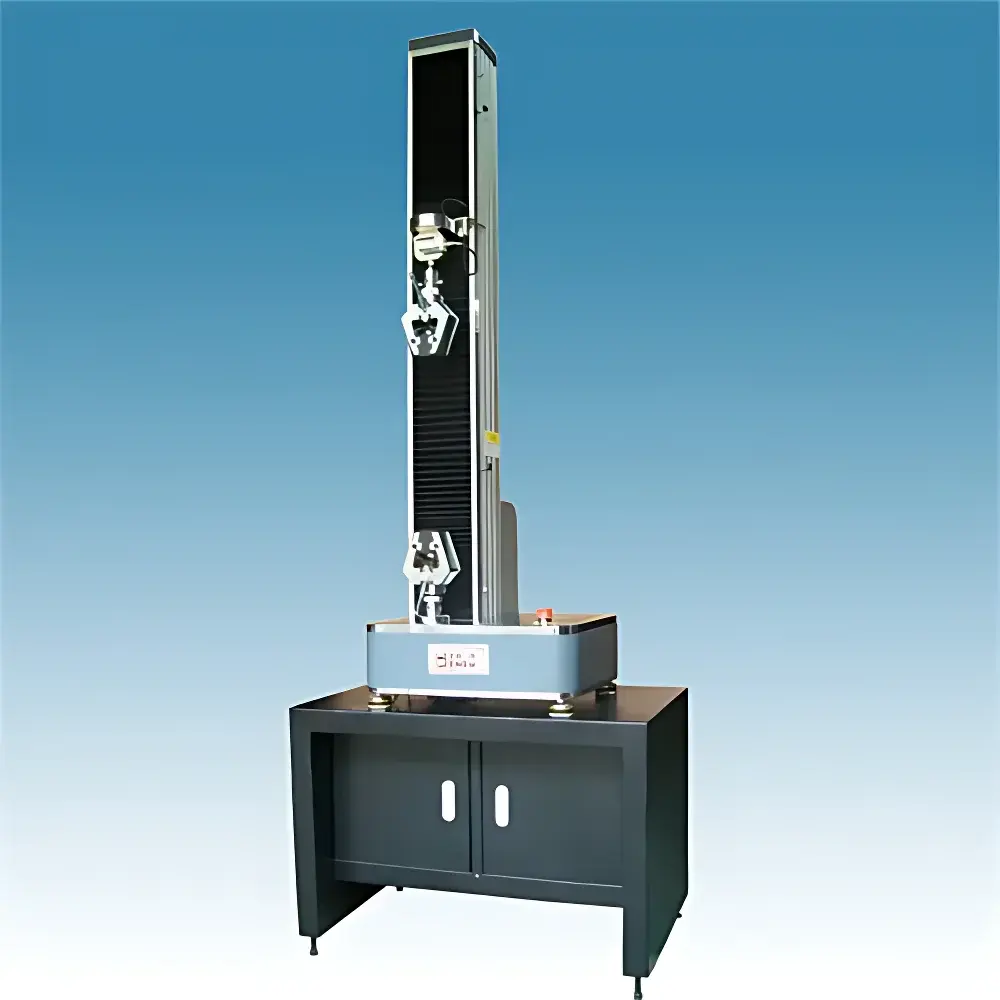
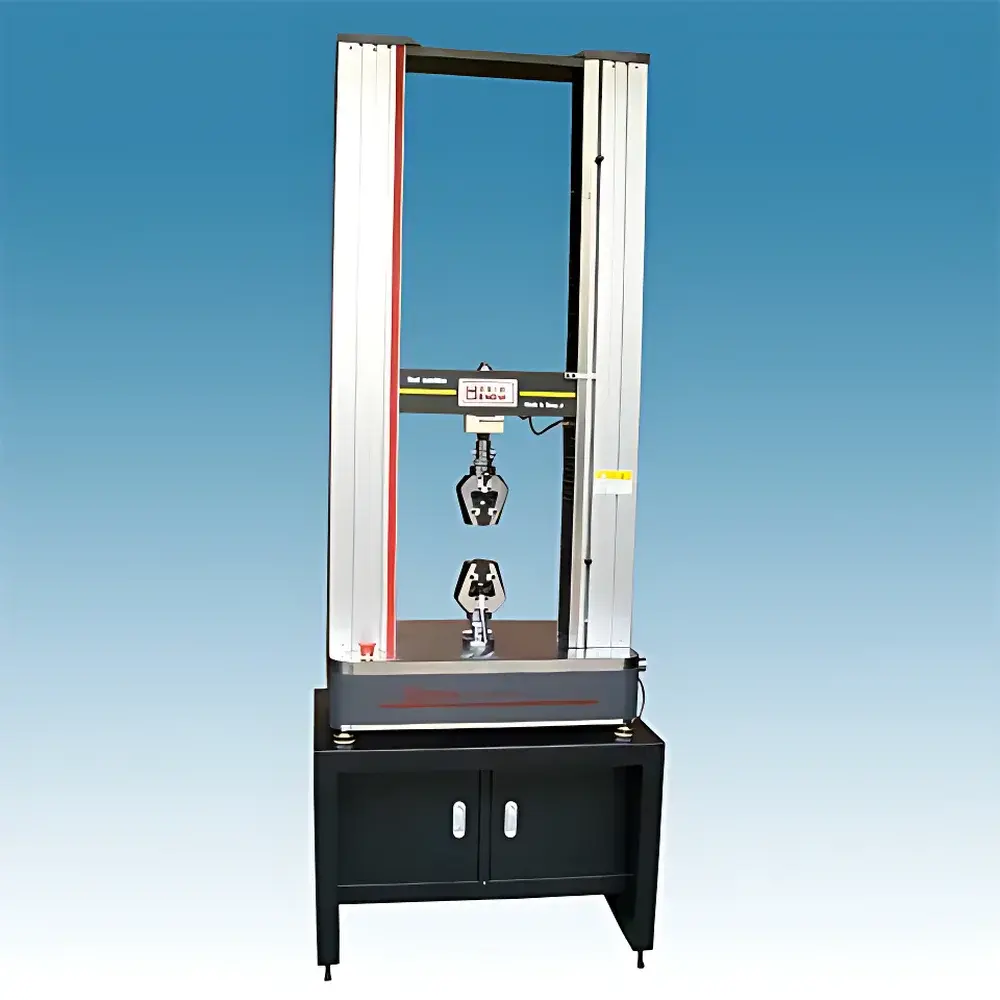
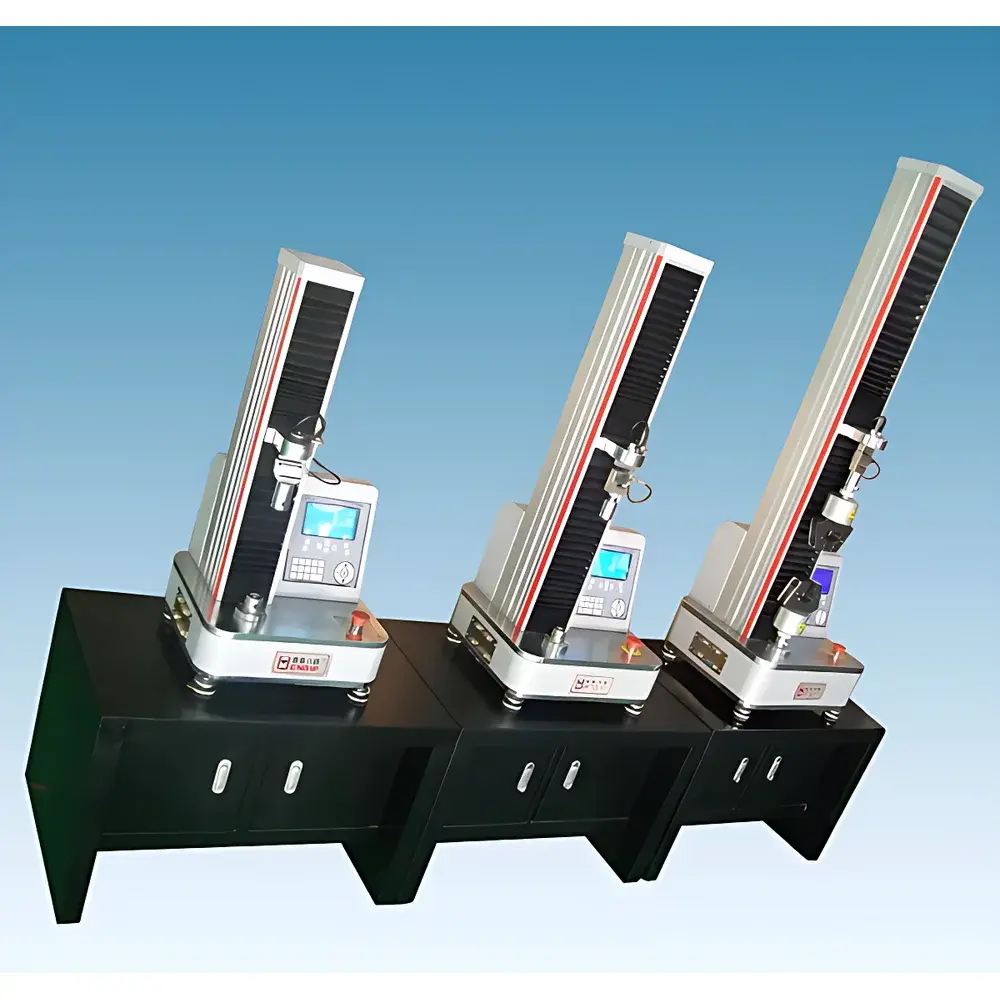
Hengyi HY-0580TGBGYY Universal Testing Machine for Soft Tissue and Biomaterials
| Brand | Hengyi |
|---|---|
| Origin | Shanghai, China |
| Manufacturer Type | Direct Manufacturer |
| Product Category | Domestic |
| Model | HY-0580TGBGYY |
| Instrument Type | Electromechanical Universal Testing Machine |
| Load Capacity Options | 1N–5000N (interchangeable load cells) |
| Force Accuracy | ≤0.5% of reading |
| Effective Test Width | 120 mm |
| Vertical Test Space | 800 mm |
| Speed Range | 0.001–500 mm/min |
| Speed Accuracy | ±0.5% of set value |
| Displacement Accuracy | ±0.5% of reading |
| Strain Control Range | 0.002–6% FS/s |
| Stress Control Range | 0.005–6% FS/s |
| Force Resolution | ±500,000 counts (full-scale, no range switching) |
| Power Supply | 220 V AC, 50 Hz, 750 W |
| Dimensions (W×D×H) | 470 × 400 × 1510 mm |
| Weight | 95 kg |
| Operating Environment | 20–40 °C, 20–80% RH |
| Compliance | GB/T 228.1-2010, YY/T 1504-2016, YY/T 0342-2002, YY/T 0662-2008, YY 0017-2008, GB/T 2611-2007 |
Overview
The Hengyi HY-0580TGBGYY Universal Testing Machine is an electromechanical static-dynamic testing system engineered for high-fidelity mechanical characterization of biological and synthetic biomaterials under controlled uniaxial loading conditions. Designed specifically to meet the stringent demands of regulatory-compliant biomechanical evaluation in medical device R&D and quality assurance laboratories, it implements closed-loop servo-controlled actuation with real-time force, displacement, and strain feedback. Its architecture supports quasi-static tensile, compression, bending, shear, peel, puncture, and cyclic fatigue testing—enabling precise quantification of elastic modulus, ultimate tensile strength, yield point, elongation at break, flexural rigidity, pull-out force, and load-displacement hysteresis behavior. The system adheres to fundamental principles of linear elastic theory and plastic deformation analysis as defined in ISO 527, ASTM D638, ASTM F2193, and ISO 14879-1, while its mechanical design conforms to the structural and metrological requirements of GB/T 2611-2007 and YY/T 0662-2008.
Key Features
- Modular load cell configuration supporting interchangeable transducers from 1 N to 5000 N, ensuring optimal signal-to-noise ratio across low-force soft tissue (e.g., collagen membranes, decellularized scaffolds) and high-force orthopedic implants (e.g., titanium spinal rods, cortical bone screws).
- High-resolution force measurement with ±500,000 internal counts and ≤0.5% accuracy across full scale—no auto-ranging or manual range switching required, preserving data continuity during multi-stage protocols.
- Precise motion control with speed programmability from 0.001 to 500 mm/min and ±0.5% speed fidelity, enabling slow-strain-rate creep tests and rapid dynamic loading per ISO 14879-2.
- Dual-mode control architecture supporting stress-, strain-, and displacement-controlled test modes with independent rate programming, essential for simulating physiological loading profiles and failure envelope mapping.
- Integrated safety subsystems including electronic travel limits, overload cutoff (>110% FS), automatic return-to-start, and real-time self-diagnostic monitoring of drive current, voltage, and thermal load status.
- Rigid four-column frame with 120 mm effective test width and 800 mm vertical stroke—optimized for specimen clamping versatility and minimal frame compliance during small-displacement measurements on compliant tissues.
Sample Compatibility & Compliance
The HY-0580TGBGYY accommodates a broad spectrum of specimens used in regulatory-grade biomechanical validation, including but not limited to: vascular grafts (ePTFE, Dacron, bioresorbable polymers), soft tissue analogs (hydrogels, porcine skin, tendon fascicles), hard tissues (cortical/cancellous bone blocks, osteochondral plugs), orthopedic hardware (pedicle screws, interbody cages, locking plates), dental implants, suture anchors, and coated metallic substrates. It fully satisfies the mechanical test method requirements outlined in YY/T 1504-2016 (axial pull-out of bone screws), YY/T 0342-2002 (bending stiffness of bone plates), YY 0017-2008 (flexural strength of metallic osteosynthesis plates), and GB/T 228.1-2010 (tensile testing of metallic materials). All test procedures are traceable to national metrological standards, and raw data acquisition complies with ALCOA+ principles for audit readiness in GLP and GMP environments.
Software & Data Management
The system operates with Hengyi’s proprietary BioTest Suite v3.2—a Windows-based platform supporting ISO/IEC 17025-aligned test sequence scripting, real-time parameter visualization, and automated report generation. Software features include multi-channel synchronized acquisition (force, displacement, extensometer input), customizable pass/fail criteria per ASTM F2193 Annex A1, digital filtering options for noise suppression, and export to CSV, PDF, and XML formats compatible with LIMS integration. Audit trail functionality records user login events, method modifications, calibration history, and result approvals in accordance with FDA 21 CFR Part 11 requirements. Raw binary data files are stored with embedded metadata (test ID, operator, timestamp, environmental conditions), ensuring full data integrity and reproducibility.
Applications
- Mechanical validation of Class II/III implantable devices per ISO 14630 and ISO 12417-1.
- Preclinical evaluation of tissue-engineered constructs under physiological strain rates (0.01–0.1%/s).
- Comparative assessment of degradation-induced mechanical loss in absorbable sutures and fixation devices.
- Standardized bending tests on vertebral body replacement systems per YY/T 0662-2008.
- Dynamic fatigue life estimation of hip joint prostheses using staircase or constant-amplitude protocols.
- Shear adhesion testing of hydrogel-tissue interfaces in wound dressing development.
- Compression testing of cancellous bone analogs for orthopedic scaffold qualification.
FAQ
Does the HY-0580TGBGYY support ASTM F2193-compliant testing for spinal fixation devices?
Yes—the system’s force resolution, displacement accuracy, and closed-loop control fidelity meet all instrumentation requirements specified in ASTM F2193 for static and dynamic testing of spinal implants.
Can the machine be calibrated to ISO/IEC 17025-accredited standards?
Yes—Hengyi provides factory calibration certificates traceable to CNAS-accredited reference standards; third-party accreditation is supported via documented uncertainty budgets and calibration SOPs.
Is extensometer input supported for direct strain measurement?
Yes—the system includes dedicated analog inputs for clip-on or non-contact extensometers, enabling true strain control and Poisson’s ratio determination per ISO 527-2.
What documentation is provided for regulatory submissions?
Users receive a comprehensive IQ/OQ protocol package, software validation summary, mechanical verification report, and standard operating procedures aligned with ISO 13485 and FDA QSR requirements.
How is data integrity maintained during long-duration fatigue tests?
The system employs buffered onboard memory with write-protected logging and timestamped checksum validation—ensuring zero data loss even during unexpected power interruption or host PC disconnection.



