
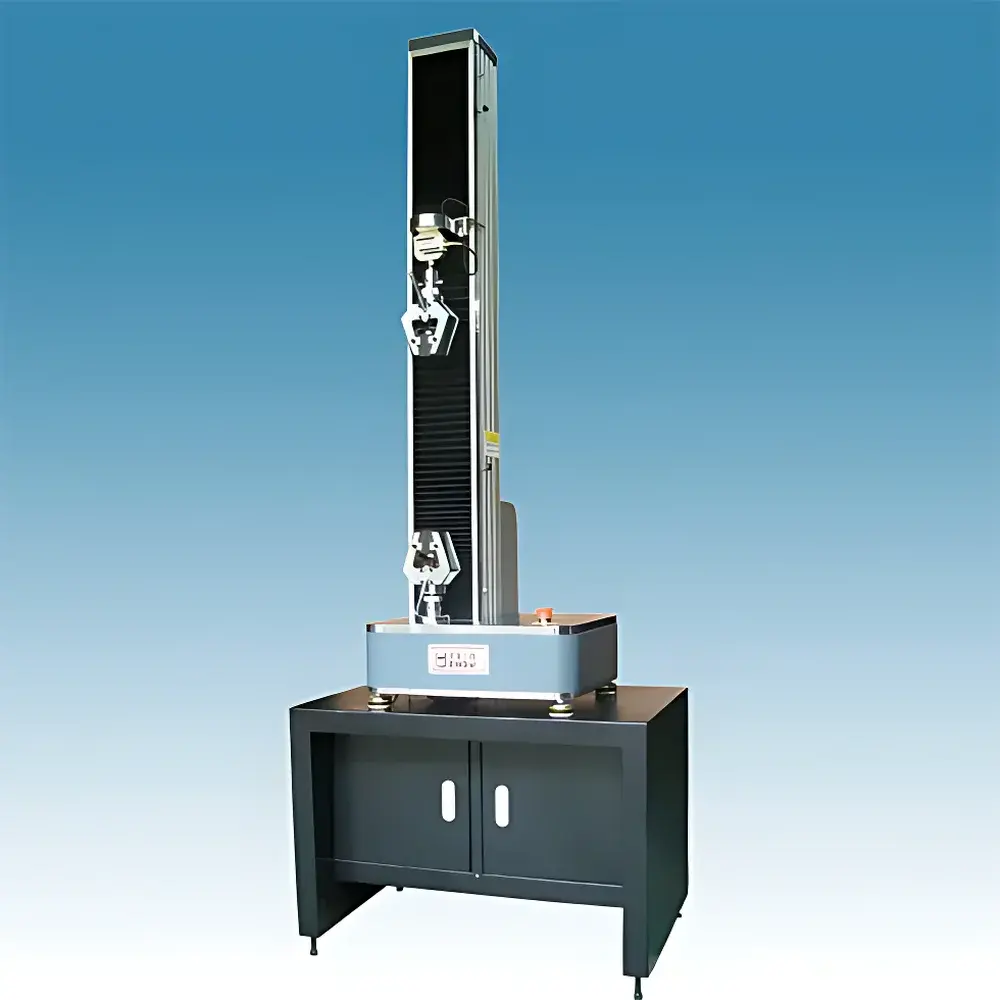
Hengyi HY-0580POK Microcomputer-Controlled Closed-Loop Electronic Universal Testing Machine
| Brand | Hengyi |
|---|---|
| Origin | Shanghai, China |
| Manufacturer Type | Direct Manufacturer |
| Regional Classification | Domestic (China) |
| Model | HY-0580POK |
| Instrument Type | Electromechanical Universal Testing Machine |
| Rated Load Capacity | ≤5000 N |
| Load Cell Accuracy | 0.01% FS |
| Measurement Accuracy | < ±1% |
| Control Mode | Full PC-Based Closed-Loop Control |
| Effective Width | 150 mm |
| Effective Stroke | 800 mm (extendable) |
| Test Speed Range | 0.001–500 mm/min (infinitely variable) |
| Speed Accuracy | ±0.5% |
| Displacement Measurement Accuracy | ±0.5% |
| Deformation Measurement Accuracy | ±0.5% |
| Safety Features | Electronic Limit Switches, Emergency Stop Button |
| Unit Weight | ~95 kg |
| Power Supply | 220 V AC |
| Dimensions (W×D×H) | 590 × 355 × 1640 mm |
Overview
The Hengyi HY-0580POK is a single-column, microcomputer-controlled closed-loop electromechanical universal testing machine engineered for high-reproducibility static mechanical characterization of materials across research, quality control, and production environments. Operating on the principle of servo-controlled force and displacement feedback, the system employs a precision ball-screw drive mechanism coupled with a high-resolution load cell (0.01% full-scale accuracy) and digital encoder-based position sensing to deliver traceable, repeatable mechanical data under ASTM E4, ISO 7500-1, and GB/T 228.1 compliance frameworks. Designed for versatility within constrained laboratory footprints, the HY-0580POK supports tensile, compressive, flexural, peel, tear, shear, and low-cycle fatigue testing up to 5 kN—making it suitable for routine evaluation of polymers, elastomers, thin metallic foils, composites, packaging films, biomedical tubing, and textile yarns.
Key Features
- Closed-loop PID control architecture ensuring dynamic load and displacement regulation with real-time error compensation
- Infinitely variable test speed range from 0.001 to 500 mm/min, calibrated to ±0.5% accuracy across the full spectrum
- Integrated dual-channel deformation measurement: high-precision extensometer input support (optional) and crosshead displacement tracking with ±0.5% linearity
- Automated event detection including yield point identification, fracture recognition, and programmable stop conditions (load-, displacement-, time-, or strain-triggered)
- Real-time multi-curve plotting with auto-scaling axes, zoom/pan functionality, and parameter extraction (e.g., Young’s modulus, yield strength, ultimate tensile strength, elongation at break)
- Dual safety redundancy: hardware-based electronic limit switches plus software-enforced stroke boundaries and emergency stop circuitry compliant with IEC 61800-5-2
- Modular software architecture supporting user-defined test methods, method validation logs, and audit-ready data export in CSV, PDF, and XML formats
Sample Compatibility & Compliance
The HY-0580POK accommodates specimens requiring clamping widths up to 150 mm and vertical travel up to 800 mm—configurable for extended stroke applications. Standard wedge-action grips, pneumatic clamps, and custom fixtures (e.g., peel jigs, bend fixtures per ASTM D790/D638) are supported. The system meets mechanical verification requirements of ISO 7500-1 Class 1, ASTM E4 calibration standards, and national metrological regulations (JJG 475). It is routinely deployed in laboratories maintaining GLP, ISO/IEC 17025, and medical device QSR (21 CFR Part 820) compliance—where instrument qualification (IQ/OQ/PQ), electronic record integrity (FDA 21 CFR Part 11 readiness), and traceable calibration certificates are mandatory.
Software & Data Management
Control and analysis are performed via Windows-based proprietary software built on VB.NET and SQL Server Compact Engine—enabling deterministic data acquisition at ≥100 Hz sampling rate, encrypted local database storage, and role-based user access control. All test sessions generate timestamped, immutable records containing raw sensor data, metadata (operator ID, environmental notes, calibration status), and calculated results. Audit trails log all method modifications, data deletions, and report exports. Export modules support direct integration with LIMS platforms and statistical process control (SPC) tools. Software validation documentation—including risk assessment (ICH Q9), functional specification (URS), and test scripts (IQ/OQ)—is available upon request for regulated environments.
Applications
- Rubber & plastics: Tensile strength, elongation, modulus, tear resistance (ASTM D624), and compression set (ISO 815)
- Electronics: Bond strength of solder joints, flexural rigidity of PCB substrates, peel adhesion of conductive tapes
- Medical devices: Burst pressure of catheters, suture tensile strength (ISO 10555), and balloon compliance testing
- Automotive: Gasket compression stress relaxation, seat belt webbing elongation, airbag fabric tensile performance
- Packaging: Seal strength (ASTM F88), puncture resistance (ASTM F1306), and peel adhesion of laminates
- Textiles & fibers: Single-yarn tenacity, loop strength, and abrasion resistance preconditioning force application
- Academic research: Teaching mechanical property fundamentals, validating constitutive models, and generating input data for finite element analysis
FAQ
What international standards does the HY-0580POK support out-of-the-box?
The system includes preconfigured test templates for ASTM D638, ISO 527-2, GB/T 1040.2, JIS K7113, and EN ISO 178—fully editable to accommodate internal SOPs or emerging standard revisions.
Is the software compliant with FDA 21 CFR Part 11 requirements?
While the base software provides electronic signatures, audit trails, and data immutability, full Part 11 compliance requires site-specific validation activities—including documented risk assessment, configuration management, and periodic review of security controls.
Can the machine be integrated into an automated production line?
Yes—via RS-232, Ethernet TCP/IP, or optional PLC interface modules (e.g., Modbus RTU/TCP), enabling remote start/stop, pass/fail signaling, and real-time data streaming to MES systems.
What maintenance intervals are recommended for long-term accuracy retention?
Load cell recalibration every 12 months (or per ISO/IEC 17025 accreditation schedule), ball-screw lubrication every 6 months, and annual mechanical verification using traceable reference standards per ISO 7500-1 Annex B.
Does the system support high-temperature or environmental chamber integration?
The base frame is compatible with third-party environmental chambers (−70°C to +300°C); temperature-compensated load cells and thermal expansion-aware fixture design must be specified at order stage.



