
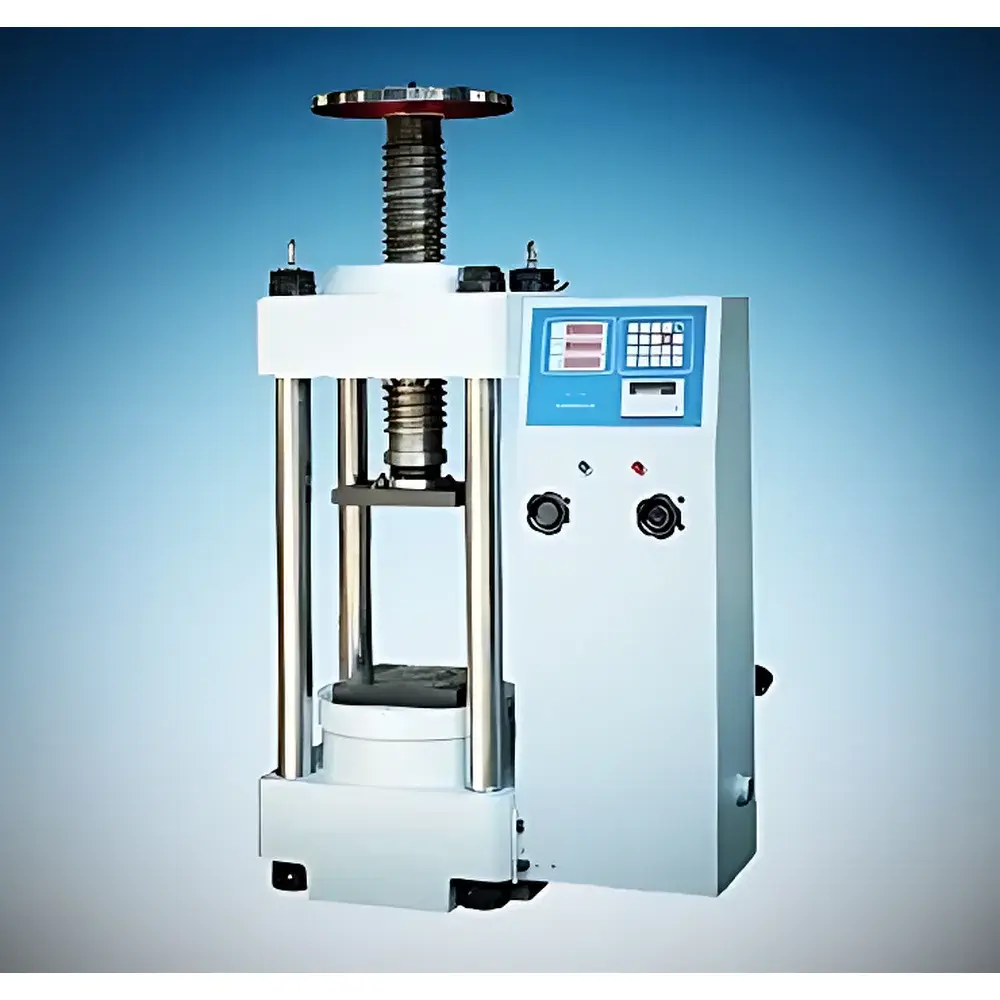
Hengyi HY(YE)-300008 Digital Display Hydraulic Compression Testing Machine
| Brand | Hengyi |
|---|---|
| Origin | Shanghai, China |
| Manufacturer Type | Direct Manufacturer |
| Country of Origin | China |
| Model | HY(YE)-300008 |
| Price | Upon Request |
| Maximum Load Capacity | 3000 kN |
| Accuracy Class | Class 1 (per GB/T 3159 & ISO 7500-1) |
| Force Measurement Range | 300–3000 kN |
| Indicated Relative Error | ±1% |
| Loading Rate Adjustment | 1–15 mm/s (manually controlled via hydraulic flow valve) |
| Internal Clear Span | 450 mm |
| Upper Platen Dimensions | 280 × 280 mm |
| Lower Platen Dimensions | 280 × 280 mm |
| Piston Stroke | 80 mm |
| Motor Power | 0.75 kW |
| Net Weight | ~1000 kg |
| Overall Dimensions (W×D×H) | 950 × 560 × 1570 mm |
| Standard Fixture | One set of compression platens with alignment guides |
Overview
The Hengyi HY(YE)-300008 Digital Display Hydraulic Compression Testing Machine is a manually operated, high-capacity universal testing system engineered for static compressive strength evaluation of construction materials and structural components. It operates on the principle of hydraulic force generation combined with electronic load sensing—where pressurized oil actuates a piston to apply axial compressive load to specimens, while a calibrated load cell transduces mechanical force into digital signal output. The machine complies with fundamental mechanical testing standards including GB/T 50081 (Concrete Mechanical Properties), GB/T 2542 (Masonry Units), and ISO 7500-1 (Metallic Materials – Calibration of Static Uniaxial Testing Machines). Designed for laboratories requiring robust, cost-effective compression evaluation without complex servo-hydraulic control systems, it delivers stable, repeatable loading under manual operator supervision—ideal for routine quality control in cement plants, brick manufacturing facilities, civil engineering labs, and third-party certification bodies.
Key Features
- Hydraulic loading system with manually adjustable flow control valve for precise, stepwise load application and constant-rate compression
- Digital force display panel showing real-time load (kN), loading rate (mm/s), and peak hold value—no external PC required for basic operation
- Electrically driven screw lift mechanism for rapid vertical positioning of upper platen, reducing setup time between tests
- Class 1 accuracy per ISO 7500-1 and GB/T 3159, verified through traceable calibration procedures using certified reference standards
- Integrated overload protection circuitry and automatic pressure cutoff at 105% of full-scale capacity to prevent mechanical damage
- Power-fail data retention function preserving last test result and system settings during unexpected shutdown
- Structural frame built from high-rigidity steel columns and reinforced crossbeams, minimizing deflection under maximum 3000 kN load
Sample Compatibility & Compliance
The HY(YE)-300008 accommodates standard cylindrical and cuboidal specimens used in construction material testing—including concrete cubes (150 mm × 150 mm × 150 mm), mortar prisms, fired clay bricks, autoclaved aerated concrete (AAC) blocks, and natural stone samples. Its 450 mm internal clear span and 280 mm × 280 mm platens ensure compatibility with ASTM C39, ASTM C109, EN 12390-3, and GB/T 7019 test configurations. All mechanical and electrical subsystems meet CE marking requirements for low-voltage equipment (2014/35/EU) and electromagnetic compatibility (2014/30/EU). While not inherently 21 CFR Part 11 compliant due to its standalone digital display architecture, audit trails and raw data export can be implemented externally via optional RS232 or USB interface modules for GLP/GMP-aligned environments.
Software & Data Management
The base configuration features embedded firmware with non-volatile memory storing up to 99 test records—including date/time stamp, peak load, displacement at failure, and loading rate setting. Optional Hengyi TestLink™ software (v3.2+) enables bidirectional communication via RS232, supporting automated report generation in PDF/Excel formats compliant with ISO/IEC 17025 documentation requirements. Data fields include user ID input, specimen ID tagging, environmental condition logging (optional temperature/humidity sensor integration), and digital signature support for authorized personnel verification. All exported reports contain embedded metadata necessary for laboratory accreditation audits.
Applications
- Compressive strength determination of Portland cement concrete per ASTM C39 and GB/T 50081
- Mechanical characterization of masonry units (fired clay, concrete, calcium silicate bricks) per ASTM C67 and GB/T 2542
- Quality assurance testing of precast concrete elements and railway sleepers
- Research-grade compression analysis of geopolymer binders, recycled aggregate concretes, and fiber-reinforced composites
- Educational use in university civil engineering laboratories for hands-on demonstration of stress–strain behavior and failure mode observation
- Third-party inspection services requiring ISO/IEC 17025 traceability and reproducible manual loading protocols
FAQ
What standards does this machine comply with for calibration and verification?
It conforms to ISO 7500-1:2018 for static compression machine calibration and GB/T 3159–2008 for universal testing machines in China.
Is the loading rate truly adjustable across the full 1–15 mm/s range?
Yes—the manual hydraulic flow valve allows continuous adjustment within that range; however, optimal repeatability is achieved between 2–10 mm/s per GB/T 50081 recommendations.
Can the machine be upgraded to support tensile or flexural testing?
No—it is configured exclusively for compression. Tensile or bending tests require separate fixtures and structural reinforcement not supported by this frame design.
Does the system include calibration certificates?
A factory calibration certificate traceable to CNAS-accredited national standards is provided with each unit; annual recalibration is recommended per ISO/IEC 17025 clause 6.6.
What maintenance intervals are recommended for hydraulic oil and seals?
Hydraulic oil should be replaced every 2,000 operating hours or biannually; O-ring seals in the cylinder assembly require inspection every 500 cycles and replacement if swelling or cracking is observed.



