
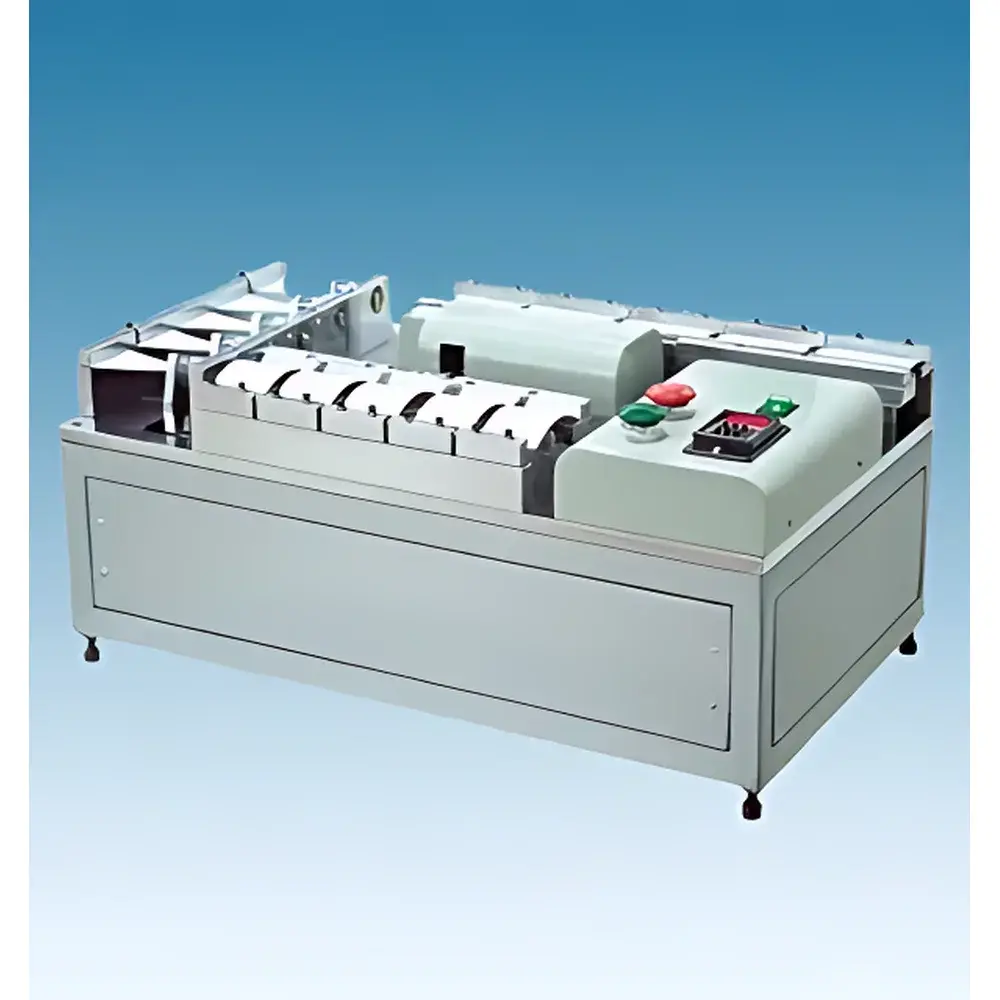
Hengyi HY(IC)SD Dynamic Bending and Bidirectional Torsion Tester for Smart Cards
| Brand | Hengyi / Hengyitest |
|---|---|
| Origin | Shanghai, China |
| Manufacturer Type | Direct Manufacturer |
| Regional Category | Domestic (China) |
| Model | HY(IC)SD |
| Pricing | Upon Request |
| Dimensions (L×W×H) | 670 × 380 × 220 mm |
| Weight | 70 kg |
| Power Supply | AC 220 V ±5% |
| Power Consumption | 35 W |
| Test Speed | Bending/Torsion at 30 rpm or 0.5 Hz |
| Cycle Count Range | 1–9999 cycles |
| Torsion Angle | ±15° ±1° (bidirectional, d = 86 mm |
| total angular displacement | 30°) |
| Long-Edge Displacement | Max 20 mm (0/−1 mm tolerance), Min 2 mm ±0.50 mm |
| Short-Edge Displacement | Max 10 mm (0/−1 mm tolerance), Min 1 mm ±0.50 mm |
| Fixture Mounting | Fully compliant with ISO/IEC 7816-1:1998 and ISO/IEC 10373-1:2016 dimensional specifications |
| Counting Method | Non-contact optical encoder (replacing legacy switch-based counting) |
| Test Stations | 15 stations — 5 long-edge bending, 5 short-edge bending, 5 torsion |
Overview
The Hengyi HY(IC)SD Dynamic Bending and Bidirectional Torsion Tester is a precision-engineered mechanical endurance testing system designed exclusively for evaluating the structural integrity and fatigue resistance of contact and contactless smart cards—including ISO/IEC 7816-compliant IC cards, EMV-compliant payment cards, and RFID-enabled identification cards. It operates on a deterministic electromechanical actuation principle: high-fidelity gear-reduced AC motors drive synchronized cam-and-lever mechanisms to impose controlled, repeatable bending and torsional loads on card specimens in accordance with standardized test profiles defined in GB/T 16649.1, GB/T 17554.1–2006, ISO/IEC 7816-1:1998, and ISO/IEC 10373-1:2016. Unlike generic flex testers, the HY(IC)SD integrates three distinct mechanical test modalities—long-edge bending, short-edge bending, and bidirectional torsion—within a single, compact benchtop platform, enabling concurrent multi-mode qualification per international conformance requirements.
Key Features
- Fifteen independent test stations: five dedicated to long-edge bending, five to short-edge bending, and five to bidirectional torsion—ensuring full compliance with multi-axis mechanical stress protocols specified in ISO/IEC 10373-1 Annex D and Annex E.
- Non-contact optical counting system with quadrature encoder feedback, eliminating mechanical switch wear and achieving near-zero failure rate over extended operational lifetimes (>10⁶ cycles).
- Precision-adjustable displacement control: long-edge deflection range from 2.0 ±0.50 mm to 20.0+0.00−1.00 mm; short-edge range from 1.0 ±0.50 mm to 10.0+0.00−1.00 mm; torsion angle precisely settable at ±15° ±1° (total 30°) about a fixed 86 mm diameter axis.
- Stable low-speed actuation at 0.5 Hz (30 rpm) with torque-regulated STK AC speed-control motor system and high-ratio planetary gear reduction—guaranteeing consistent load application without overshoot or dwell-induced creep.
- Fixture geometry strictly adheres to ISO/IEC 7816-1:1998 Clause 4.2 and ISO/IEC 10373-1:2016 Figure 12, ensuring accurate card positioning and minimizing edge slippage during dynamic loading.
- Benchtop footprint (670 × 380 × 220 mm) and lightweight construction (70 kg) facilitate integration into QC labs, R&D cleanrooms, and certification testing facilities without requiring floor anchoring or auxiliary cooling.
Sample Compatibility & Compliance
The HY(IC)SD accommodates standard ID-1 format cards (85.6 × 53.98 × 0.76 mm) including PVC, PETG, polycarbonate, and composite laminates used in banking, telecom, transportation, and government ID applications. It supports magnetic stripe cards, contact IC cards (with embedded microcontrollers), and contactless smart cards (e.g., MIFARE DESFire, Calypso). All mechanical parameters—including stroke amplitude, angular velocity, cycle count resolution, and fixture tolerances—are traceably aligned to the normative test methods of ISO/IEC 7816-1:1998 (Clause 9.2 – Mechanical Strength), ISO/IEC 10373-1:2016 (Subclauses 7.2–7.4), GB/T 16649.1–2015, and GB/T 17554.1–2006. The system is routinely deployed by third-party certification bodies and national grid laboratories (e.g., State Grid Corporation of China) for pre-certification validation under GLP-aligned internal procedures.
Software & Data Management
While the HY(IC)SD operates as a standalone hardware platform with front-panel digital counter and manual start/stop controls, its modular architecture supports optional RS-232 or USB-to-serial interface for external logging via PC-based acquisition software. Raw cycle counts, elapsed time, and operator-initiated pass/fail annotations can be exported in CSV format for inclusion in audit-ready test reports. When integrated into regulated environments—such as those governed by ISO/IEC 17025 or aligned with FDA 21 CFR Part 11 expectations—the system may be paired with validated data capture software offering electronic signatures, audit trails, and user-access controls. No proprietary firmware or cloud dependency is required for core functionality.
Applications
- Pre-production qualification of card substrate materials and lamination processes under repetitive flexural and torsional stress.
- Comparative durability assessment of alternative card form factors (e.g., metal-core, flexible polymer, hybrid composites).
- Failure mode analysis (crack initiation, delamination, antenna fracture, chip detachment) following accelerated life testing per ISO/IEC 10373-1 Annex F.
- Supporting conformity declarations for CE marking (under Directive 2014/53/EU for radio equipment) and China Compulsory Certification (CCC) for financial IC cards.
- Research into mechanical fatigue thresholds of embedded NFC antennas and ultra-thin silicon dies subjected to cyclic strain.
FAQ
Does the HY(IC)SD comply with ISO/IEC 10373-1:2016 for torsion testing?
Yes—the torsion station implements ±15° ±1° bidirectional rotation about a defined 86 mm axis, matching the dimensional and kinematic requirements of ISO/IEC 10373-1:2016 Subclause 7.4.
Can the instrument test cards with non-standard thickness or embedded metal layers?
It accommodates nominal 0.76 mm ID-1 cards; deviations up to ±0.15 mm are mechanically feasible, but users must verify fixture clearance and bending moment limits for thicker or stiffer substrates.
Is calibration documentation provided with shipment?
A factory verification report—including displacement linearity check (via calibrated dial indicator), torsion angle verification (using optical rotary encoder traceability), and cycle count accuracy validation—is supplied with each unit.
What maintenance is required for long-term reliability?
Annual inspection of gear train lubrication, cam surface wear, and optical sensor alignment is recommended; no consumables or scheduled part replacements are specified within the first 5 years of typical use.
Can test parameters be modified beyond the stated ranges?
Displacement and angle limits are mechanically constrained by cam geometry and stopper design; customization of these ranges requires OEM engineering consultation and formal design change documentation.



